

Vénus désarmant Cupidon
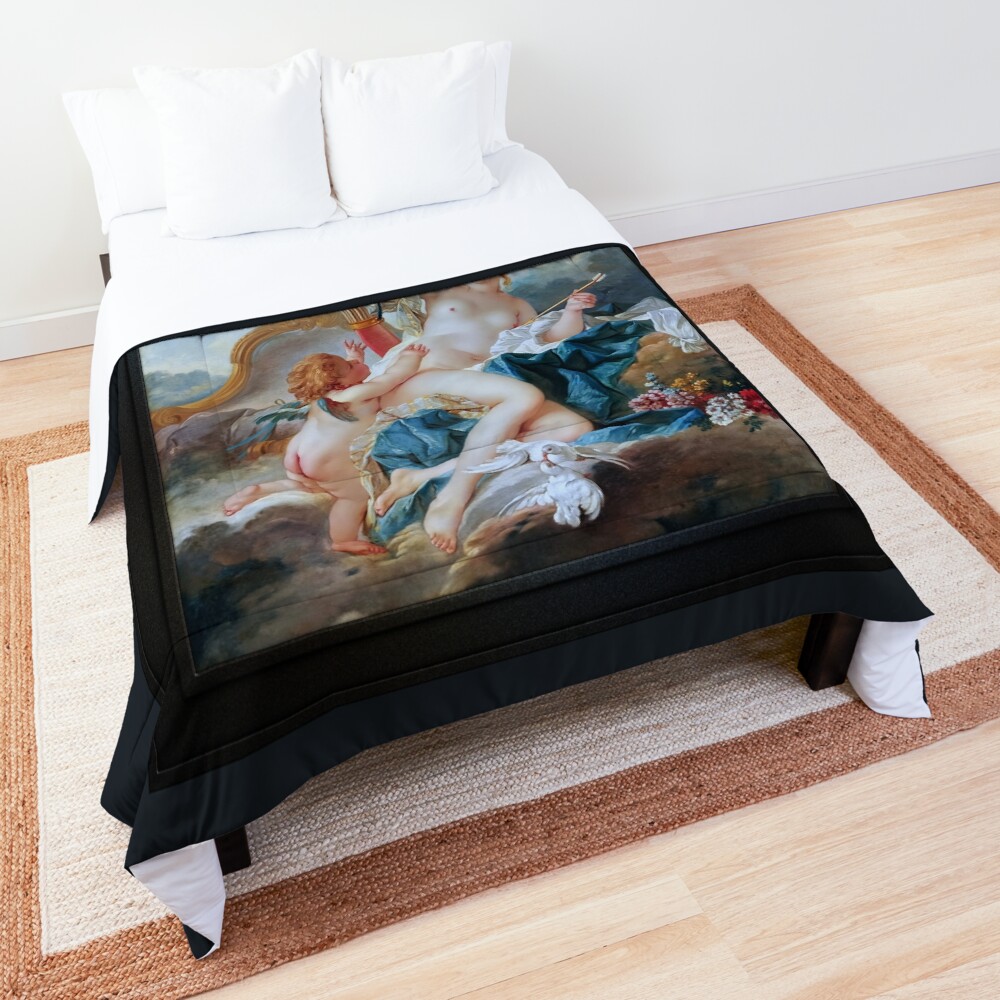
“Vénus désarmant Cupidon” (Venus Disarming Cupid), creat a 1751 by the celebrated Rococo artist Francois Boucher (1703 – 1770), is a quintessential example of the playful, sensual themes typical of the Rococo style. The painting features Venus, la deessa romana de l'amor, and Cupid, el seu fill entremaliat, in a tender and intimate moment. This work emanates an air of softness, encant, and light-heartedness, presenting a scene rich in symbolic meaning and lush visual details.
Taula de continguts
El tema principal: Venus i Cupido
In this masterful composition, Venus is the central figure, depicted in a relaxed, reclining position on an ornate couch draped in luxurious fabrics. She is the epitome of grace and beauty, with her delicate features framed by soft curls and a serene expression. Venus’ pose suggests both authority and gentleness, her body slightly turned towards Cupid as she lovingly and effortlessly disarms him. She holds the quiver of arrows, mentre que Cupido, depicted as a playful, cherubic child, attempts to pull away, symbolizing the restrained power of love.
Cupido, a symbol of unrestrained desire and the unpredictable force of love, is shown in a vulnerable moment, trying to escape from Venus’s grasp. His youthful form is soft and round, his small wings spread wide as he pushes against Venus’s tender hold. The playful struggle between mother and son represents the balance between the power of love, both as an uncontrollable force (Cupido) and as something that can be tempered or moderated by wisdom and restraint (Venus).
Objectes i simbolisme
In this Rococo masterpiece, objects within the scene are not merely decorative but carry profound symbolic weight. Venus’s quiver, from which she removes Cupid’s arrows, represents the tools of love and desire. The delicate arrows, typically seen as symbols of love’s unpredictability, are now disarmed and under Venus’s control, reinforcing her dominance over Cupid and, by extension, the power of love itself. The golden bow lying on the ground further emphasizes the shift from action to pause, and perhaps the temperance that Venus, com la deessa de l'amor, represents.
The presence of doves at Venus’s feet adds another layer of meaning. In classical mythology, doves are often associated with love, puresa, i harmonia, making them fitting companions to Venus, the goddess who embodies these ideals. The flowers scattered at the lower right of the painting, including roses and other vibrant blooms, mirror the themes of beauty, amor, i fertilitat, reinforcing the sensuous atmosphere of the work.
Terreny i Materials
The landscape within “Vénus désarmant Cupidon” is soft and atmospheric, filled with light clouds and a faint suggestion of a distant horizon. This background is not meant to be a focal point but rather provides a gentle, dream-like setting that complements the figures of Venus and Cupid. The terrain is open, unconfined, with no sharp boundaries, allowing the figures to appear as if floating in an idealized, serene world where love is the prevailing force.
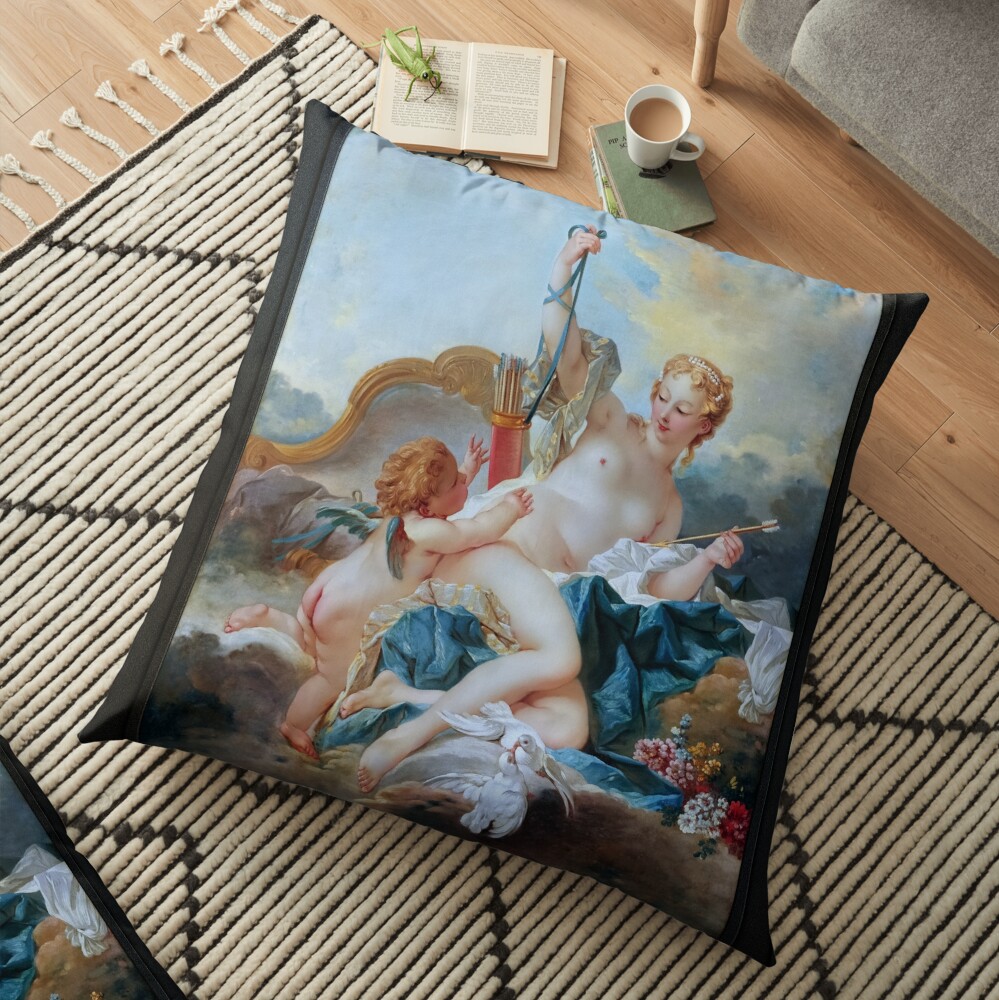
The materials depicted within the painting, teixits rics, soft drapery, and the delicate textures of skin and hair—are rendered with incredible finesse, showcasing Boucher’s mastery of texture and detail. The smoothness of the skin contrasts beautifully with the lushness of the fabric surrounding the figures, emphasizing the ethereal quality of the scene. Venus’s gown, a flowing fabric of soft blues and whites, is meticulously painted to reflect light, enhancing the sense of movement and grace in her posture.
Estil, Tema, i l'estat d'ànim
de François Boucher “Vénus désarmant Cupidon” exemplifies the Rococo style, characterized by its light, airy compositions, playful themes, and emphasis on beauty and sensuality. The soft color palette of pastel blues, roses, and whites gives the piece a delicate, qualitat gairebé d'un altre món, aligning with the Rococo emphasis on grace, elegància, i encant.
The rounded, formes suaus de les figures, juntament amb les seves postures fluides, són indicatius del rebuig del rococó de les línies dures i les composicions dramàtiques d'obres barroques anteriors.. L'ús característic de la llum i l'ombra de Boucher, juntament amb els complexos detalls de la cortina de Venus i els trets querubins de Cupido, fa que la pintura sembli gairebé viva.
L'estat d'ànim de la pintura és d'afecte lúdic. La interacció entre Venus i Cupido suggereix no només el tendre amor d'una mare pel seu fill, sinó també la criança., aspecte de control de l'amor mateix. Venus no només està desarmant Cupido; ella li està demostrant que l'amor pot ser alhora poderós i limitat. Aquesta juxtaposició entre control i innocència, força i tendresa, infon a la pintura un encant atemporal.
Conclusió
“Vénus désarmant Cupidon” és un exemple notable de la capacitat de François Boucher per combinar la bellesa delicada amb la profunditat al·legòrica.. A través del seu domini de l'estil rococó, Boucher captura els matisos de l'amor tant en les seves formes lúdiques com poderoses. Venus, com la figura dominant però nutritiva, and Cupid, com a símbol de la força imprevisible de l'amor, junts creen una narrativa atemporal d'afecte, control, i l'eterna dansa entre tots dos.
Vénus désarmant Cupidon és una reproducció d'antics mestres d'art digital remasteritzada d'una imatge de domini públic que està disponible com a impressió de tela en línia.
Informació a continuació derivada de Wikipedia.org
Natiu de París, Boucher era fill d'un pintor menys conegut Nicolas Boucher, que li va donar la seva primera formació artística. Als disset anys, un quadre de Boucher va ser admirat pel pintor François Lemoyne. Més tard, Lemoyne va nomenar Boucher com a aprenent, però després de només tres mesos, va anar a treballar per al gravador Jean-François Cars.
En 1720, va guanyar el Gran Premi d'elit de Roma de pintura, però no va aprofitar la conseqüent oportunitat per estudiar a Itàlia fins cinc anys després, per problemes econòmics de la Reial Acadèmia de Pintura i Escultura.[1] En tornar dels estudis a Itàlia va ser admès a la refundada Académie de peinture et de sculpture on 24 de novembre 1731. La seva peça de recepció (peça de recepció) va ser el seu Rinaldo i Armida de 1734.
Boucher es va casar amb Marie-Jeanne Buzeau a 1733. La parella va tenir tres fills junts. Boucher es va convertir en membre de la facultat 1734 i la seva carrera es va accelerar a partir d'aquest punt, ja que va ser ascendit a Professor i després Rector de l'Acadèmia, esdevenint inspector de la Royal Gobelins Manufactory i finalment Premier Peintre du Roi (Primer Pintor del Rei) dins 1765. Retrat de Marie-Louise O'Murphy c. 1752
Boucher va morir 30 maig 1770 al seu París natal. El seu nom, juntament amb la de la seva patrona Madame de Pompadour, s'havia convertit en sinònim de l'estil rococó francès, conduint els germans Goncourt a escriure: “Boucher és un d'aquells homes que representen el gust d'un segle, que expressen, personificar-lo i encarnar-lo.”
Boucher és famós per dir que la natura ho és “massa verd i poc il·luminat” (massa verd i mal il·luminat).
Boucher estava associat amb el gravador de pedres precioses Jacques Guay, a qui va ensenyar a dibuixar. També va ser mentor del pintor moràu-austríac Martin Ferdinand Quadal així com del pintor neoclàssic Jacques-Louis David a 1767.[4] Més tard, Boucher va fer una sèrie de dibuixos d'obres de Guay que Madame de Pompadour va gravar i va distribuir com un volum ben enquadernat als cortesans preferits.