

Vénus désarmant Cupidon
“Vénus désarmant Cupidon” (Venus Disarming Cupid), creatu in 1751 by the celebrated Rococo artist François Boucher (1703 – 1770), is a quintessential example of the playful, sensual themes typical of the Rococo style. The painting features Venus, the Roman goddess of love, and Cupid, her mischievous son, in a tender and intimate moment. This work emanates an air of softness, charm, and light-heartedness, presenting a scene rich in symbolic meaning and lush visual details.
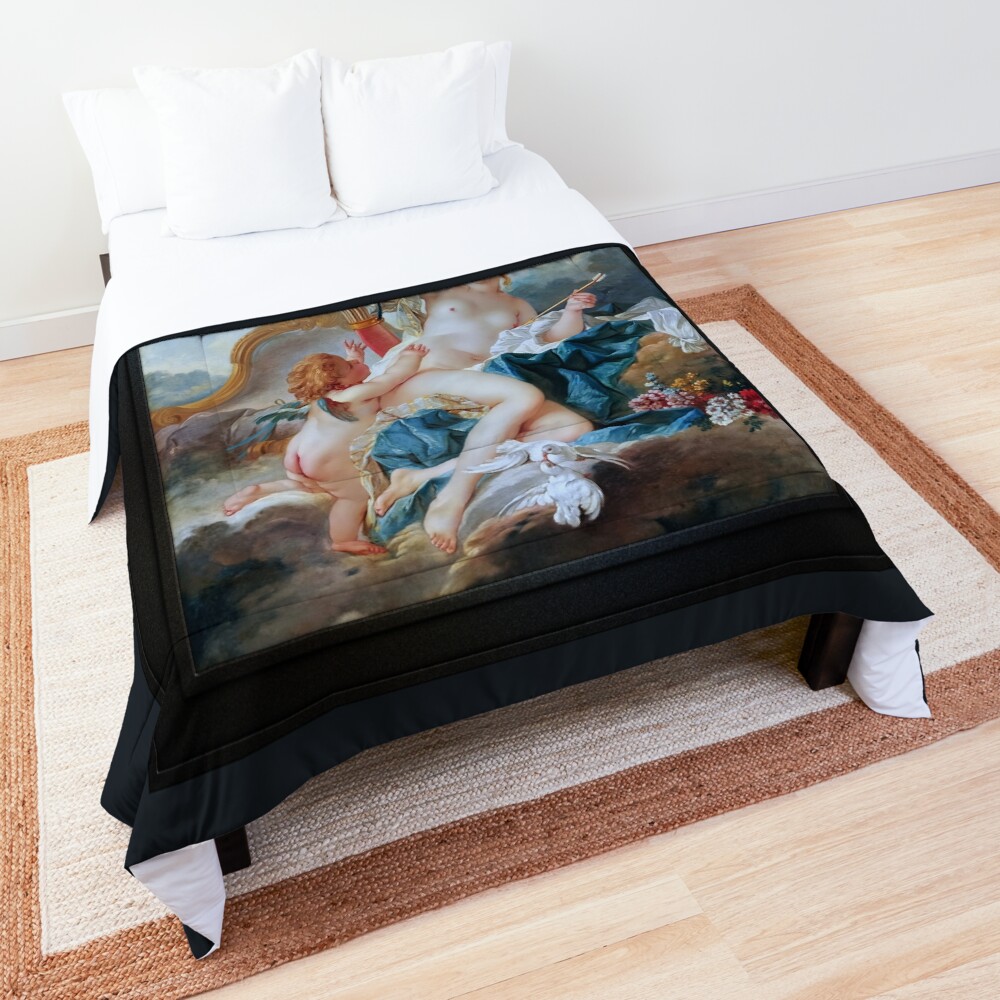
Table of Contents
U sughjettu principale: Venus and Cupid
In this masterful composition, Venus is the central figure, depicted in a relaxed, reclining position on an ornate couch draped in luxurious fabrics. She is the epitome of grace and beauty, with her delicate features framed by soft curls and a serene expression. Venere’ pose suggests both authority and gentleness, her body slightly turned towards Cupid as she lovingly and effortlessly disarms him. She holds the quiver of arrows, while Cupid, depicted as a playful, cherubic child, attempts to pull away, symbolizing the restrained power of love.
Cupid, a symbol of unrestrained desire and the unpredictable force of love, is shown in a vulnerable moment, trying to escape from Venus’s grasp. His youthful form is soft and round, his small wings spread wide as he pushes against Venus’s tender hold. The playful struggle between mother and son represents the balance between the power of love, both as an uncontrollable force (Cupid) and as something that can be tempered or moderated by wisdom and restraint (Venere).
Objects and Symbolism
In this Rococo masterpiece, objects within the scene are not merely decorative but carry profound symbolic weight. Venus’s quiver, from which she removes Cupid’s arrows, represents the tools of love and desire. The delicate arrows, typically seen as symbols of love’s unpredictability, are now disarmed and under Venus’s control, reinforcing her dominance over Cupid and, by extension, the power of love itself. The golden bow lying on the ground further emphasizes the shift from action to pause, and perhaps the temperance that Venus, as the goddess of love, represents.
The presence of doves at Venus’s feet adds another layer of meaning. In classical mythology, doves are often associated with love, purezza, and harmony, making them fitting companions to Venus, the goddess who embodies these ideals. The flowers scattered at the lower right of the painting, including roses and other vibrant blooms, mirror the themes of beauty, amore, and fertility, reinforcing the sensuous atmosphere of the work.
Terrain è Materiali
The landscape within “Vénus désarmant Cupidon” is soft and atmospheric, filled with light clouds and a faint suggestion of a distant horizon. This background is not meant to be a focal point but rather provides a gentle, dream-like setting that complements the figures of Venus and Cupid. The terrain is open, unconfined, with no sharp boundaries, allowing the figures to appear as if floating in an idealized, serene world where love is the prevailing force.
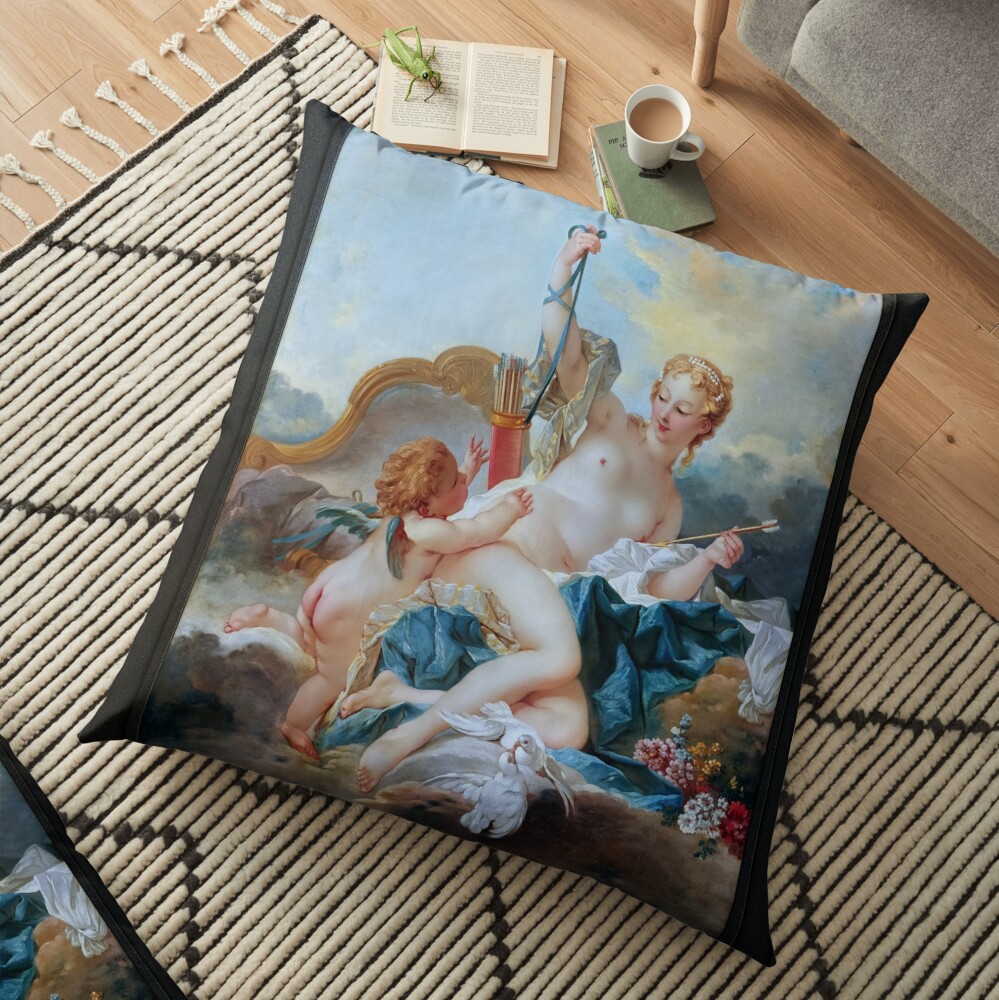
The materials depicted within the painting, tessuti ricchi, soft drapery, and the delicate textures of skin and hair—are rendered with incredible finesse, showcasing Boucher’s mastery of texture and detail. The smoothness of the skin contrasts beautifully with the lushness of the fabric surrounding the figures, emphasizing the ethereal quality of the scene. Venus’s gown, a flowing fabric of soft blues and whites, is meticulously painted to reflect light, enhancing the sense of movement and grace in her posture.
Stile, Tema, è Umore
François Boucher’s “Vénus désarmant Cupidon” exemplifies the Rococo style, characterized by its light, airy compositions, playful themes, and emphasis on beauty and sensuality. The soft color palette of pastel blues, rosa, and whites gives the piece a delicate, qualità quasi d'altru mondu, aligning with the Rococo emphasis on grace, eleganza, and charm.
The rounded, soft forms of the figures, along with their fluid poses, are indicative of the Rococo’s rejection of the hard lines and dramatic compositions of earlier Baroque works. Boucher’s signature use of light and shadow, coupled with the intricate detail of Venus’s drapery and Cupid’s cherubic features, makes the painting appear almost alive.
The mood of the painting is one of playful affection. The interaction between Venus and Cupid suggests not only the tender love of a mother for her son but also the nurturing, controlling aspect of love itself. Venus is not merely disarming Cupid; she is showing him that love can be both powerful and restrained. This juxtaposition between control and innocence, strength and tenderness, infuses the painting with a timeless charm.
Cunclusione
“Vénus désarmant Cupidon” stands as a remarkable example of François Boucher’s ability to merge delicate beauty with allegorical depth. Through his mastery of Rococo style, Boucher captures the nuances of love in both its playful and powerful forms. Venere, as the dominant yet nurturing figure, and Cupid, as the symbol of love’s unpredictable force, together create a timeless narrative of affection, control, and the eternal dance between the two.
Vénus désarmant Cupidon is a remastered digital art old masters reproduction of a public domain image that is available as a stampa di tela in linea.
Info sottu Derivatu da Wikipedia.org
Nativu di Parigi, Boucher era u figliolu di un pittore pocu cunnisciutu Nicolas Boucher, chì li dete a so prima furmazione artistica. À l'età di diciassette anni, un dipintu di Boucher era ammiratu da u pittore François Lemoyne. Lemoyne dopu hà numinatu Boucher cum'è u so apprendista, ma dopu solu trè mesi, andò à travaglià pè l'incisore Jean-François Cars.
In 1720, vincìu l'élite Grand Prix de Rome per a pittura, ma ùn hà pigliatu l'oppurtunità di studià in Italia finu à cinque anni dopu, per via di prublemi finanziarii à l'Accademia Reale di Pittura è Scultura.[1] Al suo ritorno dai suoi studi in Italia fu ammesso alla rifondata Académie de peinture et de sculpture on 24 Nuvembre 1731. U so pezzu di ricezione (pezza di ricezione) era u so Rinaldu è Armida di 1734.
Boucher sposò Marie-Jeanne Buzeau in 1733. A coppia avia trè figlioli inseme. Boucher hè diventatu un membru di a facultà in 1734 è a so carriera s'accelerà da questu puntu chì hè statu prumuvutu Prufessore dopu Rettore di l'Accademia, diventendu ispettore à a Royal Gobelins Manufactory è infine Premier Peintre du Roi (Primu Pittore di u Re) in 1765. Ritrattu di Marie-Louise O'Murphy c. 1752
Boucher hè mortu 30 Maghju 1770 in a so Parigi natale. U so nome, cù quellu di a so patrona Madame de Pompadour, era diventatu sinonimu di u stilu rococò francese, guidà i fratelli Goncourt à scrive: “Boucher hè unu di quelli omi chì rapprisentanu u gustu di un seculu, qui s'expriment, personificà è incarna.”
Boucher hè famosu per dì chì a natura hè “troppu verde è pocu illuminatu” (troppu verde è mal illuminatu).
Boucher era assuciatu cù l'incisore di pietre preziose Jacques Guay, à qui il a enseigné à dessiner. Il a également encadré le peintre moravo-austriaque Martin Ferdinand Quadal ainsi que le peintre néoclassique Jacques-Louis David en 1767.[4] Più tardi, Boucher hà fattu una serie di disegni di l'opere di Guay chì Madame de Pompadour hà poi incisu è distribuitu cum'è un voluminu bellu rilegatu à i cortigiani favuriti.