

Vénus désarmant Cupidon
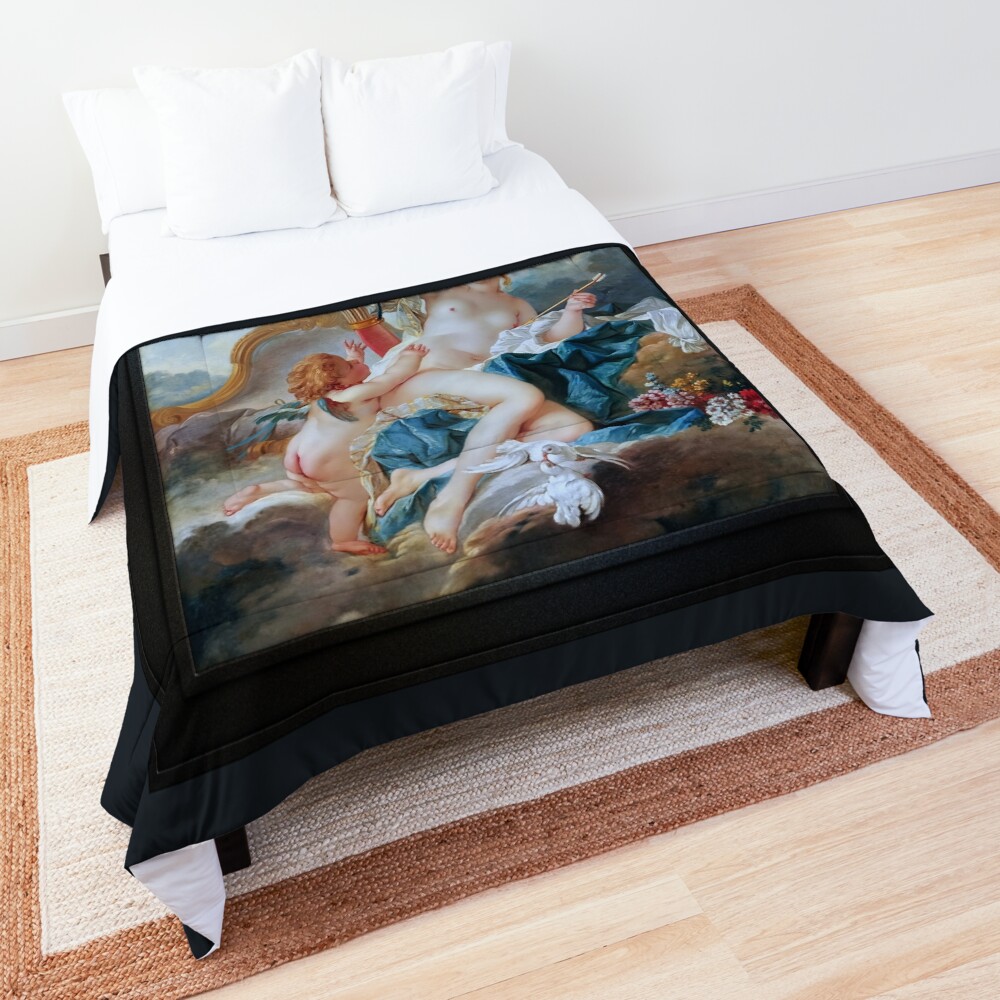
“Vénus désarmant Cupidon” (Venus Disarming Cupid), wedi'i greu yn 1751 by the celebrated Rococo artist Francois Boucher (1703 – 1770), is a quintessential example of the playful, sensual themes typical of the Rococo style. The painting features Venus, the Roman goddess of love, and Cupid, her mischievous son, in a tender and intimate moment. This work emanates an air of softness, charm, and light-heartedness, presenting a scene rich in symbolic meaning and lush visual details.
Tabl Cynnwys
Y prif bwnc: Venus and Cupid
In this masterful composition, Venus is the central figure, depicted in a relaxed, reclining position on an ornate couch draped in luxurious fabrics. She is the epitome of grace and beauty, with her delicate features framed by soft curls and a serene expression. Venus’ pose suggests both authority and gentleness, her body slightly turned towards Cupid as she lovingly and effortlessly disarms him. She holds the quiver of arrows, while Cupid, depicted as a playful, cherubic child, attempts to pull away, symbolizing the restrained power of love.
Cupid, a symbol of unrestrained desire and the unpredictable force of love, is shown in a vulnerable moment, trying to escape from Venus’s grasp. His youthful form is soft and round, his small wings spread wide as he pushes against Venus’s tender hold. The playful struggle between mother and son represents the balance between the power of love, both as an uncontrollable force (Cupid) and as something that can be tempered or moderated by wisdom and restraint (Venus).
Gwrthrychau a Symbolaeth
In this Rococo masterpiece, objects within the scene are not merely decorative but carry profound symbolic weight. Venus’s quiver, from which she removes Cupid’s arrows, represents the tools of love and desire. The delicate arrows, typically seen as symbols of love’s unpredictability, are now disarmed and under Venus’s control, reinforcing her dominance over Cupid and, by extension, the power of love itself. The golden bow lying on the ground further emphasizes the shift from action to pause, and perhaps the temperance that Venus, as the goddess of love, represents.
The presence of doves at Venus’s feet adds another layer of meaning. In classical mythology, doves are often associated with love, purdeb, and harmony, making them fitting companions to Venus, the goddess who embodies these ideals. The flowers scattered at the lower right of the painting, including roses and other vibrant blooms, mirror the themes of beauty, Creadigaethau Celf Ffractal Ffantasi Xzendor7 a Chelf Glasurol wedi'i Hailfeistroli ac Atgynhyrchu Hen Gelf Printiau Cynfas Ar-lein, and fertility, reinforcing the sensuous atmosphere of the work.
Tir a Defnyddiau
The landscape within “Vénus désarmant Cupidon” is soft and atmospheric, filled with light clouds and a faint suggestion of a distant horizon. This background is not meant to be a focal point but rather provides a gentle, dream-like setting that complements the figures of Venus and Cupid. The terrain is open, unconfined, with no sharp boundaries, allowing the figures to appear as if floating in an idealized, serene world where love is the prevailing force.
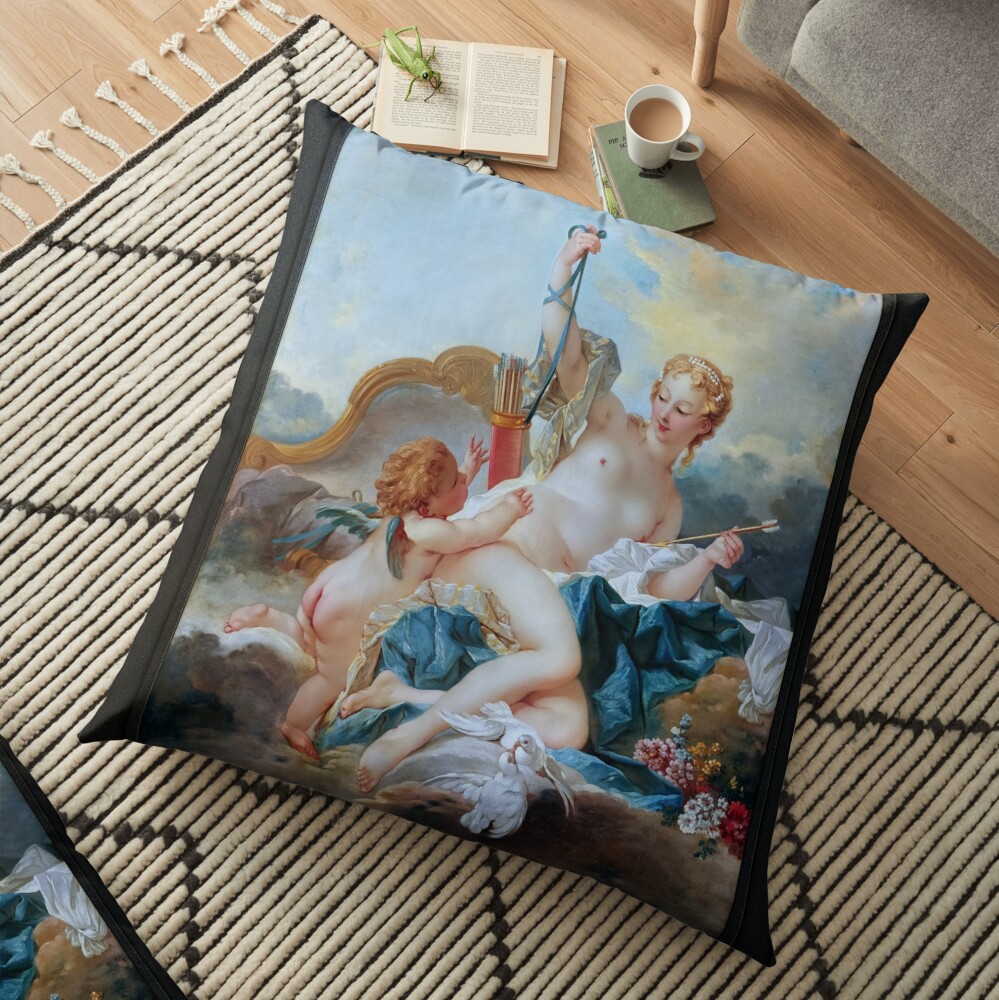
The materials depicted within the painting, rich fabrics, soft drapery, and the delicate textures of skin and hair—are rendered with incredible finesse, showcasing Boucher’s mastery of texture and detail. The smoothness of the skin contrasts beautifully with the lushness of the fabric surrounding the figures, emphasizing the ethereal quality of the scene. Venus’s gown, a flowing fabric of soft blues and whites, is meticulously painted to reflect light, enhancing the sense of movement and grace in her posture.
Arddull, Thema, a hwyliau
François Boucher’s “Vénus désarmant Cupidon” exemplifies the Rococo style, characterized by its light, airy compositions, playful themes, and emphasis on beauty and sensuality. The soft color palette of pastel blues, pinciau, and whites gives the piece a delicate, almost otherworldly quality, aligning with the Rococo emphasis on grace, geinder, a swyn.
The rounded, soft forms of the figures, along with their fluid poses, are indicative of the Rococo’s rejection of the hard lines and dramatic compositions of earlier Baroque works. Boucher’s signature use of light and shadow, coupled with the intricate detail of Venus’s drapery and Cupid’s cherubic features, makes the painting appear almost alive.
The mood of the painting is one of playful affection. The interaction between Venus and Cupid suggests not only the tender love of a mother for her son but also the nurturing, controlling aspect of love itself. Venus is not merely disarming Cupid; she is showing him that love can be both powerful and restrained. This juxtaposition between control and innocence, strength and tenderness, infuses the painting with a timeless charm.
Nghasgliad
“Vénus désarmant Cupidon” stands as a remarkable example of François Boucher’s ability to merge delicate beauty with allegorical depth. Through his mastery of Rococo style, Boucher captures the nuances of love in both its playful and powerful forms. Venus, as the dominant yet nurturing figure, and Cupid, as the symbol of love’s unpredictable force, together create a timeless narrative of affection, rheolaeth, and the eternal dance between the two.
Vénus désarmant Cupidon is a remastered digital art old masters reproduction of a public domain image that is available as a print cynfas ar-lein.
Gwybodaeth Islaw sy'n Deillio o Wikipedia.org
Brodor o Baris, Roedd Boucher yn fab i arlunydd llai adnabyddus Nicolas Boucher, a roddodd ei hyfforddiant artistig cyntaf iddo. Yn ddwy ar bymtheg oed, edmygwyd paentiad gan Boucher gan yr arlunydd François Lemoyne. Yn ddiweddarach, penododd Lemoyne Boucher yn brentis iddo, ond ar ôl dim ond tri mis, aeth i weithio i'r engrafwr Jean-François Cars.
Yn 1720, enillodd y Grand Prix de Rome elitaidd am baentio, ond ni fanteisiodd ar y cyfle canlyniadol i astudio yn yr Eidal tan bum mlynedd yn ddiweddarach, oherwydd problemau ariannol yn yr Academi Frenhinol Peintio a Cherflunio.[1] Ar ôl dychwelyd o astudio yn yr Eidal derbyniwyd ef i'r cerflun Académie de peinture et de newydd ei addurno 24 Tachwedd 1731. Ei ddarn derbyn (darn derbynfa) oedd ei Rinaldo ac Armida o 1734.
Priododd Boucher â Marie-Jeanne Buzeau yn 1733. Roedd gan y cwpl dri o blant gyda'i gilydd. Daeth Boucher yn aelod cyfadran yn 1734 a chyflymodd ei yrfa o'r pwynt hwn wrth iddo gael ei ddyrchafu'n Athro ar y pryd yn Rheithor yr Academi, dod yn arolygydd yn y Royal Gobelins Manufactory ac yn olaf Premier Peintre du Roi (Peintiwr Cyntaf y Brenin) yn 1765. Portread o Marie-Louise O’Murphy c. 1752
Bu farw Boucher ymlaen 30 Mai 1770 yn ei wlad enedigol Paris. Ei enw, ynghyd â rhywun ei noddwr Madame de Pompadour, wedi dod yn gyfystyr ag arddull Rococo Ffrainc, arwain y brodyr Goncourt i ysgrifennu: “Mae Boucher yn un o'r dynion hynny sy'n cynrychioli blas canrif, sy'n mynegi, personoli a'i ymgorffori.”
Mae Boucher yn enwog am ddweud bod natur yn “rhy wyrdd a goleuo'n wael” (rhy wyrdd a goleuo'n wael).
Roedd Boucher yn gysylltiedig â'r engrafwr gemstone Jacques Guay, y dysgodd ei dynnu. Bu hefyd yn mentora'r arlunydd Morafaidd-Awstria Martin Ferdinand Quadal yn ogystal â'r arlunydd neoglasurol Jacques-Louis David yn 1767.[4] Yn ddiweddarach, Gwnaeth Boucher gyfres o luniau o weithiau gan Guay y gwnaeth Madame de Pompadour eu hysgythru a'u dosbarthu fel cyfrol wedi'i rhwymo'n golygus i lyswyr a ffefrir