

Vénus désarmant Cupidon
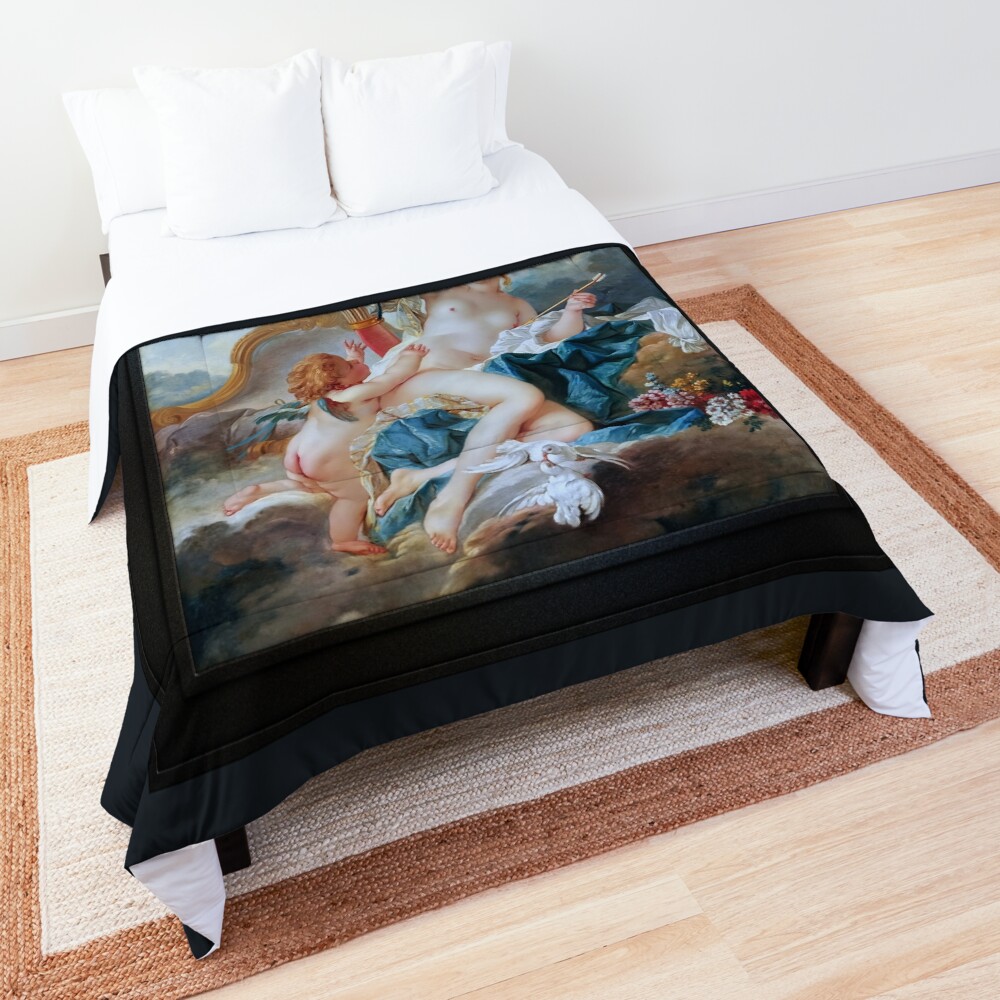
“Vénus désarmant Cupidon” (Venus Disarming Cupid), kreita en 1751 by the celebrated Rococo artist François Boucher (1703 – 1770), is a quintessential example of the playful, sensual themes typical of the Rococo style. The painting features Venus, the Roman goddess of love, and Cupid, her mischievous son, in a tender and intimate moment. This work emanates an air of softness, charm, and light-heartedness, presenting a scene rich in symbolic meaning and lush visual details.
Enhavtabelo
La Ĉefa Temo: Venuso kaj Kupido
In this masterful composition, Venus is the central figure, depicted in a relaxed, reclining position on an ornate couch draped in luxurious fabrics. She is the epitome of grace and beauty, kun ŝiaj delikataj trajtoj enkadrigitaj de molaj bukloj kaj serena esprimo. Venuso’ pozo sugestas kaj aŭtoritaton kaj mildecon, ŝia korpo iomete turniĝis al Kupido dum ŝi ame kaj senpene senarmigas lin. Ŝi tenas la sagujon de sagoj, dum Kupido, prezentita kiel ludema, keruba infano, provas retiriĝi, simbolante la retenitan potencon de amo.
Kupido, simbolo de senbrida deziro kaj la neantaŭvidebla forto de amo, montriĝas en vundebla momento, provante eskapi el la teno de Venuso. Lia juneca formo estas mola kaj ronda, liaj malgrandaj flugiloj disvastiĝis larĝe kiam li puŝas kontraŭ la tenera teno de Venuso. La ludema lukto inter patrino kaj filo reprezentas la ekvilibron inter la potenco de amo, ambaŭ kiel neregebla forto (Kupido) kaj kiel io, kio povas esti moderigita aŭ moderigita per saĝo kaj sindeteno (Venuso).
Objektoj kaj simbolismo
In this Rococo masterpiece, objects within the scene are not merely decorative but carry profound symbolic weight. Venus’s quiver, from which she removes Cupid’s arrows, represents the tools of love and desire. The delicate arrows, typically seen as symbols of love’s unpredictability, are now disarmed and under Venus’s control, reinforcing her dominance over Cupid and, by extension, the power of love itself. The golden bow lying on the ground further emphasizes the shift from action to pause, and perhaps the temperance that Venus, as the goddess of love, represents.
The presence of doves at Venus’s feet adds another layer of meaning. In classical mythology, doves are often associated with love, pureco, and harmony, making them fitting companions to Venus, the goddess who embodies these ideals. The flowers scattered at the lower right of the painting, including roses and other vibrant blooms, mirror the themes of beauty, Amo, kaj fekundeco, reinforcing the sensuous atmosphere of the work.
Tereno kaj Materialoj
The landscape within “Vénus désarmant Cupidon” is soft and atmospheric, filled with light clouds and a faint suggestion of a distant horizon. This background is not meant to be a focal point but rather provides a gentle, dream-like setting that complements the figures of Venus and Cupid. The terrain is open, unconfined, with no sharp boundaries, allowing the figures to appear as if floating in an idealized, serene world where love is the prevailing force.
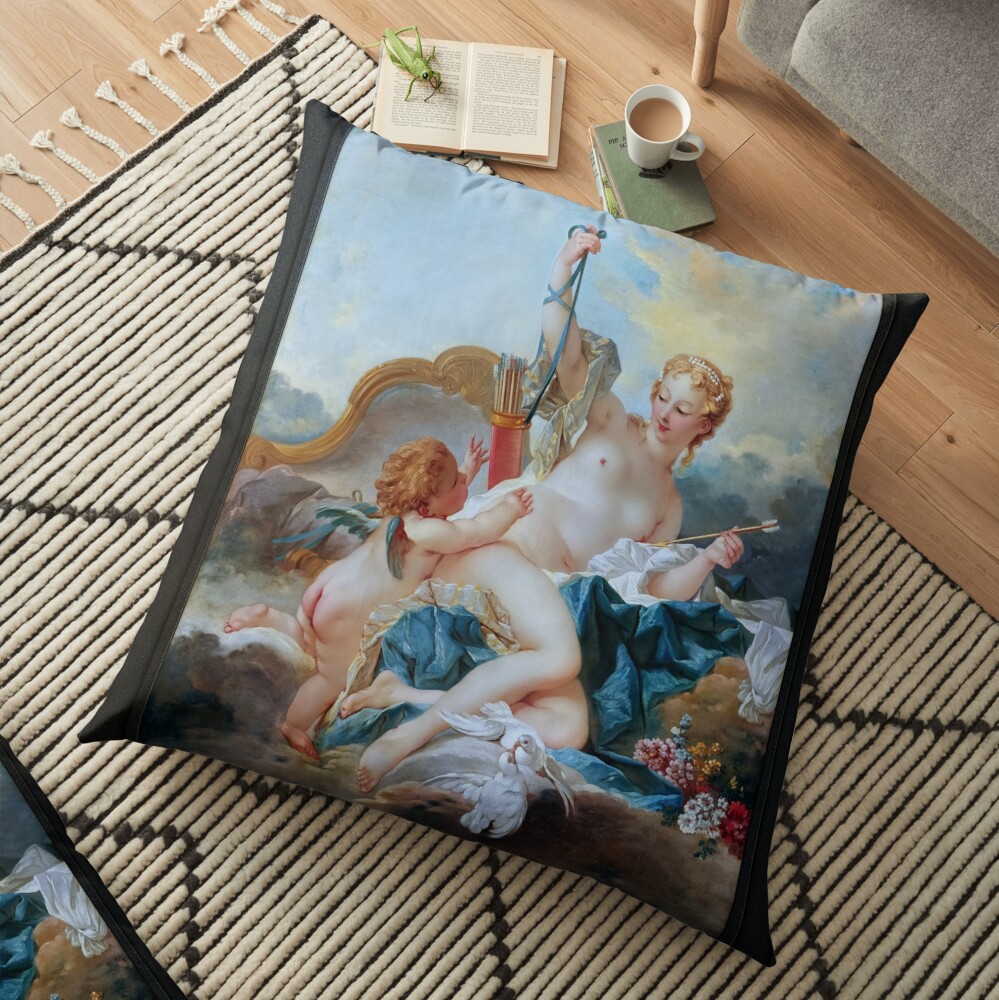
The materials depicted within the painting, rich fabrics, soft drapery, and the delicate textures of skin and hair—are rendered with incredible finesse, showcasing Boucher’s mastery of texture and detail. The smoothness of the skin contrasts beautifully with the lushness of the fabric surrounding the figures, emphasizing the ethereal quality of the scene. Venus’s gown, a flowing fabric of soft blues and whites, is meticulously painted to reflect light, enhancing the sense of movement and grace in her posture.
Stilo, Temo, kaj humoro
François Boucher’s “Vénus désarmant Cupidon” exemplifies the Rococo style, characterized by its light, airy compositions, playful themes, and emphasis on beauty and sensuality. The soft color palette of pastel blues, Pinks, and whites gives the piece a delicate, almost otherworldly quality, aligning with the Rococo emphasis on grace, Eleganteco, kaj ĉarmo.
The rounded, soft forms of the figures, along with their fluid poses, are indicative of the Rococo’s rejection of the hard lines and dramatic compositions of earlier Baroque works. Boucher’s signature use of light and shadow, coupled with the intricate detail of Venus’s drapery and Cupid’s cherubic features, makes the painting appear almost alive.
The mood of the painting is one of playful affection. The interaction between Venus and Cupid suggests not only the tender love of a mother for her son but also the nurturing, controlling aspect of love itself. Venus is not merely disarming Cupid; she is showing him that love can be both powerful and restrained. This juxtaposition between control and innocence, strength and tenderness, infuses the painting with a timeless charm.
Konkludo
“Vénus désarmant Cupidon” stands as a remarkable example of François Boucher’s ability to merge delicate beauty with allegorical depth. Through his mastery of Rococo style, Boucher captures the nuances of love in both its playful and powerful forms. Venuso, as the dominant yet nurturing figure, and Cupid, as the symbol of love’s unpredictable force, together create a timeless narrative of affection, kontrolo, and the eternal dance between the two.
Vénus désarmant Cupidon is a remastered digital art old masters reproduction of a public domain image that is available as a tolo presaĵo rete.
Informoj Malsupre Derivita De Vikipedio.org
Hejmanto de Parizo, Boucher estis la filo de malpli konata farbisto Nicolas Boucher, kiu donis al li sian unuan artan trejnadon. En la aĝo de dek sep, pentraĵo de Boucher estis admirita de la pentristo François Lemoyne. Lemoyne poste nomumis Boucher kiel sia metilernanto, sed post nur tri monatoj, li iris labori por la gravuristo Jean-François Cars.
En 1720, li gajnis la elitan Grand Prix de Rome por pentrado, sed ne prenis la konsekvencan ŝancon studi en Italio ĝis kvin jaroj poste, pro financaj problemoj ĉe la Reĝa Akademio de Pentrarto kaj Skulptaĵo.[1] Sur lia reveno de studado en Italio li estis konfesita la refonditan Académie de peinture et de sculpture on 24 novembro 1731. Lia akceptpeco (akcepta peco) Estis lia Rinaldo kaj Armida de 1734.
Boucher geedziĝis kun Marie-Jeanne Buzeau en 1733. La paro havis tri infanojn kune. Boucher iĝis fakultatano en 1734 kaj lia kariero akcelis de tiu punkto kiam li estis promociita Profesoro tiam Rektoro de la Akademio, iĝante inspektisto ĉe la Reĝa Gobelins Manufactory kaj finfine ĉefministro Peintre du Roi (Unua Pentristo de la Reĝo) en 1765. Portreto de Marie-Louise O'Murphy ĉ. 1752
Boucher mortis plu 30 majo 1770 en sia naskiĝa Parizo. Lia nomo, kune kun tiu de lia patrono Madame de Pompadour, fariĝis sinonima kun la franca rokoka stilo, kondukante la fratojn Goncourt skribi: “Boucher estas unu el tiuj viroj, kiuj reprezentas la guston de jarcento, kiuj esprimas, personigi kaj enkorpigi ĝin.”
Boucher estas fama pro diri ke naturo estas “tro verda kaj malbone lumigita” (tro verda kaj malbone lumigita).
Boucher estis asociita kun la gemogravuristo Jacques Guay, kiun li instruis desegni. Li ankaŭ mentores la morav-aŭstran farbiston Martin Ferdinand Quadal same kiel la novklasikan farbiston Jacques-Louis David en 1767.[4] Poste, Boucher faris serion de desegnaĵoj de verkoj de Guay kiujn sinjorino de Pompadour tiam gravuris kaj distribuis kiel bele ligita volumeno al favoritaj korteganoj.