

金星がキューピッドを武装解除する
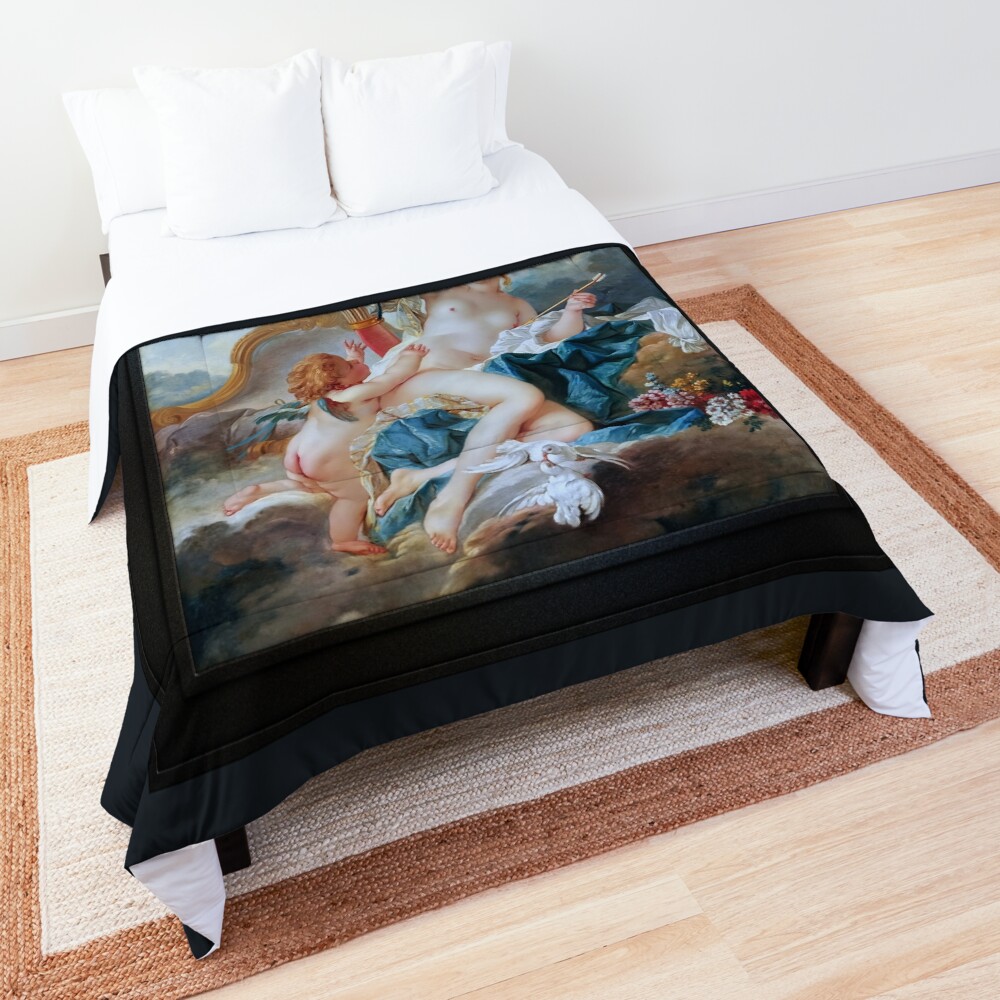
“金星がキューピッドを武装解除する” (Venus Disarming Cupid), に作成されました 1751 by the celebrated Rococo artist フランソワ・ブーシェ (1703 – 1770), is a quintessential example of the playful, sensual themes typical of the Rococo style. The painting features Venus, 愛のローマの女神, and Cupid, 彼女のいたずらっぽい息子, in a tender and intimate moment. This work emanates an air of softness, 魅力, and light-heartedness, presenting a scene rich in symbolic meaning and lush visual details.
目次
本題: ヴィーナスとキューピッド
In this masterful composition, Venus is the central figure, depicted in a relaxed, reclining position on an ornate couch draped in luxurious fabrics. She is the epitome of grace and beauty, with her delicate features framed by soft curls and a serene expression. 金星’ pose suggests both authority and gentleness, her body slightly turned towards Cupid as she lovingly and effortlessly disarms him. She holds the quiver of arrows, キューピッドがいる間, depicted as a playful, cherubic child, attempts to pull away, symbolizing the restrained power of love.
キューピッド, a symbol of unrestrained desire and the unpredictable force of love, is shown in a vulnerable moment, trying to escape from Venus’s grasp. His youthful form is soft and round, his small wings spread wide as he pushes against Venus’s tender hold. The playful struggle between mother and son represents the balance between the power of love, both as an uncontrollable force (キューピッド) and as something that can be tempered or moderated by wisdom and restraint (金星).
オブジェクトと象徴性
In this Rococo masterpiece, objects within the scene are not merely decorative but carry profound symbolic weight. Venus’s quiver, from which she removes Cupid’s arrows, represents the tools of love and desire. The delicate arrows, typically seen as symbols of love’s unpredictability, are now disarmed and under Venus’s control, reinforcing her dominance over Cupid and, by extension, the power of love itself. The golden bow lying on the ground further emphasizes the shift from action to pause, and perhaps the temperance that Venus, 愛の女神として, represents.
The presence of doves at Venus’s feet adds another layer of meaning. In classical mythology, doves are often associated with love, 純度, and harmony, making them fitting companions to Venus, the goddess who embodies these ideals. The flowers scattered at the lower right of the painting, including roses and other vibrant blooms, mirror the themes of beauty, 愛, そして肥沃度, reinforcing the sensuous atmosphere of the work.
地形と材質
The landscape within “金星がキューピッドを武装解除する” is soft and atmospheric, filled with light clouds and a faint suggestion of a distant horizon. This background is not meant to be a focal point but rather provides a gentle, dream-like setting that complements the figures of Venus and Cupid. The terrain is open, unconfined, with no sharp boundaries, allowing the figures to appear as if floating in an idealized, serene world where love is the prevailing force.
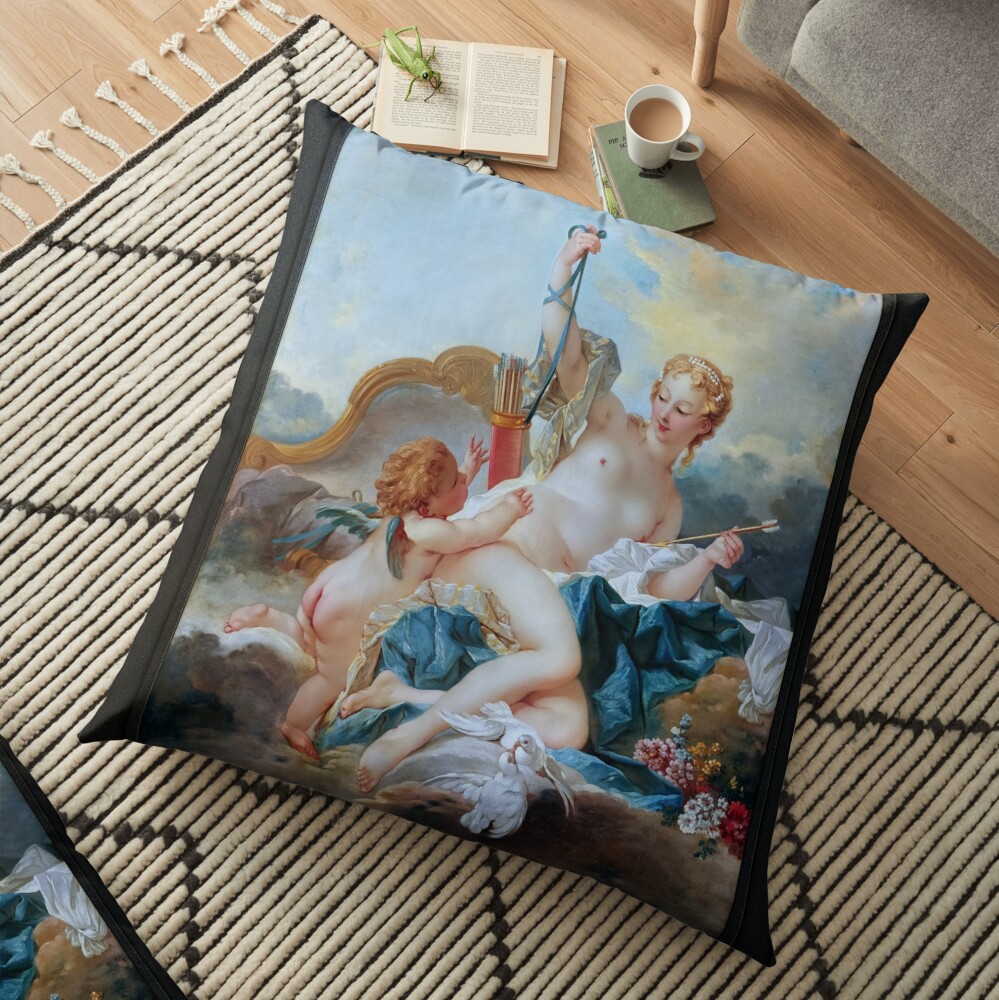
The materials depicted within the painting, 豊富な生地, soft drapery, and the delicate textures of skin and hair—are rendered with incredible finesse, showcasing Boucher’s mastery of texture and detail. The smoothness of the skin contrasts beautifully with the lushness of the fabric surrounding the figures, emphasizing the ethereal quality of the scene. Venus’s gown, a flowing fabric of soft blues and whites, is meticulously painted to reflect light, enhancing the sense of movement and grace in her posture.
スタイル, テーマ, と気分
フランソワ・ブーシェ “金星がキューピッドを武装解除する” exemplifies the Rococo style, characterized by its light, 風通しの良い作曲, playful themes, and emphasis on beauty and sensuality. The soft color palette of pastel blues, ピンク, and whites gives the piece a delicate, ほぼ異世界の品質, aligning with the Rococo emphasis on grace, 優雅, そして魅力.
The rounded, soft forms of the figures, along with their fluid poses, are indicative of the Rococo’s rejection of the hard lines and dramatic compositions of earlier Baroque works. Boucher’s signature use of light and shadow, coupled with the intricate detail of Venus’s drapery and Cupid’s cherubic features, makes the painting appear almost alive.
The mood of the painting is one of playful affection. The interaction between Venus and Cupid suggests not only the tender love of a mother for her son but also the nurturing, controlling aspect of love itself. Venus is not merely disarming Cupid; she is showing him that love can be both powerful and restrained. This juxtaposition between control and innocence, strength and tenderness, infuses the painting with a timeless charm.
結論
“金星がキューピッドを武装解除する” stands as a remarkable example of François Boucher’s ability to merge delicate beauty with allegorical depth. Through his mastery of Rococo style, Boucher captures the nuances of love in both its playful and powerful forms. 金星, as the dominant yet nurturing figure, and Cupid, as the symbol of love’s unpredictable force, together create a timeless narrative of affection, コントロール, and the eternal dance between the two.
Vénus désarmant Cupidon は、リマスターされたデジタル アートの古いマスターの複製であり、パブリック ドメインの画像として入手できます。 キャンバスプリント オンライン.
以下の情報から派生 Wikipedia.org
パリ出身, ブーシェはあまり知られていない画家ニコラスブーシェの息子でした, 彼に彼の最初の芸術的訓練を与えた人. 17歳で, ブーシェの絵画は、画家フランソワ・ルモワンに賞賛されました. Lemoyneは後にBoucherを彼の見習いとして任命しました, でもたった3ヶ月で, 彼は彫刻家ジャン=フランソワ・カーズのために働きに行きました.
に 1720, 彼は絵画でエリートローマグランプリを受賞しました, しかし、5年後までイタリアで勉強する結果的な機会をとらなかった, 王立絵画彫刻アカデミーの財政問題のため。[1] イタリアでの勉強から戻ったとき、彼は再建された王立絵画彫刻アカデミーに入学しました。 24 11月 1731. 彼のレセプションピース (レセプションピース) 彼のリナルドとアルミダは 1734.
ブーシェはマリージャンヌブゾーと結婚しました 1733. カップルには3人の子供がいました. Boucherはの教員になりました 1734 そして彼のキャリアはこの時点から加速し、彼は教授、そしてアカデミーの学長に昇進しました。, 王立ゴブラン製作所の検査官になり、ついに国王の筆頭画家になりました (王の最初の画家) に 1765. マリー=ルイーズ・オマーフィーの肖像c. 1752
ブーシェはで死んだ 30 5月 1770 彼の生まれ故郷のパリで. 彼の名前, 彼の常連客であるポンパドゥール夫人のそれと一緒に, フランスのロココ様式の代名詞になっていた, ゴンコート兄弟を率いて書く: “ブーシェは世紀の味を代表する男性の一人です, 表現する人, それを具体化して具体化します。”
ブーシェは自然が “緑が多すぎて照明が不十分” (緑が強すぎて照明が悪い).
ブーシェは宝石の彫刻家ジャック・ゲと関係がありました, 彼が描くことを教えた人. 彼はまた、モラヴィア・オーストリアの画家マーティン・フェルディナンド・クアダルと新古典主義の画家ジャック=ルイ・ダヴィッドを指導しました。 1767.[4] 後で, ブーシェは、ポンパドゥール夫人が彫刻し、好意的な廷臣に見事に綴じられた巻として配布した、グアイの一連の作品の素描を作成しました。