

Voluptuous Platinum Blonde
“Voluptuous Platinum Blonde,” created by Peruvian artist Alberto Vargas (1896 – 1982) i lár an 20ú haois, showcases the artist’s signature style and mastery in depicting feminine beauty. Born in Peru, Vargas became one of the most iconic pin-up artists of his time.
Known for his sensual and evocative portrayals of women, this particular work stands as a prime example of his ability to infuse glamour, allure, and a touch of surreal softness into his figures. An phéintéireacht, finished in the 1940s or 1950s, captures a moment of intimate self-expression, presenting a woman in an almost dreamlike, serene pose. Tríd an bpíosa seo, Vargas reveals his deep understanding of the human form, the textures of skin and hair, and the intricacies of light and shadow.
Clár na nÁbhar
An príomh -ábhar: The Sensual Woman
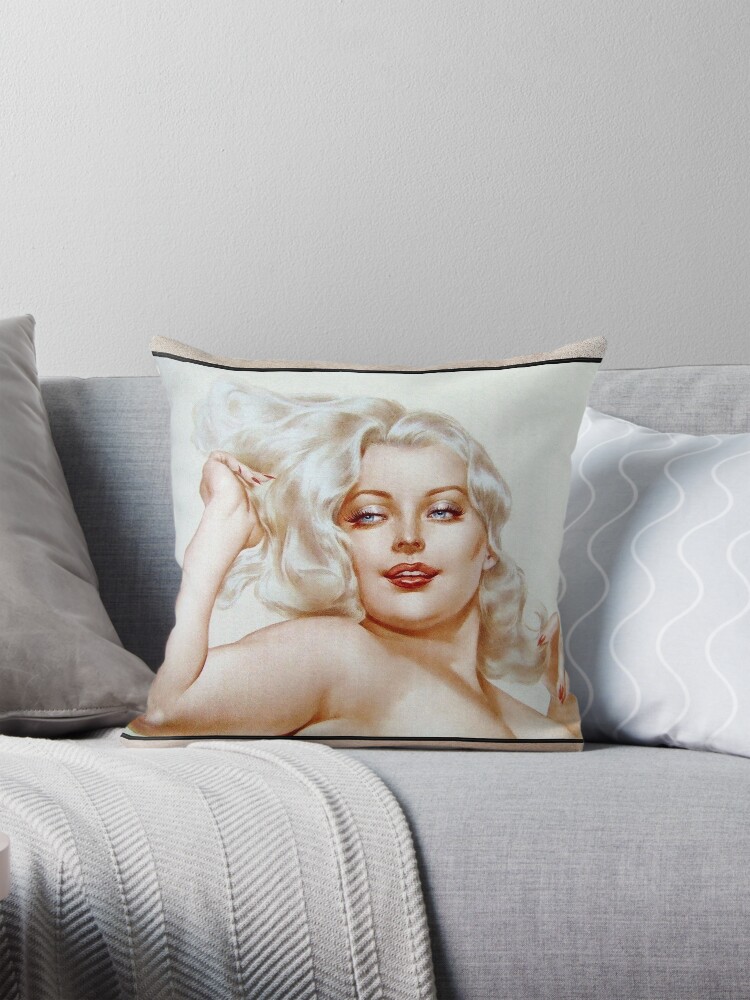
Tá fócas lárnach na “Voluptuous Platinum Blonde” is undoubtedly the woman herself. The subject of the painting is a voluptuous, platinum blonde woman with a smooth and glowing complexion that captures the viewer’s attention immediately. She possesses a classic beauty, with delicate features that include full lips, arched eyebrows, agus mór, expressive eyes. A radharc, while direct, is softened by a gentle smile that hints at both confidence and vulnerability. She seems to gaze beyond the viewer, lost in her own thoughts or daydreams, adding an element of mystery to her character.
A cuid gruaige, a cascade of platinum blonde waves, is effortlessly tousled, as though the wind has just swept through it. The texture of her hair is captured with great attention to detail—each strand appears to flow in a natural rhythm, contributing to the ethereal mood of the piece. The woman’s pose is fluid yet grounded, her arm raised to touch her hair, suggesting a moment of calm introspection or simply the act of adjusting her locks. This subtle movement contrasts with the otherwise still atmosphere of the image, giving the figure a sense of life.
The Theme and Mood: Glamour and Sensuality
“Voluptuous Platinum Blonde” embodies themes of sensuality, galánta, agus glamour, hallmarks of Vargas’ work. The mood conveyed is one of subtle eroticism, without overtly sexualized imagery. The figure is undeniably seductive, yet there is an air of dignity and poise to the woman that suggests she is aware of her own beauty but not consumed by it. This portrayal aligns with the classic ideals of femininity that were celebrated in Vargas’ ré, evoking a sense of timeless allure. The subject’s allure is not just about her physical beauty but also about the quiet strength and confidence she exudes, a strength that does not need to be loud to be impactful.
The painting carries a serene yet powerful atmosphere, accentuated by the soft yet vivid colors Vargas employs. The woman’s smooth, fair skin and platinum blonde hair glow against the more muted, neutral backdrop. The soft gradient of the background gives the painting a dreamy, almost otherworldly feel, as if the viewer is peering into a moment suspended in time. Vargas’ expert use of light enhances the subject’s features, creating a lifelike, almost tactile quality to the painting that invites the viewer to feel as though they could reach out and touch the woman’s skin.
Ábhair agus Teicnící: Mastery of Light and Texture
Alberto Vargas was known for his technical precision, agus “Voluptuous Platinum Blonde” ní haon eisceacht é. The artist’s use of oil paints lends the piece a rich, velvety texture, with the smoothness of the woman’s skin and hair juxtaposed against the softer background. Vargas expertly manipulates the paint to create a realistic effect, particularly in the way he captures the reflection of light on the woman’s skin and hair. The use of soft, blending tones allows for the subtle transitions between light and shadow, giving the figure a three-dimensional quality despite the flatness of the canvas.
The artist’s delicate brushwork and the precision with which he paints the details—such as the individual locks of hair and the soft curves of the woman’s body—reflect his exceptional skill in portraiture. Each curve and contour is carefully articulated, drawing the viewer’s eye across the canvas in a continuous motion. The juxtaposition of the warm hues of the woman’s skin and the cooler tones of her blonde hair further emphasizes her sensuality, highlighting the contrast between the warm and cool elements of the composition.
The background is a soft, blurred gradient that transitions from a light, warm beige to a deeper, darker tone, enhancing the three-dimensionality of the subject and making her stand out even more vividly. This contrast allows the viewer to focus solely on the woman, while the backdrop serves as an atmospheric complement to her figure.
Conclúid
Íomhá áitritheora Alberto Vargas’ “Voluptuous Platinum Blonde” is not just a painting of a woman; it is a timeless portrayal of feminine beauty and allure. With meticulous attention to detail and a deep understanding of light and form, Vargas creates a piece that speaks to the viewer’s senses, inviting them to appreciate the elegance and sensuality of the female figure. The work encapsulates the ideals of glamour and femininity that defined the mid-20th century, while maintaining a modern sophistication that still resonates today. Tríd an saothar ealaíne seo, Vargas cements his legacy as a master of capturing both the visible and the intangible aspects of beauty, mothúcháin, agus allure.
Blonde Platanam Voluptuous le hEalaíontóir Peruvian Íomhá áitritheora Alberto Vargas (1896 – 1982); mar gheall ar a ealaín sollúnta agus fíorálainn do chailíní agus meastar gurb í an seánra ealaíontóra is cáiliúla í.
Portráid Voluptuous Platinum Blonde Blue Eyed Vargas Pin-up Girl, ag nochtadh áilleacht céadfach Woman
Is é atá i gceist leis seo ná sean-mháistrí ealaíne digití atáirgeadh ar íomhá fearainn phoiblí.
Beathaisnéis Ealaíontóir
Eolas Thíos Ó Wikipedia.org
Rugadh in Arequipa é, Peiriú, ba mhac é leis an ngrianghrafadóir Peruvian suntasach Max T.. Vargas. Bhog Alberto Vargas go dtí na Stáit Aontaithe i 1916 tar éis staidéar a dhéanamh ar ealaín san Eoraip, Zurich, agus an Ghinéiv roimh an gCéad Chogadh Domhanda.
Le linn dó a bheith san Eoraip tháinig sé ar an iris Francach La Vie Parisienne, le clúdach le Raphael Kirchner, a dúirt sé a raibh tionchar mór aige ar a chuid oibre.
I measc a ghairmréime i Nua Eabhrac bhí obair mar ealaíontóir do na Ziegfeld Follies agus do go leor stiúideonna Hollywood. Crochadh Ziegfeld a phictiúr de Olive Thomas ag an amharclann, agus measadh go raibh sí ar cheann de na Cailíní Vargas is luaithe.
Vargas’ bhí an píosa oibre scannáin is cáiliúla le haghaidh póstaer an 1933 scannán The Sin of Nora Moran, a thaispeánann Zita Johann atá beagnach nocht i staid an éadóchais. Is minic a ainmnítear an póstaer ar cheann de na póstaeir scannáin is mó a rinneadh riamh.
Tugadh suntas dó sna 1940idí mar chruthaitheoir na mbiorán íocónach ón Dara Cogadh Domhanda don iris Esquire ar a dtugtar “Cailíní Vargas.” Idir 1940 agus 1946 Vargas a tháirgtear 180 pictiúir don iris.
Spreagadh agus oiriúnaíodh ealaín srón a lán aerárthaí Meiriceánacha agus Comhghuaillithe ón Dara Cogadh Domhanda ó na bioráin Esquire seo, chomh maith leo siúd George Petty, agus ealaíontóirí eile.