

Who’s On The Line
Gil Elvgren (1914 – 1980), an American illustrator renowned for his pin-up art, created the iconic piece titled “Who’s On The Line,” likely during the mid-20th century. Elvgren’s work exemplifies the essence of American pin-up art, a genre that became synonymous with youthful charm, Flirteanaidh, and a sense of playfulness. Anns a 'phìos seo, we see a striking example of Elvgren’s mastery in capturing the human form, emphasizing not only physical allure but also the narrative and emotion conveyed through a seemingly simple, yet evocative, moment.
Clàr-innse
Am Prìomh Chuspair: A Flirty Young Woman
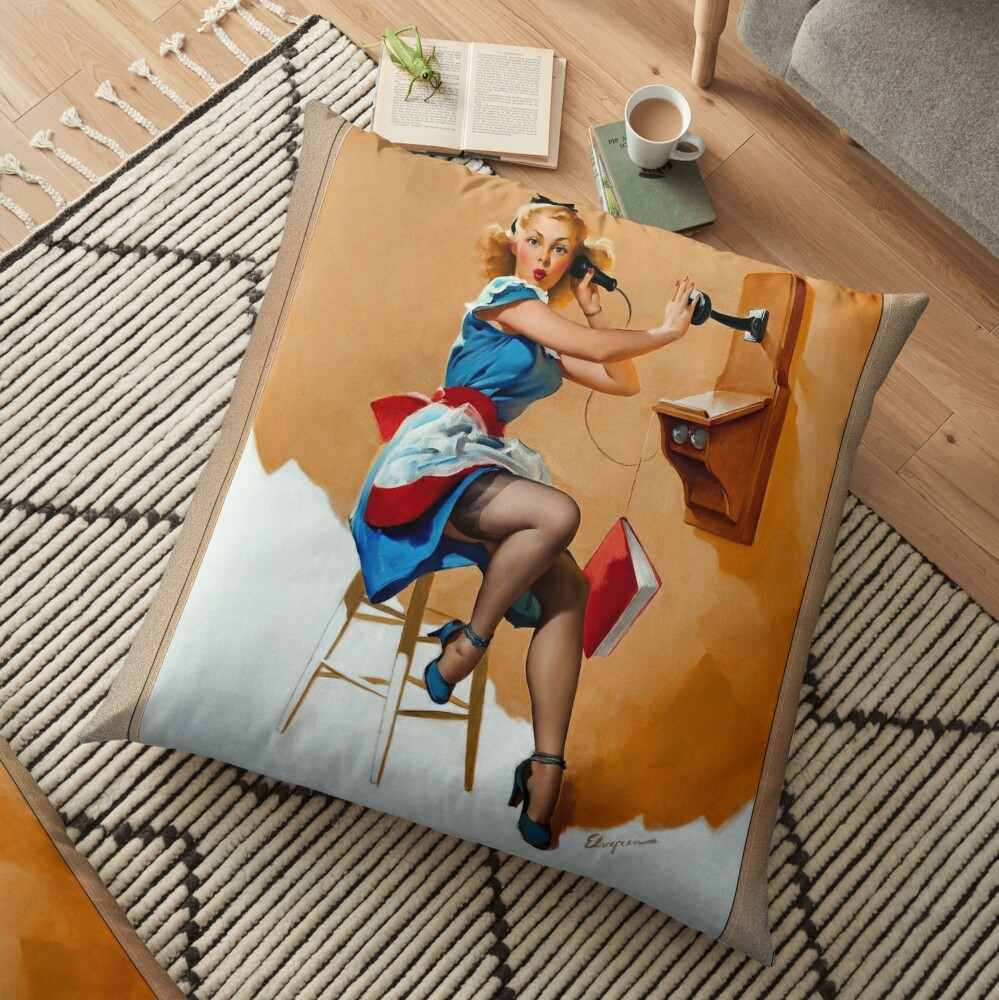
Aig cridhe na “Who’s On The Line” is a youthful and playful woman, a typical subject of Elvgren’s pin-up work. She is positioned in the center of the artwork, striking a dynamic pose that captures her both in motion and caught in a moment of surprise. The woman is dressed in a playful, slightly retro blue dress with a white apron.
The dress is belted at the waist with a bold red ribbon, which creates a lively contrast against her soft skin tone and the surrounding colors. Her pose is flirtatious and casual, yet she exudes an air of mystery, there is a sense that she is either expecting or answering an unexpected phone call. She is perched on a small wooden stool, leaning forward towards the old-fashioned telephone that seems to be a focal point of her attention.
Her expression is one of mock surprise or perhaps confusion, her mouth slightly parted as if caught in mid-conversation. One hand holds the receiver of the telephone, while her other hand rests on her hip, reinforcing the attitude of nonchalance. A falt, styled in playful curls, frèam a h-aghaidh, adding to the sense of whimsy that defines the artwork. The playful nature of her expression, coupled with the classic pin-up style, imbues the painting with a sense of fun and light-heartedness.
The Telephone: A Symbol of Connection
The telephone itself is an integral part of the narrative in “Who’s On The Line.” Positioned prominently on the wall beside the woman, it serves as the bridge between the subject and the unseen world outside the frame. The old-fashioned telephone, with its rotary dial and hand receiver, is a relic of a time before modern communication, evoking a sense of nostalgia and a longing for a simpler era. The object is painted with great care, with attention to texture and detail, suggesting its importance not only in the scene but also in the broader context of the woman’s life and experience.
While the woman’s playful pose and attire suggest the work is lighthearted, the telephone adds an element of suspense. It seems to be almost symbolic—perhaps representing a connection to someone distant or a long-awaited conversation. Tha dìth soilleireachd mun neach air ceann eile na loidhne a’ cur ris an inntinn, leigeil leis an neach-coimhead an aithris aca fhèin a chuir air an t-sealladh.
Cruth-tìre agus Cùl-fhiosrachadh: Simplicity and Focus
Cùl-fhiosrachadh a “Who’s On The Line” tha e caran minimalistic, gidheadh tha e a’ frithealadh a’ chuspair a shoilleireachadh gun dragh sam bith. Am bog, bidh balla beige a’ cruthachadh cùl-raon neodrach a chuireas cuideam air dathan beòthail dreasa boireannaich agus fòn.
Chan eil àirneis toinnte no sealladh-tìre seallaidh a tharraingeas aire air falbh bho na prìomh dhaoine; An àite sin, tha am fòcas gu tur air a’ bhoireannach agus na nithean a tha timcheall oirre. Tha e coltach gu bheil an làr sìmplidh, uachdar le dath aotrom, gun mion-fhiosrachadh follaiseach ach an stòl air a bheil i na suidhe, a tha a’ cur ris a’ mhothachadh air modhalachd agus sìmplidheachd san t-sealladh.
The lack of ornate surroundings allows the viewer to focus on the interaction between the woman and the phone. The scene could be taking place in a humble domestic setting, reinforcing the narrative of everyday life, but with a touch of glamour, an artifice that pin-up art often aimed to depict. An rèidh, clean background provides a canvas for the character to shine, an dà chuid gu corporra agus gu faireachail.
An Stoidhle: Classic Pin-Up Art
Gil Elvgren’s style is immediately recognizable and widely regarded as the epitome of the mid-20th-century American pin-up genre. His works often feature women in moments of playful flirtation or light-hearted mischief, captured with smooth lines and rich colors. “Who’s On The Line” follows this tradition with its clean, polished aesthetic, characterized by an almost idealized depiction of the female form. Tha lùban a’ chuspair air an neartachadh le cumaidhean an dreasa agus an dòigh anns a bheil an solas ag eadar-obrachadh le a craiceann. Elvgren a’ toirt seachad aodann a’ bhoireannaich gu faiceallach, a faireachdainn spòrsail, agus tha bogachd a h-ìomhaigh a’ nochdadh a sgil ann a bhith a’ glacadh gach cuid mothachalachd agus neo-chiontachd ann an tomhas co-ionann..
Am Mood: Playful and Teasing
An fhaireachdainn iomlan de “Who’s On The Line” tha e spòrsail agus a 'magadh. Tha lùth flirtatious don phìos, air a neartachadh le suidheachadh grinn agus faireachdainn neònach a’ bhoireannaich. Tha nàdar aotrom an deilbh a’ toirt cuireadh don neach-coimhead aithris a dhèanamh far am faodadh an cuspair a bhith a’ dol an sàs ann an còmhradh suirghe no ma dh’fhaodte gun tèid a ghlacadh le fios fòn. Tha an eadar-obrachadh leis a’ fòn a’ nochdadh teannachadh inntinneach, leis an neach-coimhead air fhàgail gus iongnadh a dhèanamh air dearbh-aithne an neach air ceann eile na loidhne.
The mood is further emphasized by the color choices in the painting. The combination of the vibrant red ribbon, the soft blues of her dress, and the muted tones of the background creates a balance between warmth and coolness. This harmony adds to the sense of relaxed charm, allowing the viewer to enjoy the scene without feeling overwhelmed by any intense emotions. The subject’s charm and innocent allure are conveyed through her body language and facial expression, inviting the viewer to share in the moment.
Co-dhùnadh: A Timeless Snapshot of Playful Femininity
“Who’s On The Line” by Gil Elvgren captures a moment of playful femininity in a beautifully crafted image that balances sensuality with innocence. The painting’s timeless appeal lies in its ability to transport the viewer to a moment of flirtation and curiosity, evoking a nostalgic sense of charm and youth. Tro aire chùramach gu mion-fhiosrachadh, Elvgren brings to life a character who is both whimsical and grounded, caught between an era gone by and the timeless nature of the human experience. This piece is a perfect example of Elvgren’s ability to merge art with narrative, capturing the essence of his era with both humor and grace.
Is e seo ath-riochdachadh seann mhaighstirean ealain didseatach ath-leasaichte de ìomhaigh raon poblach a tha ri fhaighinn mar a clò-bhualadh canabhas air-loidhne.
Neach-ealain bi a thàinig bho Wikipedia.org
Gillette A.. Rugadh Elvgren ann an St.. Pòl, Minnesota, agus chaidh e gu Àrd-sgoil an Oilthigh. An dèidh ceumnachadh, thòisich e ag ionnsachadh ealain aig Institiùd Ealain Minneapolis.
Às deidh sin ghluais e gu Chicago gus sgrùdadh a dhèanamh aig Acadamaidh Ealain Ameireagaidh, agus cheumnaich e bhon Acadamaidh aig àm an ìsleachaidh mhòir, aig aois fichead ’s a dhà.
An dèidh ceumnachadh chaidh Elvgren a-steach don stàball de luchd-ealain aig Stevens agus Gross, A ’bhuidheann sanasachd as cliùitiche ann an Chicago, agus thàinig e gu bhith na protégé den neach-ealain Haddon Sundblom.
Ann an 1937, Thòisich Gil a ’peantadh prìneachan mìosachain airson Louis F.. Dow, aon de na prìomh chompanaidhean foillseachaidh ann an Ameireagaidh, rè na h-ùine sin chruthaich e mu dheidhinn 60 bidh nighean pin-up ag obair air canabhas 22 ″ × 28 ″ agus gan comharrachadh le ainm-sgrìobhte clò-bhuailte.
Chaidh mòran de na biorran aige ath-riochdachadh mar ealain sròin air itealain armachd san Dàrna Cogadh; agus bha e mun àm seo a-steach 1944, gun do bhruidhinn Companaidh Foillseachaidh Brown agus Bigelow ri Elvgren; companaidh a tha fhathast a ’cumail smachd air an raon ann a bhith a’ dèanamh mìosachain, stuthan sanasachd agus stuthan sanasachd.
An ath bhliadhna bho 1945 gus 1972, Bha ceangal aig Elvgren ris a ’Bhrùnach & Companaidh foillseachaidh Bigelow, agus thòisich e ag obair le 24 òirleach le 30 canabhasan òirleach, cruth a bhiodh e a ’cleachdadh airson an ath fhear 30 bliadhna, agus chuir e ainm ris an obair aige ann an cursive.
Bha Elvgren soirbheachail gu malairteach. Bha e a ’fuireach ann an diofar àiteachan, agus bha e gnìomhach bho na 1930an gu na 1970an. Ann an 1951 thòisich e a ’peantadh ann an stiùidio san dachaigh aige, an uairsin ann an Winnetka, Illinois, a ’cleachdadh neach-cuideachaidh gus solais a chuir air dòigh, togail props agus seallaidhean, seataichean dhealbhan, agus ullaich a pheant.
Am measg an luchd-dèiligidh aige bha companaidhean ainmeil mar Brown agus Bigelow, Coke, General Electric agus Companaidh Sealy Mattress, airson beagan ainmeachadh. A bharrachd air, anns na 1940an agus na 1950an dhealbhaich e sgeulachdan airson grunn irisean, leithid The Saturday Evening Post agus deagh chumail taighe.
Am measg nam modailean agus uirsgeulan Hollywood a pheant Elvgren rè a cùrsa-beatha bha Myrna Hansen, Donna Reed, Barbara Hale, Arlene Dahl, Lola Albright agus Kim Novak.