

Who’s On The Line
Gil Elvgren (1914 – 1980), an American illustrator renowned for his pin-up art, created the iconic piece titled “Who’s On The Line,” likely during the mid-20th century. Elvgren’s work exemplifies the essence of American pin-up art, a genre that became synonymous with youthful charm, flirt, e un senso di giocosità. In questo pezzo, we see a striking example of Elvgren’s mastery in capturing the human form, emphasizing not only physical allure but also the narrative and emotion conveyed through a seemingly simple, yet evocative, moment.
Sommario
Il soggetto principale: A Flirty Young Woman
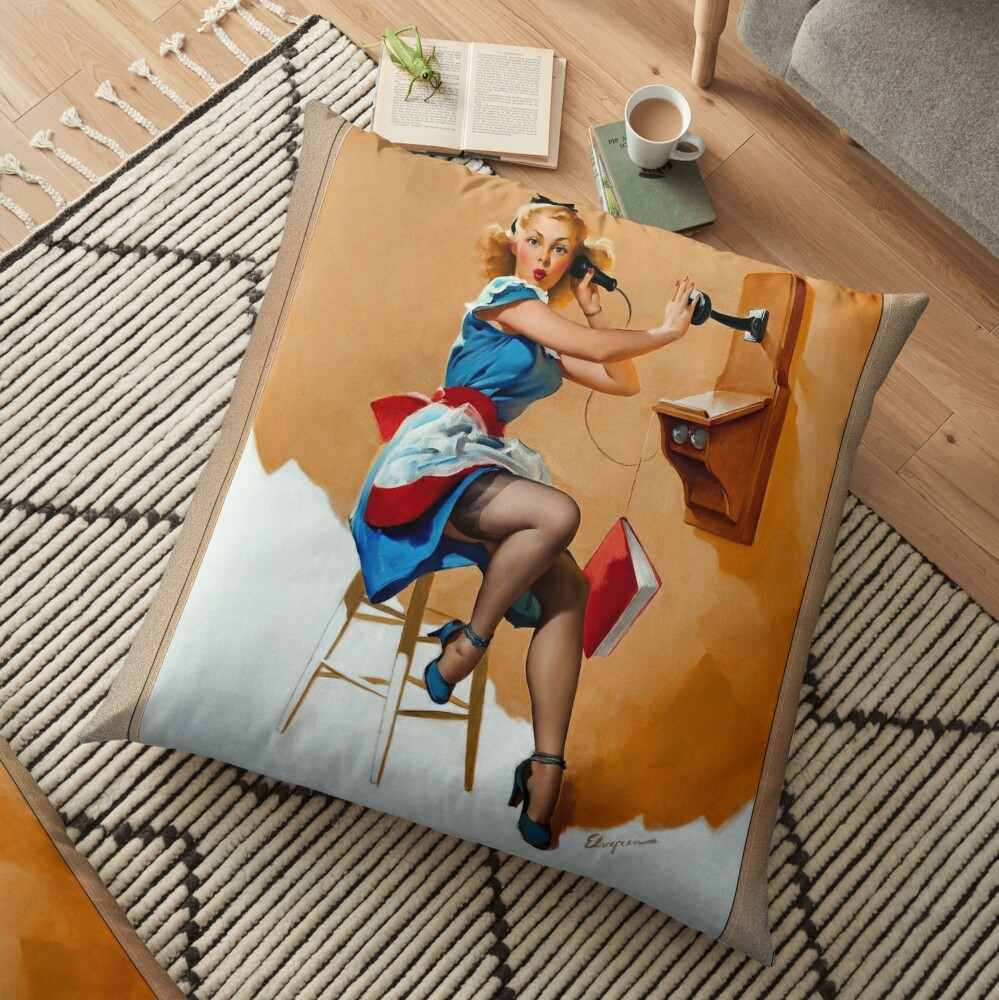
Al centro di “Who’s On The Line” is a youthful and playful woman, a typical subject of Elvgren’s pin-up work. She is positioned in the center of the artwork, striking a dynamic pose that captures her both in motion and caught in a moment of surprise. The woman is dressed in a playful, slightly retro blue dress with a white apron.
The dress is belted at the waist with a bold red ribbon, which creates a lively contrast against her soft skin tone and the surrounding colors. Her pose is flirtatious and casual, yet she exudes an air of mystery, there is a sense that she is either expecting or answering an unexpected phone call. She is perched on a small wooden stool, leaning forward towards the old-fashioned telephone that seems to be a focal point of her attention.
Her expression is one of mock surprise or perhaps confusion, her mouth slightly parted as if caught in mid-conversation. One hand holds the receiver of the telephone, while her other hand rests on her hip, reinforcing the attitude of nonchalance. I suoi capelli, styled in playful curls, frames her face, adding to the sense of whimsy that defines the artwork. The playful nature of her expression, coupled with the classic pin-up style, imbues the painting with a sense of fun and light-heartedness.
The Telephone: A Symbol of Connection
The telephone itself is an integral part of the narrative in “Who’s On The Line.” Positioned prominently on the wall beside the woman, it serves as the bridge between the subject and the unseen world outside the frame. The old-fashioned telephone, with its rotary dial and hand receiver, is a relic of a time before modern communication, evoking a sense of nostalgia and a longing for a simpler era. The object is painted with great care, with attention to texture and detail, suggesting its importance not only in the scene but also in the broader context of the woman’s life and experience.
While the woman’s playful pose and attire suggest the work is lighthearted, the telephone adds an element of suspense. It seems to be almost symbolic—perhaps representing a connection to someone distant or a long-awaited conversation. The lack of clarity about the person on the other end of the line enhances the intrigue, allowing the viewer to project their own narrative onto the scene.
Il terreno e lo sfondo: Simplicity and Focus
Lo sfondo di “Who’s On The Line” is rather minimalistic, yet it serves to highlight the subject without distraction. Il morbido, beige wall creates a neutral backdrop that emphasizes the vibrant colors of the woman’s dress and the telephone.
There is no intricate furniture or scenic landscape that pulls attention away from the central figures; Piuttosto, the focus is entirely on the woman and the immediate objects around her. The floor appears to be a simple, light-colored surface, with no prominent details other than the stool she sits on, which adds to the sense of modesty and simplicity in the scene.
The lack of ornate surroundings allows the viewer to focus on the interaction between the woman and the phone. The scene could be taking place in a humble domestic setting, reinforcing the narrative of everyday life, but with a touch of glamour, an artifice that pin-up art often aimed to depict. Il liscio, clean background provides a canvas for the character to shine, sia fisicamente che emotivamente.
Lo stile: Classic Pin-Up Art
Gil Elvgren’s style is immediately recognizable and widely regarded as the epitome of the mid-20th-century American pin-up genre. His works often feature women in moments of playful flirtation or light-hearted mischief, captured with smooth lines and rich colors. “Who’s On The Line” follows this tradition with its clean, polished aesthetic, characterized by an almost idealized depiction of the female form. The curves of the subject are accentuated by the contours of the dress and the way the light interacts with her skin. Elvgren’s careful rendering of the woman’s face, her playful expression, and the softness of her figure demonstrates his skill at capturing both sensuality and innocence in equal measure.
The Mood: Playful and Teasing
L'umore generale di “Who’s On The Line” is playful and teasing. There is a flirtatious energy to the piece, enhanced by the woman’s cheeky pose and curious expression. The painting’s light-hearted nature invites the viewer into a narrative where the subject may be engaging in a flirtatious conversation or perhaps caught off guard by a phone call. The interaction with the telephone suggests an intriguing tension, with the viewer left to wonder about the identity of the person on the other end of the line.
The mood is further emphasized by the color choices in the painting. The combination of the vibrant red ribbon, the soft blues of her dress, and the muted tones of the background creates a balance between warmth and coolness. This harmony adds to the sense of relaxed charm, allowing the viewer to enjoy the scene without feeling overwhelmed by any intense emotions. The subject’s charm and innocent allure are conveyed through her body language and facial expression, inviting the viewer to share in the moment.
Conclusione: A Timeless Snapshot of Playful Femininity
“Who’s On The Line” by Gil Elvgren captures a moment of playful femininity in a beautifully crafted image that balances sensuality with innocence. The painting’s timeless appeal lies in its ability to transport the viewer to a moment of flirtation and curiosity, evoking a nostalgic sense of charm and youth. Through careful attention to detail, Elvgren brings to life a character who is both whimsical and grounded, caught between an era gone by and the timeless nature of the human experience. This piece is a perfect example of Elvgren’s ability to merge art with narrative, capturing the essence of his era with both humor and grace.
Questa è una riproduzione di vecchi maestri di arte digitale rimasterizzata di un'immagine di pubblico dominio disponibile come file a ha dipinto le pinup per la commedia di Errol Flynn Never Say Goodbye.
Biografia dell'artista derivata da Wikipedia.org
Gillette A. Elvgren è nato a St. Paolo, Minnesota, e ha frequentato il Liceo Scientifico. Dopo la laurea, ha iniziato a studiare arte al Minneapolis Institute of Arts.
In seguito si trasferì a Chicago per studiare all'American Academy of Art, e si è laureato all'Accademia durante la grande depressione, all'età di ventidue anni.
Dopo la laurea, Elvgren è entrato a far parte della scuderia di artisti di Stevens and Gross, L'agenzia pubblicitaria più prestigiosa di Chicago, e divenne un protetto dell'artista Haddon Sundblom.
Nel 1937, Gil ha iniziato a dipingere le pin-up del calendario per Louis F. Dow, una delle principali case editrici americane, durante il quale ha creato circa 60 la pin-up lavora su tela 22″×28″ e le distingue da una firma stampata.
Molte delle sue pin-up sono state riprodotte come arte del naso su aerei militari durante la seconda guerra mondiale; ed è stato più o meno in questo periodo in 1944, che Elvgren è stato contattato dalla Brown and Bigelow Publishing Company; un'azienda che ancora domina il settore nella produzione di calendari, specialità pubblicitarie e prodotti promozionali.
L'anno prossimo da 1945 fino a 1972, Elvgren era associato ai Brown & Casa editrice Bigelow, e ho iniziato a lavorare con 24 pollice per 30 tele pollici, un formato che avrebbe usato per il prossimo 30 anni, e ha firmato il suo lavoro in corsivo.
Elvgren è stato un successo commerciale. Ha vissuto in varie località, ed è stato attivo dagli anni '30 agli anni '70. Nel 1951 ha iniziato a dipingere in uno studio a casa sua, poi in Winnetka, Illinois, utilizzando un assistente per impostare l'illuminazione, costruire oggetti di scena e scene, set fotografici, e prepara i suoi colori.
I suoi clienti includevano aziende famose come Brown e Bigelow, Coca Cola, General Electric e Sealy Mattres Company, per dirne alcuni. Inoltre, durante gli anni '40 e '50 ha illustrato storie per una serie di riviste, come The Saturday Evening Post e Good Housekeeping.
Tra le modelle e le leggende di Hollywood che Elvgren ha dipinto durante la sua carriera c'era Myrna Hansen, donna reed, Barbara Hale, Arlene Dahl, Lola Albright e Kim Novak.