

Will It Be Fine c1896
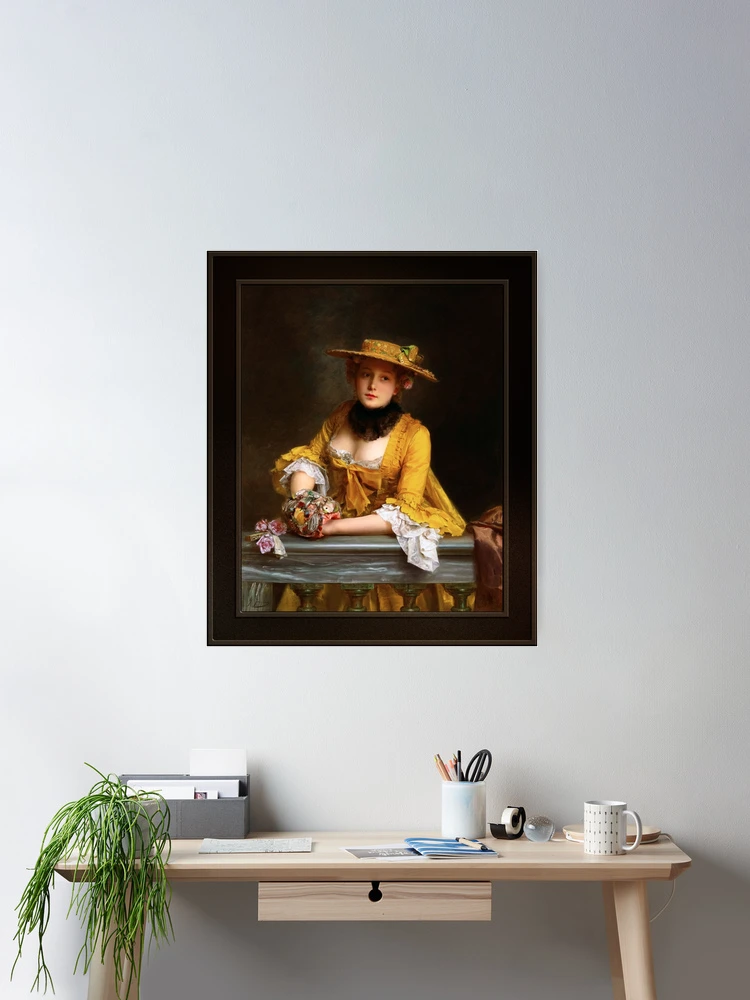
“Will It Be Fine,” oprettet i 1896 by French painter Gustave Jean Jacquet (1846 – 1909), is a portrait that captures a moment of contemplation and grace, reflecting the aesthetic trends of the late 19th century. The painting features a young woman, dressed in an elegant yellow gown, leaning against a table as she holds a bouquet of flowers.
Her delicate pose and thoughtful expression invite the viewer into her world, perhaps pondering a future decision or the course of her life. Emnets påklædning, hairstyle, and surroundings embody the refined atmosphere of the period, blending naturalism with a touch of Romanticism. The attention to detail and the soft, warm tones of the painting evoke a sense of timeless beauty and a tranquil moment of introspection.
Indholdsfortegnelse
Emnet: A Portrait of Elegance
I hjertet af “Will It Be Fine” is the portræt af en ung kvinde, likely a representation of femininity in its most delicate form. She is seated in a relaxed yet poised manner, with one arm resting on a table, and her gaze directed slightly off to the side, giving the impression that she is lost in thought. Her facial expression, serene and composed, speaks to the psychological depth that Jacquet was able to achieve through his meticulous brushwork.
The woman’s features are finely detailed, med blød, pale skin that contrasts subtly against the deeper tones of her clothing. The artist’s precision in capturing the texture and structure of her face is noteworthy, with every detail, from her soft cheeks to her slightly parted lips, contributing to a sense of realism that was characteristic of Jacquet’s work.
Kvindens påklædning, a yellow gown with intricate ruffles, is a statement of high fashion typical of the late 19th century. The dress, with its vibrant yellow color, is composed of fine fabrics that catch the light, enhancing the richness of the scene. The wide-brimmed hat atop her head, adorned with floral embellishments, completes her ensemble.
The rich textures of the fabric and the carefully painted details of her accessories, such as the ribbon tied at the neckline and the delicate bouquet she holds, all contribute to the luxurious feel of the portrait. The ensemble exudes elegance, signifying her high social status or noble birth. The bouquet of flowers, også, is a key detail, symbolizing beauty, ungdom, and perhaps the fleeting nature of time.
The Setting and Materials
The background of the portrait is subtle, providing a muted contrast to the vibrancy of the subject’s attire. The artist uses a dark, almost ethereal backdrop that adds a sense of depth and focus to the subject while enhancing the intimate mood of the piece. The table in front of her, upon which she rests her arm, is rendered with a sense of realism, though it remains in the background, serving as a support rather than a focal point. The use of light and shadow across her face and gown helps to create a three-dimensional effect, emphasizing the naturalistic approach Jacquet was known for.
Materialerne i selve maleriet er olie på lærred, som giver mulighed for de bløde overgange af farve og lys, bidrager til den naturtro kvalitet af arbejdet. Anvendelsen af lys og skygge er særlig veludført, Med Jacquet anvender delikate højdepunkter for at give stoffet i kjolen en følelse af tekstur. Lyset ser ud til at kærtegne emnets ansigt og hænder, henleder opmærksomheden på den subtile skønhed i hendes hud og blødheden i hendes udtryk.
Stil, Tema, og humør
“Will It Be Fine” er et eksemplarisk arbejde fra det franske portrætter fra det 19. århundrede, med påvirkninger fra både den akademiske tradition og den mere intime, Psykologiske udforskninger, der opstod på det tidspunkt. Jacquets stil blander realisme med en romantiseret fortolkning af sit emne, At fange kvindens fysiske lighed, mens hun også imødekommer hende med en følelse af følelsesmæssig dybde. Maleriets realisme er tydeligt i den nøjagtige gengivelse af tekstilerne, Teksturerne, og lyset, Mens den bløde behandling af kvindens ansigt og stemningen skabt af hendes fjerne blik giver stykket en luft af introspektion og kontemplation.
Temaet for maleriet ser ud til at udforske et øjeblik med stille forventning, Måske stille spørgsmålet om, hvorvidt fremtiden vil bringe glæde eller sorg - symboliseret af titlen “Vil det være fint.” Titlen, i forbindelse med figurens kontemplative stemning, foreslår en følelse af usikkerhed eller håbefuldhed, evoking a time in the subject’s life when decisions or events may alter her course.
The overall mood of the painting is one of calm introspection. Farverne, especially the warm yellow of the gown and the softness of the background, contribute to a sense of peace. Endnu, there is also an undercurrent of uncertainty, as the subject’s expression is not one of absolute confidence, but rather one of quiet contemplation.
Konklusion
I “Will It Be Fine,” Gustave Jean Jacquet succeeds in capturing a moment that is both timeless and evocative. The painting speaks to the viewer not just through its technical mastery but also through its emotional resonance. The young woman in her opulent attire, holding her bouquet and gazing into the distance, seems to embody a silent narrative of waiting, of pondering the future. Jacquets dybe håndtering af lys, hans omhyggelige gengivelse af stoffer, Og hans evne til at fremkalde en række følelser gennem motivets udtryk samles for at skabe et portræt, der ikke kun er en skildring af en kvinde, Men en meditation om skønhed, ungdom, og tiden.
Dette er en retoucheret digital kunst, som gamle mestre gengiver et billede af det offentlige domæne.
Artsit Bio er afledt af 19thcenturypaintings.com
Gustave blev født i Paris, Frankrig videre 1846 og var elev af den franske maler William-Adolphe Bouguereau (1825 – 1905) af nyklassicismen, Realisme, Akademisk, Symbolik, Moderne kunst æra; og var aldrig mentor med nogen anden kunstner og var stærkt påvirket af ham i den tidlige del af hans karriere.
Gustaves debutkunst var La Reverie, et allegoriværk præsenteret for Salonen i 1865; derefter ind 1866 præsenterede malerier i små dimensioner, der skildrede livet i 16, 17th og 18. århundredes liv, samt male portrætter af motiver i tidstypiske dragter fra 1500-tallet.
I 1875 Gustave blev tildelt en fortræffelighedsmedalje og 4 år senere blev han udnævnt til Ridder af Æreslegionen (Æreslegion, tidligere den kongelige hædersorden); er den højeste franske fortjeneste, både militære og civile. Etableret i 1802 af Napoleon Bonaparte.