

Will It Be Fine c1896
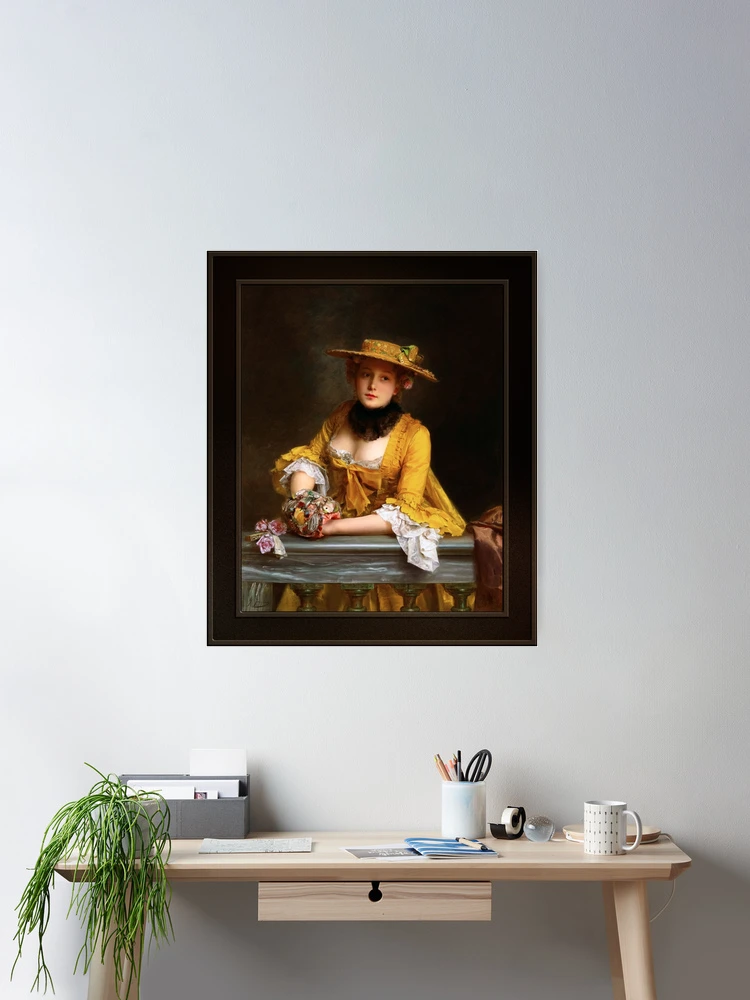
“Will It Be Fine,” gemaakt in 1896 by French painter Gustave Jean Jacquet (1846 – 1909), is a portrait that captures a moment of contemplation and grace, reflecting the aesthetic trends of the late 19th century. The painting features a young woman, dressed in an elegant yellow gown, leaning against a table as she holds a bouquet of flowers.
Her delicate pose and thoughtful expression invite the viewer into her world, perhaps pondering a future decision or the course of her life. The subject’s attire, hairstyle, and surroundings embody the refined atmosphere of the period, blending naturalism with a touch of Romanticism. The attention to detail and the soft, warm tones of the painting evoke a sense of timeless beauty and a tranquil moment of introspection.
Inhoudsopgave
Het onderwerp: A Portrait of Elegance
In het hart van “Will It Be Fine” is the portret van een jonge vrouw, likely a representation of femininity in its most delicate form. She is seated in a relaxed yet poised manner, with one arm resting on a table, and her gaze directed slightly off to the side, giving the impression that she is lost in thought. Her facial expression, serene and composed, speaks to the psychological depth that Jacquet was able to achieve through his meticulous brushwork.
The woman’s features are finely detailed, met zacht, pale skin that contrasts subtly against the deeper tones of her clothing. The artist’s precision in capturing the texture and structure of her face is noteworthy, with every detail, from her soft cheeks to her slightly parted lips, contributing to a sense of realism that was characteristic of Jacquet’s work.
De kleding van de vrouw, a yellow gown with intricate ruffles, is a statement of high fashion typical of the late 19th century. De jurk, with its vibrant yellow color, is composed of fine fabrics that catch the light, enhancing the richness of the scene. The wide-brimmed hat atop her head, adorned with floral embellishments, completes her ensemble.
The rich textures of the fabric and the carefully painted details of her accessories, such as the ribbon tied at the neckline and the delicate bouquet she holds, all contribute to the luxurious feel of the portrait. The ensemble exudes elegance, signifying her high social status or noble birth. The bouquet of flowers, te, is a key detail, symboliseert schoonheid, jeugd, en misschien wel de vluchtige aard van de tijd.
The Setting and Materials
De achtergrond van het portret is subtiel, waardoor een gedempt contrast ontstaat met de levendigheid van de kleding van het onderwerp. De kunstenaar gebruikt een donker, een bijna etherische achtergrond die een gevoel van diepte en focus aan het onderwerp toevoegt en tegelijkertijd de intieme sfeer van het stuk versterkt. De tafel voor haar, waarop zij haar arm rust, wordt weergegeven met een gevoel van realisme, ook al blijft het op de achtergrond, fungeren als steunpunt en niet als centraal punt. Het gebruik van licht en schaduw over haar gezicht en jurk helpt een driedimensionaal effect te creëren, met de nadruk op de naturalistische benadering waar Jacquet bekend om stond.
De materialen van het schilderij zelf zijn olieverf op doek, wat zorgt voor de zachte overgangen van kleur en licht, bijdragen aan de levensechte kwaliteit van het werk. Bijzonder goed is de toepassing van licht en schaduw uitgevoerd, waarbij Jacquet delicate highlights gebruikte om de stof van de jurk een gevoel van textuur te geven. Het licht lijkt het gezicht en de handen van het onderwerp te strelen, vestigt de aandacht op de subtiele schoonheid van haar huid en de zachtheid van haar uitdrukking.
Stijl, Thema, en stemming
“Will It Be Fine” is een voorbeeldig werk van de 19e-eeuwse Franse portretkunst, met invloeden uit zowel de academische traditie als de meer intieme, psychologische verkenningen die destijds opkwamen. Jacquets stijl combineert realisme met een geromantiseerde interpretatie van zijn onderwerp, capturing the physical likeness of the woman while also imbuing her with a sense of emotional depth. The painting’s realism is evident in the precise rendering of the fabrics, the textures, and the light, while the soft treatment of the woman’s face and the mood created by her distant gaze lend the piece an air of introspection and contemplation.
The theme of the painting seems to explore a moment of quiet anticipation, perhaps asking the question of whether the future will bring joy or sorrow—symbolized by the title “Will It Be Fine.” The title, in conjunction with the contemplative mood of the figure, suggests a sense of uncertainty or hopefulness, evoking a time in the subject’s life when decisions or events may alter her course.
The overall mood of the painting is one of calm introspection. De kleuren, especially the warm yellow of the gown and the softness of the background, contribute to a sense of peace. Nog, there is also an undercurrent of uncertainty, as the subject’s expression is not one of absolute confidence, but rather one of quiet contemplation.
Conclusie
In “Will It Be Fine,” Gustave Jean Jacquet succeeds in capturing a moment that is both timeless and evocative. The painting speaks to the viewer not just through its technical mastery but also through its emotional resonance. The young woman in her opulent attire, holding her bouquet and gazing into the distance, seems to embody a silent narrative of waiting, of pondering the future. Jacquet’s deft handling of light, his careful rendering of fabrics, en zijn vermogen om via de uitdrukking van het onderwerp een scala aan emoties op te roepen, komen allemaal samen om een portret te creëren dat niet alleen een afbeelding van een vrouw is, maar een meditatie over schoonheid, jeugd, en het verstrijken van de tijd.
Dit is een retoucheerde digitale reproductie van kunst oude meesters van een openbaar domeinafbeelding.
Artsit Bio is afgeleid van 19thcenturypaintings.com
Gustave werd geboren in Parijs, Frankrijk aan 1846 en was een leerling van de Franse schilder William-Adolphe Bouguereau (1825 – 1905) van het neoclassicisme, Realisme, academisch, Symboliek, Tijdperk van de moderne kunst; en nooit begeleid met een andere artiest en sterk door hem beïnvloed tijdens het begin van zijn carrière.
Gustave debuutkunstwerk was La Reverie, een allegoriestuk gepresenteerd aan de Salon in 1865; dan in 1866 presenteerde schilderijen met kleine afmetingen die het leven van de 16e verbeeldden, 17leven in de e en 18e eeuw, evenals het schilderen van portretten van onderwerpen in historische kostuums uit de 16e eeuw.
In 1875 Gustave werd bekroond met een medaille van uitmuntendheid en 4 jaren later werd hij benoemd tot Ridder in het Legioen van Eer (Legioen van Eer, voorheen de Koninklijke Orde van het Legioen van Eer); is de hoogste Franse rangorde, zowel militair als civiel. opgericht in 1802 door Napoleon Bonaparte.