

Winterlandschap met reizigers
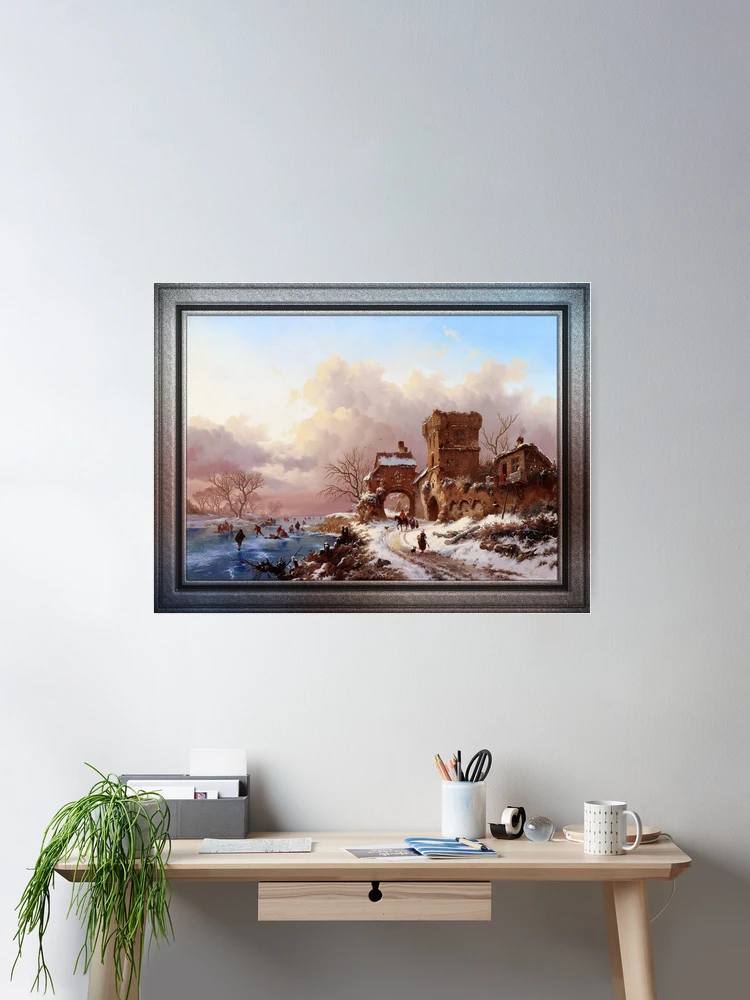
In Winter Landscape With Travelers Near The Town Gate, painted by Frederik Marinus Kruseman (1816 – 1882), the viewer is transported to a serene winter’s day in the 19th century, where the tranquility of the frozen landscape is punctuated by the movements of travelers. This stunning piece, dating from around 1857, exemplifies the Dutch Romanticism style, characterized by its detailed naturalistic approach, its emphasis on the landscape as both a subject of beauty and contemplation, and its carefully composed atmosphere. The artist presents a rich narrative of rural life in the cold months, capturing both the splendor and harshness of winter in a northern European town.
Inhoudsopgave
Hoofdonderwerp en compositie
At the heart of the painting is a town gate, acting as the focal point of the composition. This structure, grand and imposing, stands against the backdrop of a serene but somewhat desolate winter scene. The gate leads into a quaint village or town, which is implied but not directly shown in the artwork. On either side of the entrance, towering bare trees stretch their limbs into the cold air, their gnarled branches reaching out toward the sky, their starkness enhanced by the absence of leaves. Deze bomen, mostly without foliage, evoke a sense of dormancy, signifying the depth of winter’s grip.
Just outside the town gate, the ground is blanketed in a layer of snow, its purity highlighted by the faint tinge of sunset light that reflects off its surface. The snow is soft and undisturbed near the gate, but as it stretches farther into the scene, the untouched white is interrupted by travelers on foot, creating dynamic movement within the otherwise still landscape.
Deze figuren, bundled in winter coats and cloaks, traverse the icy terrain, their heads lowered against the cold wind, adding a sense of realism and humanity to the scene. The scene thus tells a story of daily life during winter, where travel and movement persist despite the frozen conditions.
Objecten en materialen
The painting’s attention to detail is evident in its depiction of materials. The stone structure of the town gate is textured and weathered, with intricate architectural features that reflect the period’s craftsmanship. The gate itself serves as a symbolic barrier between the bustling life of the town and the expansive, icy wilderness outside. The faint glow from the window of the building atop the gate hints at warmth within, contrasting the harsh cold of the outside world.
The snow is not just a passive element in the scene; Kruseman skillfully uses it to highlight the light effects of the setting sun. The snow, with its delicate, powdery texture, reflects the amber and pale colors of the sky, which gently fade into a soft pinkish hue near the horizon.
Het water, visible in the foreground, has a frozen sheen to it, allowing travelers and skaters to glide across its surface. There are figures visible on the ice, engaged in the sport of skating—a pastime synonymous with cold winters in the Low Countries during the 19th century. The figures’ motion contrasts with the stillness of the trees and the looming town gate.
Terrain and Surroundings
The surrounding terrain consists of a variety of textures and layers, from the soft snow that covers the ground to the frozen river in the foreground, which adds depth and intrigue to the scene. De rivier, partially frozen, reflects the cloudy sky above, while thin cracks in the ice hint at the fragile nature of the winter landscape. In de verte, the horizon is dominated by the fading light of the sunset, casting a warm glow across the scene that contrasts with the cool tones of the snow and ice.
The snow-covered path that leads to the town gate is marked by the footprints of the travelers, whose dark forms stand out against the pale ground. This path draws the viewer’s eye toward the gate, enhancing the sense of movement within the otherwise quiet scene. Kruseman legt het nauwgezette karakter van de winter op het Nederlandse platteland vast, het gebruik van natuurlijke elementen zoals de ijskoude rivier en bladerloze bomen om de stille eenzaamheid van het moment over te brengen.
Stijl en techniek
Krusemans beheersing van licht en schaduw is duidelijk zichtbaar in dit schilderij, terwijl hij de warme tinten van de zonsondergang effectief contrasteert met de koelere tinten van het winterlandschap. De penseelvoering is delicaat, met Krusemans aandacht voor detail in de afbeelding van bomen, sneeuw, en architectuur die een harmonieus evenwicht creëren tussen realisme en artistieke expressie.
Het gebruik van licht door de kunstenaar speelt een belangrijke rol bij het bepalen van de sfeer van het schilderij. De zachte, diffuus licht suggereert het einde van een dag, die een vredige en contemplatieve sfeer oproepen. The viewer is invited to imagine the quiet of the countryside as the sun sets, with the only sounds being the crunch of snow underfoot and the distant voices of the travelers.
The figures in the painting are rendered with a great deal of realism, with Kruseman capturing the naturalistic details of their clothing and movements. The traveler’s cloaks and hats evoke the practical fashion of the time, as they were meant to shield the wearer from the biting cold of winter. The posture of the travelers also adds a sense of realism—heads lowered against the wind, bodies slightly bent as they move through the snow.
Thema en stemming
The predominant mood in Winter Landscape With Travelers Near The Town Gate is one of quiet solitude, tempered by the presence of life and motion. The scene captures the interplay between nature and humanity, showing how the people in the painting are subject to the forces of nature, yet continue to move forward despite the harsh winter conditions. There is a sense of resilience in the travelers’ purposeful strides, contrasting with the stillness of the frozen landscape.
This is a portrayal of a community enduring the winter season, yet finding a certain peacefulness within it. The town gate acts as both a literal and symbolic threshold, representing the boundary between the warmth and security of the town and the harshness of the world outside. The traveler’s presence suggests a world beyond the gate, one of movement and passage, yet still part of the larger natural landscape.
In essentie, Kruseman’s work reflects a deep reverence for the natural world, het legt de grimmige schoonheid van de winter vast en suggereert tegelijkertijd de blijvende geest van degenen die erin leven. Het schilderij roept thema's van uithoudingsvermogen op, het verstrijken van de tijd, en de stille schoonheid die te vinden is in de vaak over het hoofd geziene details van het dagelijks leven.
Winterlandschap met reizigers is een geretoucheerde digitale kunst oude meesters reproductie van een afbeelding uit het publieke domein.
Deze digitale kunstcreatie, zoals bij alle kunstwerken die op de Xzendor7-website te vinden zijn, is deze online te koop in verschillende materiaalformaten, waaronder canvasafdrukken, acryl afdrukken, metalen prints, hout prints, ingelijste afdrukken, affiches, en zoals opgerolde canvasafdrukken in verschillende maten uit 12 inch tot 72 inch, afhankelijk van de grootte van het daadwerkelijke kunstwerk en de print on demand-winkel waar je de kunst wilt kopen.
Het artwork is ook beschikbaar op een breed scala aan heren- en dameskleding, mokken, bakken, sjaals, notitieboekjes en tijdschriften en veel woondecoratieproducten.
Over de kunstenaar
Info hieronder afgeleid van Wikipedia.org
Frederik kreeg zijn eerste tekenlessen van stillevenschilder Jan Reekers (1790 – 1858), die destijds directeur was van de Koninklijke Academie voor Beeldende Kunsten in Amsterdam; en die ook bijles had gegeven aan zijn neef Jan Adam[ tijdens het volgen van een vakschool in Haarlem van 1832 naar 1833.
In 1833 hij begon toen schilderen te studeren bij Dutch Painter, Graveur, Lithograaf, Watercolorist and Illustrator Nicolaas Johannes Roosenboom (1805 – 1880).
Dan in 1835 hij verhuisde naar Het Gooi in het centrum van Nederland, waar hij geavanceerde studies volgde bij de Nederlandse landschapsschilder Jan van Ravenswaay (1789 – 1869); evenals een korte periode studeren bij de Nederlandse landschapsschilder en lithograaf Barend Cornelis Koekkoek (1803 – 1862).
Later keerde hij terug naar Haarlem en vandaar naar Kleef in het noordwesten van Duitsland, waar hij landschappen schilderde, voordat ik naar huis terugkeer 1839.
In 1841 hij verhuisde naar Brussel en bleef daar tot 1852, behalve voor een korte periode van een paar maanden toen hij naar Parijs ging. In 1852 hij ging terug naar huis naar Haarlem en bleef daar vier jaar, waarna hij naar België ging, waar hij bleef tot aan zijn dood in 1882.