

Winter Landscape With Travelers
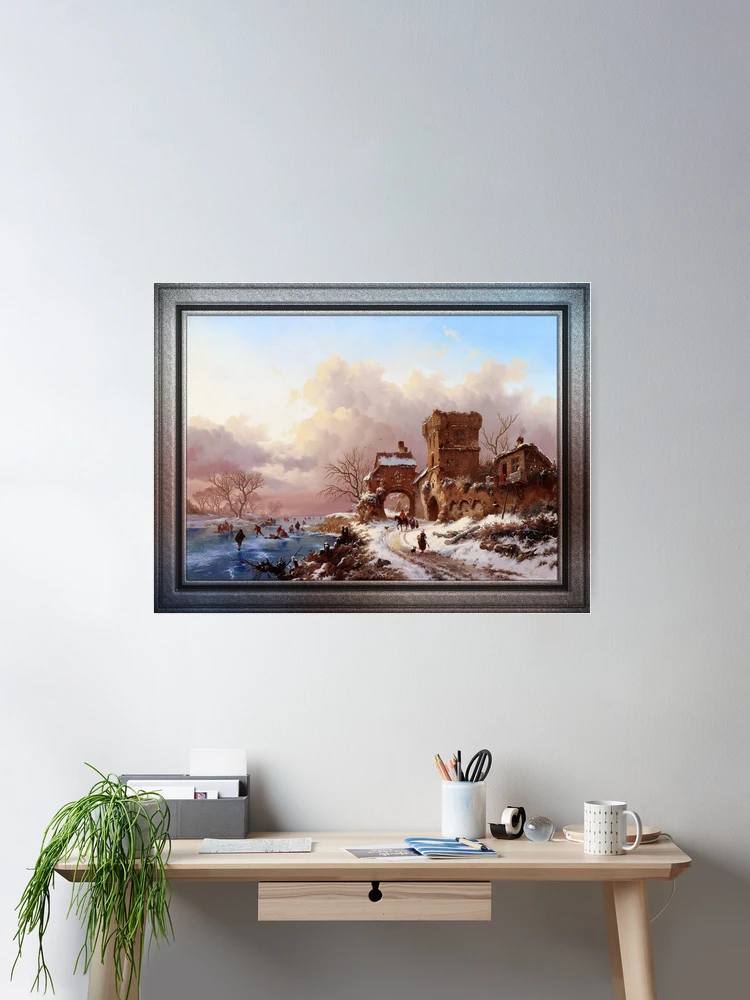
W Winter Landscape With Travelers Near The Town Gate, painted by Frederik Marinus Kruseman (1816 – 1882), the viewer is transported to a serene winter’s day in the 19th century, where the tranquility of the frozen landscape is punctuated by the movements of travelers. This stunning piece, dating from around 1857, exemplifies the Dutch Romanticism style, characterized by its detailed naturalistic approach, its emphasis on the landscape as both a subject of beauty and contemplation, and its carefully composed atmosphere. The artist presents a rich narrative of rural life in the cold months, capturing both the splendor and harshness of winter in a northern European town.
Spis treści
Główny temat i kompozycja
At the heart of the painting is a town gate, acting as the focal point of the composition. Ta struktura, grand and imposing, stands against the backdrop of a serene but somewhat desolate winter scene. The gate leads into a quaint village or town, which is implied but not directly shown in the artwork. On either side of the entrance, towering bare trees stretch their limbs into the cold air, their gnarled branches reaching out toward the sky, their starkness enhanced by the absence of leaves. These trees, mostly without foliage, evoke a sense of dormancy, signifying the depth of winter’s grip.
Just outside the town gate, the ground is blanketed in a layer of snow, its purity highlighted by the faint tinge of sunset light that reflects off its surface. The snow is soft and undisturbed near the gate, but as it stretches farther into the scene, the untouched white is interrupted by travelers on foot, creating dynamic movement within the otherwise still landscape.
Te liczby, bundled in winter coats and cloaks, traverse the icy terrain, their heads lowered against the cold wind, adding a sense of realism and humanity to the scene. The scene thus tells a story of daily life during winter, where travel and movement persist despite the frozen conditions.
Przedmioty i materiały
The painting’s attention to detail is evident in its depiction of materials. The stone structure of the town gate is textured and weathered, with intricate architectural features that reflect the period’s craftsmanship. The gate itself serves as a symbolic barrier between the bustling life of the town and the expansive, icy wilderness outside. The faint glow from the window of the building atop the gate hints at warmth within, contrasting the harsh cold of the outside world.
The snow is not just a passive element in the scene; Kruseman skillfully uses it to highlight the light effects of the setting sun. The snow, with its delicate, powdery texture, reflects the amber and pale colors of the sky, which gently fade into a soft pinkish hue near the horizon.
Woda, visible in the foreground, has a frozen sheen to it, allowing travelers and skaters to glide across its surface. There are figures visible on the ice, engaged in the sport of skating—a pastime synonymous with cold winters in the Low Countries during the 19th century. Liczby’ motion contrasts with the stillness of the trees and the looming town gate.
Terrain and Surroundings
Otaczający teren składa się z różnorodnych tekstur i warstw, od miękkiego śniegu pokrywającego ziemię po zamarzniętą rzekę na pierwszym planie, co dodaje scenie głębi i intrygi. Rzeka, częściowo zamrożone, odzwierciedla zachmurzone niebo powyżej, podczas gdy cienkie pęknięcia w lodzie wskazują na kruchą naturę zimowego krajobrazu. W oddali, na horyzoncie dominuje gasnące światło zachodu słońca, rzucając na scenę ciepły blask, który kontrastuje z chłodnymi odcieniami śniegu i lodu.
Zaśnieżona ścieżka prowadząca do bramy miejskiej jest oznaczona śladami podróżników, których ciemne postacie wyróżniają się na tle bladej ziemi. Ścieżka ta kieruje wzrok widza w stronę bramy, wzmacniając wrażenie ruchu w skądinąd cichej scenie. Kruseman captures the meticulous nature of winter in the Dutch countryside, using natural elements such as the icy river and leafless trees to convey the quiet solitude of the moment.
Styl i technika
Kruseman’s mastery of light and shadow is evident in this painting, as he effectively contrasts the warm tones of the sunset against the cooler shades of the winter landscape. The brushwork is delicate, with Kruseman’s attention to detail in the depiction of trees, snow, and architecture creating a harmonious balance between realism and artistic expression.
The artist’s use of light plays a significant role in setting the mood of the painting. Miękkie, diffused light suggests the end of a day, evoking a peaceful and contemplative atmosphere. The viewer is invited to imagine the quiet of the countryside as the sun sets, with the only sounds being the crunch of snow underfoot and the distant voices of the travelers.
The figures in the painting are rendered with a great deal of realism, with Kruseman capturing the naturalistic details of their clothing and movements. The traveler’s cloaks and hats evoke the practical fashion of the time, as they were meant to shield the wearer from the biting cold of winter. The posture of the travelers also adds a sense of realism—heads lowered against the wind, bodies slightly bent as they move through the snow.
Temat i nastrój
The predominant mood in Winter Landscape With Travelers Near The Town Gate is one of quiet solitude, tempered by the presence of life and motion. The scene captures the interplay between nature and humanity, showing how the people in the painting are subject to the forces of nature, yet continue to move forward despite the harsh winter conditions. There is a sense of resilience in the travelers’ purposeful strides, contrasting with the stillness of the frozen landscape.
This is a portrayal of a community enduring the winter season, yet finding a certain peacefulness within it. The town gate acts as both a literal and symbolic threshold, representing the boundary between the warmth and security of the town and the harshness of the world outside. The traveler’s presence suggests a world beyond the gate, one of movement and passage, yet still part of the larger natural landscape.
W istocie, Kruseman’s work reflects a deep reverence for the natural world, capturing the stark beauty of winter while also suggesting the enduring spirit of those who live within it. The painting invokes themes of endurance, upływ czasu, and the quiet beauty found in the often-overlooked details of daily life.
Winter Landscape With Travelers is a retouched digital art old masters reproduction of a public domain image.
To dzieło sztuki cyfrowej, podobnie jak wszystkie dzieła sztuki, które można znaleźć na stronie internetowej Xzendor7, można kupić online w różnych formatach materiałów, w tym odbitki na płótnie, wydruki akrylowe, metalowe nadruki, druki na drewnie, wydruki w ramkach, plakaty, oraz jako zwinięte wydruki na płótnie w różnych rozmiarach od 12 cale do 72 cale w zależności od rozmiaru rzeczywistej grafiki i sklepu z drukiem na żądanie, w którym zdecydujesz się kupić sztukę.
Grafika jest również dostępna na szerokiej gamie odzieży męskiej i damskiej, kubki, torby, szaliki, notesy i czasopisma oraz wiele produktów do dekoracji wnętrz.
O Artystce
Informacje poniżej pochodzą z Wikipedia.org
Frederik received his first drawing lessons from still life painter Jan Reekers (1790 – 1858), who at the time was Director of the Royal Acadamy of Fine Arts in Amsterdam; and who had also tutored his cousin Jan Adam[ while attending a vocational school in Haarlem from 1832 do 1833.
W 1833 he then began to study painting with Dutch Painter, Grawer, Lithographer, Akwarelista i ilustrator Nicolaas Johannes Roosenboom (1805 – 1880).
Następnie w 1835 przeniósł się do Het Gooi w centrum Holandii, gdzie odbył zaawansowane studia u holenderskiego malarza krajobrazu Jana van Ravenswaaya (1789 – 1869); a także krótkie studia u holenderskiego malarza krajobrazu i litografa Barenda Cornelisa Koekkoeka (1803 – 1862).
Później wrócił do Haarlemu, a stamtąd do Kleve w północno-zachodnich Niemczech, gdzie malował pejzaże, przed powrotem do domu w 1839.
W 1841 przeniósł się do Brukseli i pozostał tam do 1852, z wyjątkiem krótkiego okresu kilku miesięcy, kiedy wyjechał do Paryża. W 1852 wrócił do domu do Haarlemu i pozostał tam przez cztery lata, po czym wyjechał do Belgii, gdzie pozostał aż do śmierci w 1882.