

Witches Going To Their Sabbath
Witches Ascending: A Nightly Gathering in Falero’s Allegorical Vision
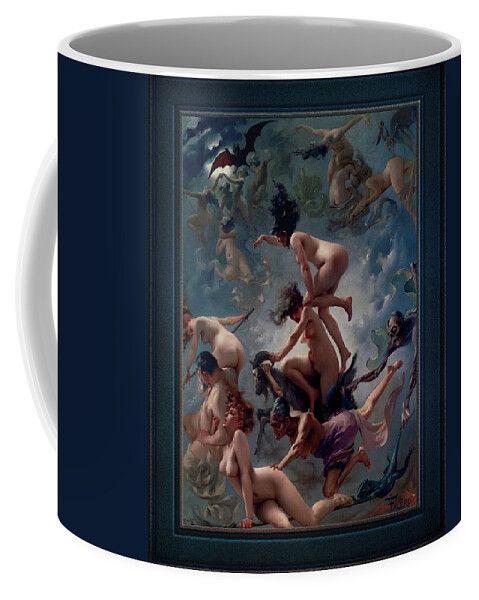
Witches Going to Their Sabbath c1878 by Luis Ricardo Falero’s (1851 – 1896), (also known as “The Departure of the Witches”), is a striking example of late 19th-century Spanish academic art. The work draws heavily from Romantic and Symbolist influences, depicting a fantastical scene of female figures ascending into a stormy night sky, presumably on their way to a witches’ sabbath. Falero’s painting isn’t merely a depiction of folklore; it is an exploration of the human imagination, temer, and the allure of the supernatural. The composition is dynamic and theatrical, prioritizing movement and dramatic effect over strict realism.
Índice
Estrutura Composicional & Narrative Flow
The artwork immediately draws the viewer into a swirling vortex of figures and clouds. The lower portion of the canvas depicts a chaotic gathering of nude women, some prostrate on the ground, others leaping or crawling towards the sky. This base layer establishes a sense of frenzied energy and unrestrained desire for upward movement. Above this tumultuous scene, several female forms are already airborne, suspenso em pleno voo em meio a nuvens rodopiantes e um céu noturno dramaticamente iluminado. A composição não é estática; sugere um processo contínuo de ascensão, com figuras em transição entre o reino terrestre e a expansão celestial.
O foco central é atraído para um azarão montado por uma figura que parece liderar a procissão. Esta figura, parcialmente obscurecido pela sombra, funciona como ponto focal, guiando as bruxas em direção ao seu destino. A trajetória ascendente da composição cria uma sensação de antecipação e mistério, convidando o espectador a contemplar a natureza deste encontro noturno.
Técnica Artística & Paleta de cores
A habilidade técnica de Falero é evidente na sua representação da forma humana e dos efeitos atmosféricos. Ele emprega uma técnica de claro-escuro – o uso dramático de luz e sombra – para aumentar a sensação de drama e mistério. As figuras são banhadas por um etéreo, brilho quase sobrenatural, contrastando com as sombras profundas que envolvem grande parte da cena. Esta interação de luz e escuridão enfatiza a natureza sobrenatural do assunto.
A paleta de cores é dominada por tons frios: blues, cinzas, e roxos, que contribuem para a atmosfera sombria e inquietante da pintura. Dicas de cores mais quentes – amarelos e laranjas – são estrategicamente colocadas para destacar figuras-chave e criar pontos de interesse visual. A pincelada do artista é solta e expressiva na parte inferior da tela, transmitindo uma sensação de caos e movimento, enquanto se torna mais refinado à medida que o olho sobe em direção ao céu.
Simbolismo & Interpretations
O simbolismo da pintura é rico e em camadas. As próprias bruxas representam não apenas figuras do folclore, mas também representações arquetípicas do poder feminino e da rebelião contra as normas sociais.. A sua nudez pode ser interpretada como uma rejeição das restrições convencionais e uma aceitação dos instintos primitivos.. O céu noturno tempestuoso simboliza as emoções turbulentas e as forças ocultas que impulsionam o comportamento humano.
O cavalo, frequentemente associado à selvageria e energia indomada, reforça ainda mais este tema de libertação e transformação. A presença de um morcego no canto superior esquerdo é outro símbolo tradicional de bruxaria e escuridão. A obra de Falero não oferece uma interpretação definitiva; em vez de, it invites viewers to engage with their own imaginations and draw their own conclusions about the meaning of the scene.

Contexto & Artistic Influences
Falero created “Witches Going to Their Sabbath” during a period when interest in folklore, mythology, and the occult was experiencing a resurgence in Europe. The painting reflects the influence of Romanticism, which emphasized emotion, imagination, and the sublime, as well as Symbolism, which sought to express abstract ideas through symbolic imagery. Artists like Francisco Goya, with his depictions of fantastical scenes and dark themes, likely influenced Falero’s artistic vision.
The academic art tradition, in which Falero was trained, prioritized technical skill and adherence to classical principles. No entanto, Falero’s painting transcends the limitations of academic convention by incorporating elements of fantasy and symbolism that were characteristic of more progressive artistic movements. The work stands as a testament to his ability to blend traditional techniques with innovative ideas.
Legado & Significance
“Witches Going to Their Sabbath” remains an intriguing and captivating artwork, admired for its dramatic composition, technical skill, and symbolic depth. It offers a glimpse into the cultural anxieties and imaginative preoccupations of 19th-century Europe, while also demonstrating Falero’s unique artistic talent. The painting continues to resonate with audiences today, inviting them to explore the enduring power of myth, folklore, and the human imagination.
Biografia do artista de Wikipédia.org
Falero nasceu em Granada e originalmente seguiu carreira na Marinha Espanhola, but gave it up to his parents’ disappointment. He traveled on foot to Paris, onde estudou arte, química e engenharia mecânica.
The experiments which he had to conduct in the latter two were dangerous, leading him to decide to focus on painting alone. He was a student of Gabriel Ferrier. Depois de Paris, he studied in London, where he eventually settled.
Falero tinha um interesse particular pela astronomia e incorporou constelações celestes em muitas de suas obras., como “O casamento de um cometa” e “Estrelas Gêmeas”. Seu interesse e conhecimento em astronomia também o levaram a ilustrar as obras de Camille Flammarion.
Em 1896, o ano de sua morte, Maud Harvey processou Falero por paternidade. O processo alegou que Falero seduziu Harvey quando ela era 17, primeiro servindo como sua empregada doméstica, and then model. Quando ele descobriu que ela estava grávida, ele a dispensou.
Ela ganhou o caso e recebeu cinco xelins por semana para sustentar seu filho. Falero morreu no University College Hospital, Londres, com a idade de 45
This is a retouched digital art old masters reproduction of a public domain image that you can purchase as a impressão em tela on-line.