

Nainen ja ruusut
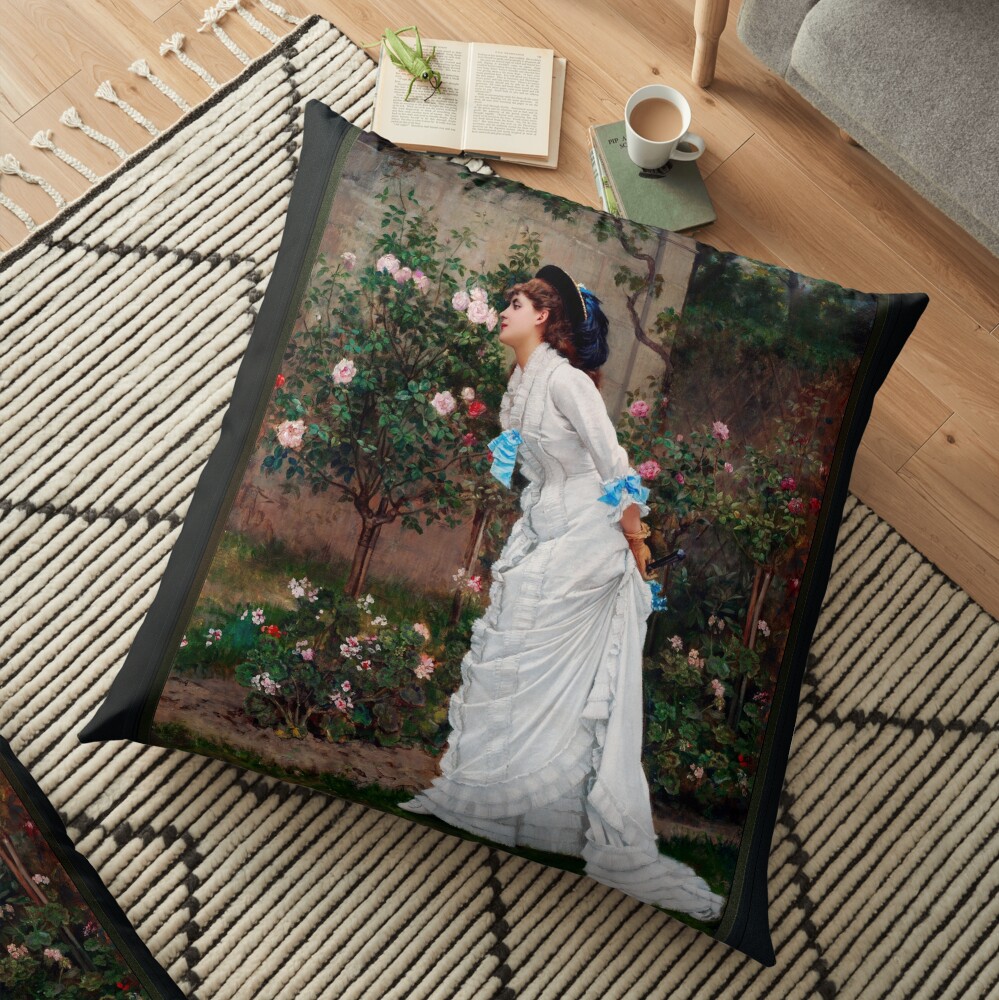
“Woman and Roses c1879” is a stunning example of the Romantic style, created by the French painter Auguste Toulmouche (1829 – 1890). The painting portrays a fashionable young woman of the late 19th century, carefully set against the backdrop of a lush, blooming rose garden. Toulmouche’s attention to detail and focus on realism captures both the delicacy of the woman and the vibrant beauty of the roses she admires, giving the viewer a moment of grace and elegance that reflects the ideals of beauty and femininity during the period.
Sisällysluettelo
Kohde ja koostumus
The subject of this genre painting is a young woman dressed in the fashionable attire of the late 1800s. Hänen tyylikäs valkoinen pukunsa on koristeltu runsaasti sinisillä nauhoilla, jotka korostavat virtaavaa kangasta, joka laskeutuu hänen jalkojensa ympärille. Puku on tyylikkäästi suunniteltu monimutkaisilla röyhelöillä ja kerroksilla, jotka korostavat ajan käsityötaitoa, paljastaa Toulmouchen erinomaisen huomion yksityiskohtiin. Nuoren naisen selkä on hieman kaareva, kun hän kumartuu kohti kukkivaa ruusupensaaa, hänen kasvonsa kallistuivat hellästi sivuun, lisäämällä hiljaisen mietiskelyn tunteen hänen asentoinsa.
Hänen asentonsa viittaa siihen, että hän on imeytynyt puutarhan kauneuteen, ehkä ihaillen häntä ympäröiviä tuoksuvia ruusuja. Tämä rauhallinen vuorovaikutus naisen ja kukkien välillä antaa harmonian ja rauhan tunteen. Taiteilija käyttää mestarillisesti valon ja varjon vuorovaikutusta tuodakseen kohtaukseen syvyyttä, erityisesti naisen mekon poimuissa ja auringonvalon herkässä leikissä hänen ihollaan, korostaa entisestään sävellyksen realistisuutta.
Maalauksen taustalla on klassinen puutarhaympäristö, eriväriset ja -kokoiset ruusut täyttävät tilan. Toulmouchen ruusuvalinta keskeiseksi kukkaelementiksi liittyy viktoriaaniseen kiehtomiseen symbolisella merkityksellä; ruusut yhdistettiin usein kauneuteen, rakkaus, ja naisellisuus. Taidemaalari asettelee kukat huolellisesti täydentämään naisen asua ja olemusta, tarjoaa saumattoman sekoituksen luontoa ja ihmisen läsnäoloa. Puutarhan kivimuurien lempeät linjat ja vehreys luovat hienovaraisuutta, mutta voimakas kontrasti ruusujen pehmeälle tekstuurille ja naisen herkälle muodolle.
Materiaalit ja tekniikka
Toulmouche’s painting technique is a testament to his skill in capturing the textures and subtleties of fabric, flesh, ja luonto. His use of oil paints enables him to create layers of depth and luminosity, particularly in the way the light interacts with the white gown and the varying hues of the roses. The brushwork is refined yet expressive, and each element of the composition – from the woman’s facial expression to the intricate details of the roses – is carefully rendered, showcasing the artist’s ability to bring life to each subject.
The textures in the painting are rich and varied. The woman’s gown is soft, with folds and creases that suggest the movement of the fabric, while the roses are vibrantly painted, with each petal carefully shaded to create the illusion of three-dimensionality. The background greenery and stone wall are painted in a more subdued manner, allowing the woman and the roses to take center stage, yet they still provide a rich and textured environment that enhances the overall scene.
Mieliala ja ilmapiiri
Mieliala “Woman and Roses” is one of tranquility, armo, and quiet contemplation. The young woman seems lost in thought as she admires the flowers, her slight smile suggesting a moment of peace in an otherwise busy world. The soft colors of the painting, particularly the whites and blues of the woman’s attire and the subtle hues of the roses, lend a serene quality to the scene, invoking feelings of calm and beauty. The natural setting further enhances this atmosphere, creating a moment where the viewer can pause and reflect upon the delicate balance between nature and humanity.
Toulmouche’s use of light also contributes significantly to the atmosphere of the painting. The warm sunlight gently illuminates the woman’s face and gown, highlighting her beauty while casting soft shadows that add depth to the composition. This attention to light creates a harmonious interplay between the figure, the flowers, and the surrounding greenery, giving the painting a sense of quiet elegance and timelessness.
Tyyli ja teemat
The painting exemplifies the Romantic style, a movement that celebrated the individual, the emotional, and the natural world. Toulmouche’s focus on a single, contemplative figure placed in a natural setting aligns with the Romantic fascination with introspection and the sublime beauty of nature. While his works often feature highly detailed depictions of women in refined attire, “Woman and Roses” also taps into a larger cultural fascination with the idealization of femininity during the 19th century.
The theme of beauty – both human and natural – is central to this work. Nainen, with her graceful demeanor and delicate features, embodies an idealized vision of femininity, while the roses symbolize love, passion, and nature’s eternal beauty. Toulmouche’s careful rendering of both the figure and the surrounding garden invites the viewer to appreciate the finer details of the world around them and to reflect on the harmony between human existence and the natural environment.
Johtopäätös
“Woman and Roses c1879” käyttäjältä Auguste Toulmouche is a quintessential example of Romanticism in art. With its serene and elegant portrayal of a fashionable woman in a rose garden, the painting captures both the beauty of the individual and the splendor of nature. Toulmouche’s mastery of light, rakenne, and detail creates a scene of quiet contemplation that resonates with viewers, offering them a timeless glimpse into the past.
Tämä on remasteroitu digitaalisen taiteen vanhojen mestareiden kopio julkisessa käytössä olevasta kuvasta, joka on saatavilla a kankaalle printti verkossa.
Alla olevat tiedot ovat peräisin Wikipedia.org
Auguste was born to the well established broker Émile Toulmouche and his wife Rose Sophie Mercier in Nantes, France on September 21, 1829.
He began his artistic studies locally, first studying sculpture with the French Academic sculptor and teacher Amédée Ménard (1806 -1873); and painting with the French Portraitist Biron, and then continuing his studies in 1846 wth the Swiss Painter Marc Gabriel Charles Gleyre (1806 – 1874) Pariisissa.
Iässä 19 Auguste exhibited hos first paintings at the Paris Salon in 1848 and then again in 1849 ja 1850, by which time he was specializing in portraiture; painting an idealized version of the Academic Realist style which at the time was the dominant painting style.
The subjects of his portraits were most of young attractive Parisian women that were members of the upper bourgeoisie class; and his work was most popular with the French and American public and his worked was generally approved by the critics of the time.
Sisään 1852 Emperor Napoleon III (1808 – 1873) osti yhden maalauksistaan nimeltä La Fille tai The Girl tulevalle vaimolleen keisarinna Eugénie de Montijo (1826 – 1920), ja keisarillinen perhe ostaa lisää hänen töitään, vahvisti asemansa muodikkaana maalarina.