

Woman with Lily
Woman with Lily by American Lithographer Louis Prang (1824 – 1909)
Listaverkið sem heitir “Woman with Lily” was created by American lithographer Louis Prang, fæddur í 1824 og gengur inn 1909. Litógrafið, produced in the late 19th century, exemplifies Prang’s mastery in the detailed and vibrant portrayal of figures in the delicate style typical of the Victorian era. The image portrays a young woman holding a lily, and this piece was part of the popular genre of fine art lithography that Prang specialized in. Known for his skill in the medium of chromolithography, Prang’s work sought to combine naturalism with an idealized form of beauty, creating images that appealed to a wide audience at the time.
Efnisyfirlit
Aðalefni og samsetning
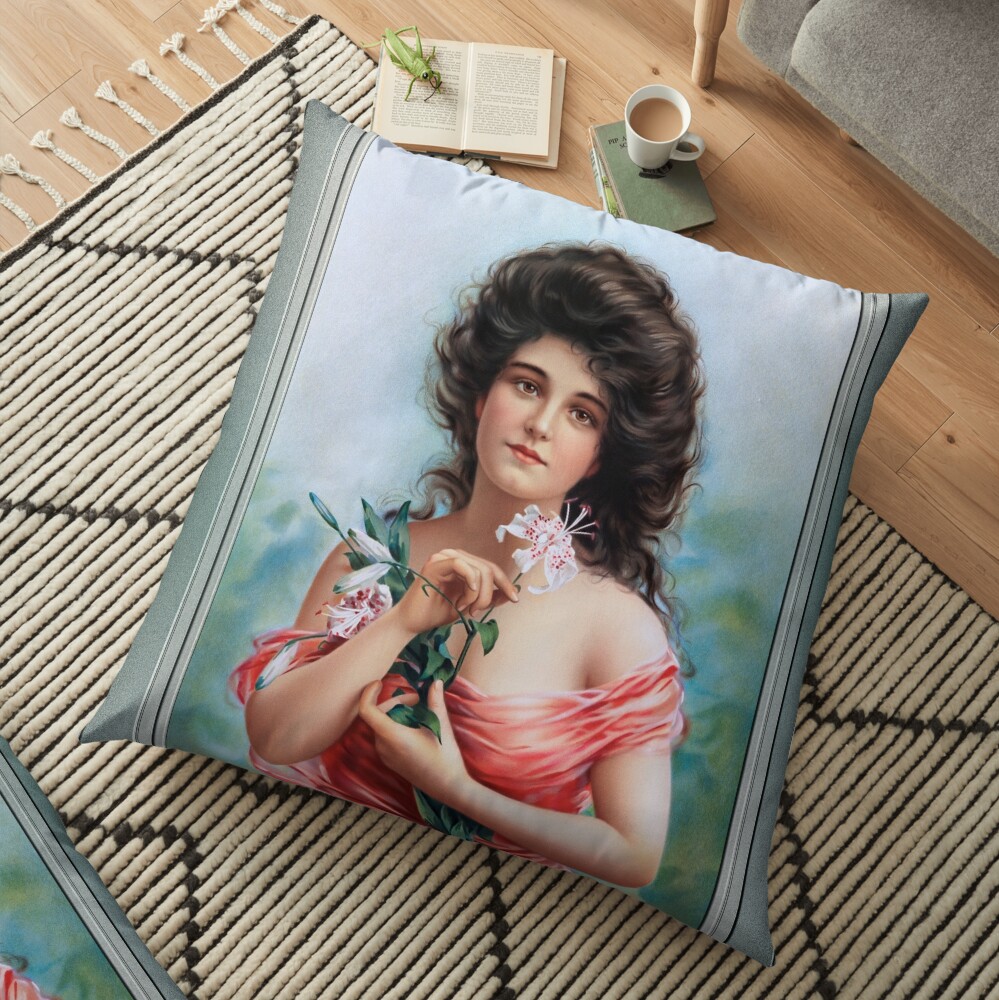
The central subject of the artwork is a young woman, portrayed with a serene and gentle expression. She is depicted in a soft, flowing pink dress, which contrasts beautifully with the green foliage surrounding her. The woman gazes softly at the viewer, her brown eyes exuding a sense of quiet grace and elegance. Her flowing dark hair is styled in a natural yet polished manner, with soft curls framing her face. Her posture is poised and elegant, as she gently holds a large lily in her right hand. The lily is a key feature of the composition, symbolizing purity and innocence, and its delicate white petals contrast with the soft hues of the woman’s dress and the surrounding background.
The background of the lithograph is a soft blend of light greens and blues, suggesting a tranquil outdoor scene. While the terrain is not explicitly detailed, the hazy green tones give the impression of a lush, náttúrulegt umhverfi. The overall composition is balanced and harmonious, with the woman’s figure positioned centrally within the frame, making her the undeniable focal point. The arrangement emphasizes her graceful demeanor, with her slightly tilted head and gentle hands reinforcing a sense of delicacy and refinement.
Stíll og tækni
Prang’s lithographic technique is evident in the fine detail and vibrant color palette used throughout the piece. The subtle gradients in the woman’s dress, from light pink to deeper rose tones, highlight Prang’s skill in creating depth and dimension. The artist uses delicate shading to suggest the volume and texture of the fabric, adding to the realism of the portrait. The folds in her dress are softly rendered, mimicking the natural flow of the material.
The portrayal of light and shadow is another notable element of the artwork. The light source appears to come from the upper left, casting a soft glow on the woman’s face and arms. This highlights her skin’s smooth, porcelain-like quality and contrasts with the darker tones of the background and her dress. The light touches the lily as well, emphasizing its white petals against the soft pink of the woman’s attire.
Prang’s skillful use of color also adds to the overall mood of the piece. The softness of the pink dress, combined with the lush greenery and blue tones of the background, creates an atmosphere of tranquility and calm. Litirnir, though bright, viðhalda tilfinningu um náttúrulega mýkt, forðast harðar andstæður sem gætu truflað blíða andrúmsloftið. Þaggaðir grænir og bláir bakgrunnurinn eykur enn æðruleysið, eins og verið sé að flytja áhorfandann inn í friðsælt, idyllískum heimi.
Þema og stemning
Þemað í “Woman with Lily” er ein af sakleysi, hreinleiki, og náttúrufegurð. Unga konan, með fíngerðum svipum sínum og tignarlegu líkamsstöðu, felur í sér kvenleikahugsjónir sem voru í hávegum hafðar seint á 19. öld. Liljan, tákn um hreinleika og dyggð, styrkir þetta þema, skapa tilfinningu fyrir samræmi milli myndarinnar og náttúrunnar í kringum hana. Það er lúmsk vísbending um tímaleysi í listaverkinu, þar sem konan er ekki bundin af ákveðnu tímabili eða umhverfi, en í staðinn táknar alhliða tákn kvenlegrar náðar og fegurðar.
Stemning listaverksins er ró og æðruleysi. Mjúku litirnir, mildur svipur konunnar, og viðkvæma blómaþátturinn stuðlar allt að friðsælu, nánast draumkennd andrúmsloft. Áhorfandinn er dreginn inn í myndina ekki af dramatískri frásögn, en af hljóðlátum glæsileika myndarinnar og kyrrlátu umhverfinu sem hún er sett í. Lítil svipbrigði konunnar, með enga greinanlega tilfinningu nema mjúka, rólegt augnaráð, býður áhorfandanum að umgangast hana á íhugulan hátt, sem bendir til þess að hin sanna fegurð verksins liggi ekki í stórum látbragði eða aðgerðum, en í rólegheitunum, þokkafull nærvera viðfangsefnisins.
Materials and Execution
Litógrafið var útfært með mikilli athygli á smáatriðum, aðalsmerki verka Louis Prang. Lithography involves drawing on a stone or metal surface with a greasy substance and then transferring the image onto paper. The artist’s precise line work and careful application of color demonstrate his mastery of this technique. In Prang’s era, chromolithography was a popular method for producing vibrant, colored prints, and his ability to use color to enhance the mood and emotion of his pieces was highly regarded.
The quality of the lithograph suggests that it was printed on high-quality paper, a medium that allows for rich, líflega liti. The paper’s texture is likely smooth, providing an ideal surface for the fine details of the woman’s features and the delicate rendering of the lily. The framing of the piece in the image adds to its overall effect, með íburðarmiklum ramma sem styrkja tilfinninguna fyrir fágun og fegurð sem listaverkið miðlar.
Niðurstaða
“Woman with Lily” eftir Louis Prang er fallegt dæmi um litógrafík á 19. öld, sýna hæfileika listamannsins á litum og smáatriðum. Verkið sýnir kyrrláta og tímalausa mynd af kvenlegri fegurð, fanga fíngerða þokka ungrar konu innan um mjúka, idyllískur bakgrunnur. Með því að nota líflega en milda liti, fíngerð skygging, og vandað samsetning, Prang skapar mynd sem vekur tilfinningar um ró, hreinleiki, og hljóðlátur glæsileiki. Verkið er ekki aðeins vitnisburður um tæknilega færni Prang heldur einnig útfærsla á hugsjónum kvenleika og fegurðar sem var fagnað á Viktoríutímanum..
Woman with Lily is a remastered digital art old masters reproduction of a public domain image that is available as a strigaprentun á netinu.
Um Listamanninn
Upplýsingar hér að neðan fengnar úr Wikipedia.org
Louis was the son of a textile manufacturer was born in Breslau in Prussian Silesia (now Southwestern Poland) inn 1824 to Jonas Louis Prang of French Huguenot origin, and Rosina Silverman, who was German.
As a boy Louis became an apprentice to his father and learned the skills of engraving and calico dyeing and printing, og af 1840 traveled to Bohemia, in the Czech Republic working with companies that produced prints and textiles.
He also traveled throughout Europe and in 1848 found himself in a bit of trouble getting involved in the March Revolutions ot the German Revolutions of 1848-49; which resulted in the establishment of the German State and the introduction of a Liberal Constitution.
With the Prussian government hot on his heels he traveled to Switzerland in 1850 and then emigrated to the United States; settling in Boston, Massachusetts.
Í 1856 Louis along with a partner created a press company called Prang and Mayer, that produced lithographs; with a specialty in producing prints of building and towns in Massachusetts; and four years later brought out Mayer and changed the name of the company to L. Prang & Company.
The new company began work in color printing, producing advertisements and other forms of business material; and became quite successful, being known for the war maps that were distributed by newspapers during the American Civil War (1861 – 1865).
Í 1864, Louis decided to leave America and travel back to Europe to learn what was then the cutting edge of German lithography printing; and upon returning home the following year, he began to produce high quality reproduction of major works of art.
He also began producing a series of album card which became quite popular, that were advertised as collectibles for scrapbooks, that depicted natural scenes and patriotic symbols; þá inn 1873 he began producing greeting cards for the popular market in Britain and a year later, Christmas Card in America.
Louis Prang is also known for is effort in improving art education in the United States and fro creating and publishing instructional art books; as well as creating a foundation to train art teachers.