

Vrouw met Lelie
Vrouw met lelie door de Amerikaanse lithograaf Louis Prang (1824 – 1909)
Het kunstwerk getiteld “Vrouw met Lelie” was created by American lithographer Louis Prang, geboren in 1824 en passeren 1909. The lithograph, produced in the late 19th century, exemplifies Prang’s mastery in the detailed and vibrant portrayal of figures in the delicate style typical of the Victorian era. The image portrays a young woman holding a lily, and this piece was part of the popular genre of fine art lithography that Prang specialized in. Known for his skill in the medium of chromolithography, Prang’s work sought to combine naturalism with an idealized form of beauty, creating images that appealed to a wide audience at the time.
Inhoudsopgave
Hoofdonderwerp en compositie
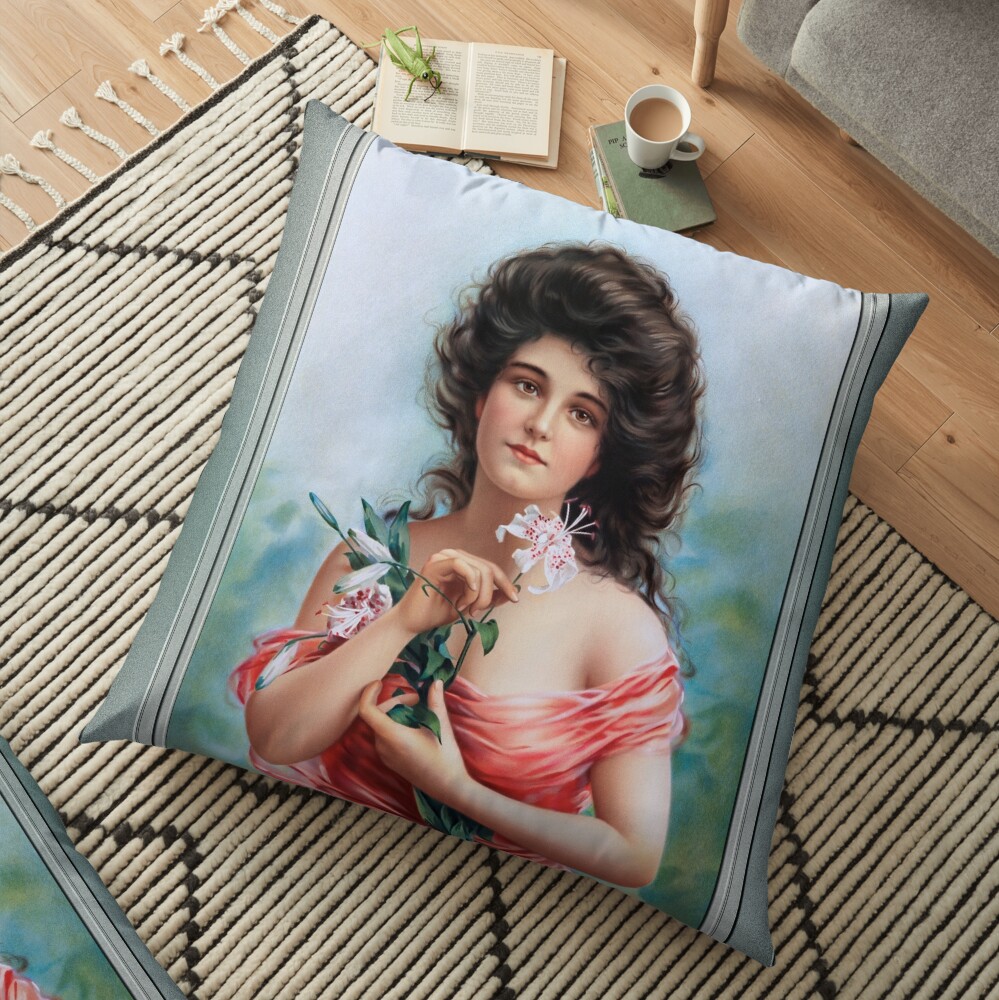
The central subject of the artwork is a young woman, portrayed with a serene and gentle expression. She is depicted in a soft, flowing pink dress, which contrasts beautifully with the green foliage surrounding her. The woman gazes softly at the viewer, her brown eyes exuding a sense of quiet grace and elegance. Her flowing dark hair is styled in a natural yet polished manner, with soft curls framing her face. Her posture is poised and elegant, as she gently holds a large lily in her right hand. The lily is a key feature of the composition, symbolizing purity and innocence, and its delicate white petals contrast with the soft hues of the woman’s dress and the surrounding background.
The background of the lithograph is a soft blend of light greens and blues, suggesting a tranquil outdoor scene. While the terrain is not explicitly detailed, the hazy green tones give the impression of a lush, natural setting. The overall composition is balanced and harmonious, with the woman’s figure positioned centrally within the frame, making her the undeniable focal point. The arrangement emphasizes her graceful demeanor, with her slightly tilted head and gentle hands reinforcing a sense of delicacy and refinement.
Stijl en techniek
Prang’s lithographic technique is evident in the fine detail and vibrant color palette used throughout the piece. The subtle gradients in the woman’s dress, from light pink to deeper rose tones, highlight Prang’s skill in creating depth and dimension. The artist uses delicate shading to suggest the volume and texture of the fabric, adding to the realism of the portrait. The folds in her dress are softly rendered, mimicking the natural flow of the material.
The portrayal of light and shadow is another notable element of the artwork. The light source appears to come from the upper left, casting a soft glow on the woman’s face and arms. This highlights her skin’s smooth, porcelain-like quality and contrasts with the darker tones of the background and her dress. The light touches the lily as well, emphasizing its white petals against the soft pink of the woman’s attire.
Prang’s skillful use of color also adds to the overall mood of the piece. The softness of the pink dress, combined with the lush greenery and blue tones of the background, creates an atmosphere of tranquility and calm. De kleuren, though bright, maintain a sense of natural softness, avoiding harsh contrasts that might disrupt the gentle atmosphere. The muted greens and blues of the background further enhance the sense of serenity, as if the viewer is being transported into a peaceful, idyllic world.
Thema en stemming
Het thema van “Vrouw met Lelie” is one of innocence, zuiverheid, and natural beauty. De jonge vrouw, with her delicate features and graceful posture, embodies the ideals of femininity that were highly regarded in the late 19th century. The lily, a symbol of purity and virtue, reinforces this theme, creating a sense of harmony between the figure and the natural world around her. There is a subtle suggestion of timelessness in the artwork, as the woman is not bound by a particular time period or setting, but instead represents a universal symbol of feminine grace and beauty.
The mood of the artwork is one of calm and serenity. The soft colors, the woman’s gentle expression, and the delicate floral element all contribute to a peaceful, bijna droomachtige sfeer. The viewer is drawn into the image not by a dramatic narrative, but by the quiet elegance of the figure and the serene environment in which she is placed. The woman’s subtle expression, with no discernible emotion other than a soft, tranquil gaze, invites the viewer to engage with her in a contemplative way, suggesting that the true beauty of the piece lies not in grand gestures or action, but in the quiet, graceful presence of the subject.
Materialen en uitvoering
The lithograph was executed with great attention to detail, a hallmark of Louis Prang’s work. Lithography involves drawing on a stone or metal surface with a greasy substance and then transferring the image onto paper. The artist’s precise line work and careful application of color demonstrate his mastery of this technique. In Prang’s era, chromolithography was a popular method for producing vibrant, colored prints, and his ability to use color to enhance the mood and emotion of his pieces was highly regarded.
The quality of the lithograph suggests that it was printed on high-quality paper, a medium that allows for rich, levendige kleuren. The paper’s texture is likely smooth, providing an ideal surface for the fine details of the woman’s features and the delicate rendering of the lily. The framing of the piece in the image adds to its overall effect, with the ornate border reinforcing the sense of refinement and beauty that the artwork conveys.
Conclusie
“Vrouw met Lelie” by Louis Prang is a beautiful example of 19th-century lithographic art, showcasing the artist’s mastery of color and detail. The piece presents a serene and timeless portrait of feminine beauty, capturing the delicate grace of a young woman amidst a soft, idyllic background. Through the use of vibrant yet gentle colors, subtle shading, and a careful composition, Prang creates an image that evokes feelings of calm, zuiverheid, and quiet elegance. The work is not only a testament to Prang’s technical skill but also an embodiment of the ideals of femininity and beauty that were celebrated in the Victorian era.
Woman with Lily is een geremasterde digitale kunstreproductie van oude meesters van een afbeelding uit het publieke domein die beschikbaar is als canvas print online.
Over de kunstenaar
Onderstaande informatie afgeleid van: Wikipedia.org
Louis was de zoon van een textielfabrikant en werd geboren in Breslau in Pruisisch Silezië (nu Zuidwest-Polen) in 1824 aan Jonas Louis Prang van Franse hugenootse afkomst, en Rosina Zilverman, die Duitser was.
Als jongen werd Louis een leerling van zijn vader en leerde hij de vaardigheden van graveren, calicoverven en drukken, en bij 1840 reisde naar Bohemen, in Tsjechië werkten ze samen met bedrijven die prints en textiel produceerden.
Hij reisde ook door heel Europa en in 1848 merkte dat hij wat problemen ondervond toen hij betrokken raakte bij de Maartrevoluties of de Duitse Revoluties van 1848-49; wat resulteerde in de oprichting van de Duitse staat en de introductie van een liberale grondwet.
Met de Pruisische regering op de hielen reisde hij naar Zwitserland 1850 en emigreerde vervolgens naar de Verenigde Staten; zich in Boston vestigen, Massachusetts.
In 1856 Louis richtte samen met een partner een persbedrijf op genaamd Prang en Mayer, die litho's produceerde; met een specialiteit in het maken van afdrukken van gebouwen en steden in Massachusetts; en vier jaar later bracht Mayer uit en veranderde de naam van het bedrijf in L. Prang & Bedrijf.
Het nieuwe bedrijf begon te werken in kleurendruk, het produceren van advertenties en andere vormen van zakelijk materiaal; en werd behoorlijk succesvol, bekend om de oorlogskaarten die tijdens de Amerikaanse Burgeroorlog door kranten werden verspreid (1861 – 1865).
In 1864, Louis besloot Amerika te verlaten en terug te reizen naar Europa om te leren wat toen het allernieuwste was op het gebied van de Duitse lithografie; en bij thuiskomst het volgende jaar, hij begon hoogwaardige reproducties van belangrijke kunstwerken te produceren.
Hij begon ook met het produceren van een serie albumkaarten die behoorlijk populair werden, die werden geadverteerd als verzamelobjecten voor plakboeken, die natuurlijke taferelen en patriottische symbolen afbeeldden; dan in 1873 hij begon met het produceren van wenskaarten voor de populaire markt in Groot-Brittannië en een jaar later, Kerstkaart in Amerika.
Louis Prang staat ook bekend om zijn inspanningen om het kunstonderwijs in de Verenigde Staten te verbeteren en om educatieve kunstboeken te maken en te publiceren; evenals het creëren van een stichting om kunstdocenten op te leiden.