

Kvinne med Lily
Woman with Lily av den amerikanske litografen Louis Prang (1824 – 1909)
Kunstverket med tittelen “Kvinne med Lily” ble skapt av den amerikanske litografen Louis Prang, født i 1824 og passerer inn 1909. Litografien, produsert på slutten av 1800-tallet, eksemplifiserer Prangs mestring i den detaljerte og levende skildringen av figurer i den delikate stilen som er typisk for viktoriansk tid. Bildet viser en ung kvinne som holder en lilje, og dette stykket var en del av den populære sjangeren av kunstlitografi som Prang spesialiserte seg på. Kjent for sin dyktighet innen kromolitografi, Prangs arbeid forsøkte å kombinere naturalisme med en idealisert form for skjønnhet, skape bilder som appellerte til et bredt publikum på den tiden.
Innholdsfortegnelse
Hovedfag og komposisjon
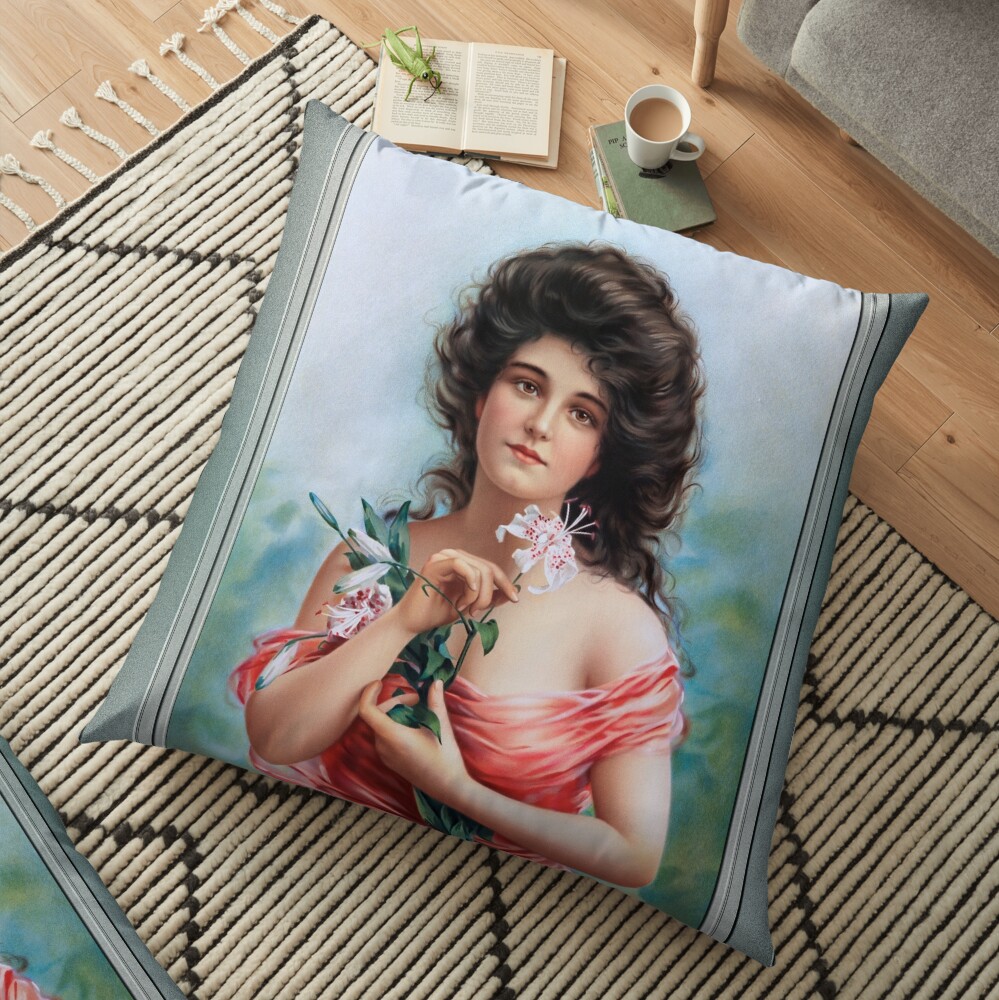
The central subject of the artwork is a young woman, portrayed with a serene and gentle expression. She is depicted in a soft, flowing pink dress, which contrasts beautifully with the green foliage surrounding her. The woman gazes softly at the viewer, her brown eyes exuding a sense of quiet grace and elegance. Her flowing dark hair is styled in a natural yet polished manner, with soft curls framing her face. Her posture is poised and elegant, as she gently holds a large lily in her right hand. The lily is a key feature of the composition, symbolizing purity and innocence, and its delicate white petals contrast with the soft hues of the woman’s dress and the surrounding background.
The background of the lithograph is a soft blend of light greens and blues, suggesting a tranquil outdoor scene. While the terrain is not explicitly detailed, the hazy green tones give the impression of a lush, natural setting. The overall composition is balanced and harmonious, with the woman’s figure positioned centrally within the frame, making her the undeniable focal point. The arrangement emphasizes her graceful demeanor, with her slightly tilted head and gentle hands reinforcing a sense of delicacy and refinement.
Stil og teknikk
Prang’s lithographic technique is evident in the fine detail and vibrant color palette used throughout the piece. The subtle gradients in the woman’s dress, from light pink to deeper rose tones, highlight Prang’s skill in creating depth and dimension. The artist uses delicate shading to suggest the volume and texture of the fabric, adding to the realism of the portrait. The folds in her dress are softly rendered, mimicking the natural flow of the material.
The portrayal of light and shadow is another notable element of the artwork. The light source appears to come from the upper left, casting a soft glow on the woman’s face and arms. This highlights her skin’s smooth, porcelain-like quality and contrasts with the darker tones of the background and her dress. The light touches the lily as well, emphasizing its white petals against the soft pink of the woman’s attire.
Prang’s skillful use of color also adds to the overall mood of the piece. The softness of the pink dress, combined with the lush greenery and blue tones of the background, creates an atmosphere of tranquility and calm. Fargene, though bright, maintain a sense of natural softness, unngå harde kontraster som kan forstyrre den milde atmosfæren. De dempede grønne og blå fargene i bakgrunnen forsterker følelsen av ro ytterligere, som om betrakteren blir transportert inn i en fredelig, idyllisk verden.
Tema og stemning
Temaet for “Kvinne med Lily” er en av uskyld, renhet, og naturlig skjønnhet. Den unge kvinnen, med hennes delikate trekk og grasiøse holdning, legemliggjør idealene om femininitet som ble høyt ansett på slutten av 1800-tallet. Liljen, et symbol på renhet og dyd, forsterker dette temaet, skaper en følelse av harmoni mellom figuren og den naturlige verden rundt henne. Det er en subtil antydning av tidløshet i kunstverket, da kvinnen ikke er bundet av en bestemt tidsperiode eller setting, men representerer i stedet et universelt symbol på feminin ynde og skjønnhet.
Stemningen i kunstverket er en av ro og stillhet. The soft colors, the woman’s gentle expression, and the delicate floral element all contribute to a peaceful, nesten drømmeaktig atmosfære. The viewer is drawn into the image not by a dramatic narrative, but by the quiet elegance of the figure and the serene environment in which she is placed. The woman’s subtle expression, with no discernible emotion other than a soft, tranquil gaze, invites the viewer to engage with her in a contemplative way, suggesting that the true beauty of the piece lies not in grand gestures or action, but in the quiet, graceful presence of the subject.
Materialer og utførelse
The lithograph was executed with great attention to detail, a hallmark of Louis Prang’s work. Lithography involves drawing on a stone or metal surface with a greasy substance and then transferring the image onto paper. The artist’s precise line work and careful application of color demonstrate his mastery of this technique. In Prang’s era, chromolithography was a popular method for producing vibrant, colored prints, and his ability to use color to enhance the mood and emotion of his pieces was highly regarded.
The quality of the lithograph suggests that it was printed on high-quality paper, a medium that allows for rich, livlige farger. The paper’s texture is likely smooth, providing an ideal surface for the fine details of the woman’s features and the delicate rendering of the lily. The framing of the piece in the image adds to its overall effect, with the ornate border reinforcing the sense of refinement and beauty that the artwork conveys.
Konklusjon
“Kvinne med Lily” by Louis Prang is a beautiful example of 19th-century lithographic art, showcasing the artist’s mastery of color and detail. The piece presents a serene and timeless portrait of feminine beauty, capturing the delicate grace of a young woman amidst a soft, idyllic background. Through the use of vibrant yet gentle colors, subtle shading, and a careful composition, Prang creates an image that evokes feelings of calm, renhet, and quiet elegance. The work is not only a testament to Prang’s technical skill but also an embodiment of the ideals of femininity and beauty that were celebrated in the Victorian era.
Woman with Lily is a remastered digital art old masters reproduction of a public domain image that is available as a lerretstrykk online.
Om kunstneren
bobler Wikipedia.org
Louis was the son of a textile manufacturer was born in Breslau in Prussian Silesia (now Southwestern Poland) i 1824 to Jonas Louis Prang of French Huguenot origin, and Rosina Silverman, who was German.
As a boy Louis became an apprentice to his father and learned the skills of engraving and calico dyeing and printing, og av 1840 traveled to Bohemia, in the Czech Republic working with companies that produced prints and textiles.
He also traveled throughout Europe and in 1848 found himself in a bit of trouble getting involved in the March Revolutions ot the German Revolutions of 1848-49; which resulted in the establishment of the German State and the introduction of a Liberal Constitution.
With the Prussian government hot on his heels he traveled to Switzerland in 1850 and then emigrated to the United States; settling in Boston, Massachusetts.
I 1856 Louis along with a partner created a press company called Prang and Mayer, that produced lithographs; with a specialty in producing prints of building and towns in Massachusetts; and four years later brought out Mayer and changed the name of the company to L. Prang & Company.
The new company began work in color printing, producing advertisements and other forms of business material; and became quite successful, being known for the war maps that were distributed by newspapers during the American Civil War (1861 – 1865).
I 1864, Louis decided to leave America and travel back to Europe to learn what was then the cutting edge of German lithography printing; and upon returning home the following year, he began to produce high quality reproduction of major works of art.
He also began producing a series of album card which became quite popular, that were advertised as collectibles for scrapbooks, that depicted natural scenes and patriotic symbols; deretter inn 1873 he began producing greeting cards for the popular market in Britain and a year later, Christmas Card in America.
Louis Prang is also known for is effort in improving art education in the United States and fro creating and publishing instructional art books; as well as creating a foundation to train art teachers.