

Cailín Óg Ag Bailiú Uisce Ag An Fountain
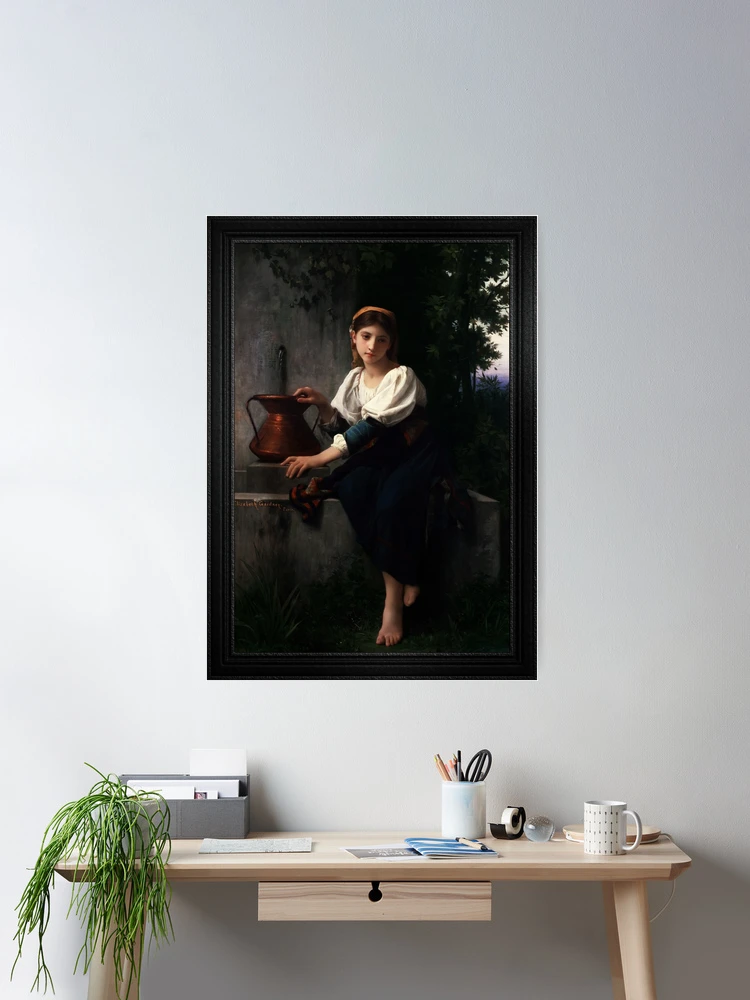
“Cailín Óg ag Bailiú Uisce ag an bhFountain” is péintéireacht mhealltach é a chruthaigh an t-ealaíontóir Meiriceánach Elizabeth Jane Gardner Bouguereau ag deireadh an 19ú haois. Gardner, rugadh i 1837 agus bás i 1922, duine mór le rá sa réalachas acadúil, agus léiríonn an píosa seo a máistreacht ar an bhfoirm dhaonna, solas nádúrtha, agus léiriú íogair. Suite i dtimpeallacht idyllic lasmuigh, Léiríonn an saothar ealaíne seo an nóiméad ina bhfuil cailín óg ag idirghníomhú le scairdeán, ábhar coitianta in ealaín na 19ú haois a thugann téamaí na hóige chun solais, neamhchiontacht, agus nádúr.
Clár na nÁbhar
Ábhar agus Comhdhéanamh
Is é ábhar lárnach na péintéireachta seo ná a cailín óg ina shuí in aice le tobair. Tá sí suite go deas ar imeall imchuach cloiche, with one hand resting on the surface of the fountain while the other gently holds a copper water jug. Her posture is relaxed, yet purposeful, as if she is caught in the moment between tasks. The girl’s face is tender and serene, conveying an expression of quiet contemplation as she gazes off into the distance. The viewer is drawn to her gentle beauty, which is enhanced by her delicate features, including soft, smooth skin and deep, reflective eyes.
Her attire is typical of the period, featuring a loose white blouse with billowing sleeves, paired with a rich blue skirt. This simple but elegant outfit contrasts with the more intricate details of her accessories. A reddish-brown sash is tied around her waist, and a headscarf, worn in a loose knot, frames her face and adds a touch of rustic charm to her appearance. The fabric of her clothing is painted with exquisite attention to detail, capturing the soft texture of linen and wool. The artist’s precision in rendering the clothing emphasizes her technical skill, a hallmark of Gardner’s realist approach.
The girl’s bare feet are casually positioned on the stone surface, further emphasizing the natural setting and the simplicity of rural life. This focus on unadorned, natural beauty is consistent with Bouguereau’s style, which often celebrated the purity and grace of youth in rural settings.
Rudaí agus siombalachas
The objects within the scene play an important role in reinforcing the themes of domestic life, nádúr, and labor. The fountain itself is a key element of the composition, agus tugann a láithreacht le fios timthriall na dtascanna laethúla a ghlacann an cailín óg páirt iontu. Uisce, acmhainn riachtanach i saol na tuaithe, siombail an saol féin. Rud suntasach eile sa phictiúr is ea an crúiscín copair atá aici. Ba ábhar coitianta é copar a úsáideadh le haghaidh uirlisí tí i rith an ama, agus cuireann frithchaitheamh solais ar a dhromchla doimhneacht leis an saothar ealaíne. Feidhmíonn an crúiscín mar mheafar caolchúiseach do ról an chailín sa teach, chomh maith lena ceangal leis an dúlra agus leis an talamh.
Is struchtúr cloiche simplí é an tobair, le huisce ag sileadh go réidh as an gob. Is beag nach raibh fuaim an uisce ag rith isteach san imchuach le cloisteáil ó shocair an phictiúir. Cuireann úsáid uisce atá ag sileadh gné ghluaiseachta leis an radharc síochánta ar shlí eile. The surrounding environment features lush greenery, with ivy climbing the stone backdrop. The foliage and the light, dappled through the trees, lend the setting a serene and natural feel. The artist’s careful rendering of the plant life in the background conveys a sense of harmony between the young girl and the landscape.
Tír -raon agus cúlra
The terrain in “Cailín Óg ag Bailiú Uisce ag an bhFountain” is a picturesque and tranquil rural setting. The backdrop features a stone wall with trailing ivy that suggests a weathered, natural environment. The foliage surrounding the fountain includes rich greens and subtle earth tones, with the detailed rendering of each leaf and vine enhancing the depth of the scene.
I gcéin, the landscape fades into a soft horizon where the sky meets a distant body of water or a continuation of lush countryside, creating a sense of vastness beyond the scene. The artist uses soft gradients of color in the background to evoke the warmth of sunlight filtering through the trees, casting a gentle glow across the girl’s face and surroundings.
Gardner Bouguereau’s choice of landscape highlights a sense of peace and simplicity, reflecting a rural life untouched by the noise of urban society. The calm, natural setting reinforces the mood of tranquility and timelessness, making the scene feel both intimate and universal. The detailed texture of the stone and the foliage contrasts beautifully with the smoothness of the girl’s skin and the flowing nature of her attire, creating a balance of solidity and fluidity within the painting.
Stíl agus Teicníc Ealaíne
As with many of her works, Elizabeth Jane Gardner Bouguereau employed a highly refined and meticulous style in “Young Girl Gathering Water at the Fountain.” Her use of light and shadow is particularly noteworthy, as it serves to model the forms of the figures and create a sense of depth within the composition. The gentle diffusion of light across the girl’s face and clothing enhances the realism of the scene and brings an almost photographic quality to the work.
Gardner Bouguereau was influenced by the academic tradition of French realism, which emphasized the accurate and detailed portrayal of human figures, particularly in outdoor settings. Her mastery of flesh tones and the representation of the human form is on full display in this painting. The careful attention to anatomical detail, such as the subtle play of light across the girl’s face and body, reveals the artist’s technical prowess. Her ability to capture the texture of fabrics and the reflective quality of light on surfaces is one of the defining aspects of her work, and it is especially evident in this painting.
Meon agus Téama
The mood of the painting is one of peaceful contemplation, with an undercurrent of nostalgia for a simpler time. The scene evokes a sense of harmony between the figure and the natural world, reinforcing the connection between youth, neamhchiontacht, agus nádúr. The girl, seated at the fountain, represents an archetype of rural life, embodying the purity and grace that were highly regarded in academic realism. The simplicity of her task – gathering water – reflects the importance of domestic chores and the relationship between humans and the land.
The overall theme of the painting is one of timelessness. The young girl and her actions transcend any specific era or place, representing universal values of youth, simplicity, and the connection to nature. The painting invites the viewer to reflect on the past and on the enduring beauty of rural life.
Conclúid
“Cailín Óg ag Bailiú Uisce ag an bhFountain” by Elizabeth Jane Gardner Bouguereau is a masterful example of 19th-century academic realism. Through her technical expertise and her delicate portrayal of the human form, Gardner Bouguereau captures a serene moment in the life of a young girl. The attention to detail, the balance of light and shadow, and the harmonious composition all contribute to the timeless beauty of this piece. It serves as both a celebration of youth and nature, as well as a poignant reminder of the simplicity and grace that can be found in the everyday tasks of life.
Is é atá i gceist leis seo ná sean-mháistrí ealaíne digití atáirgeadh ar íomhá fearainn phoiblí.
Ealaíontóir Bith Díorthaithe Ó Wikipedia.org
Elizabeth Gardner was born in Exeter, New Hampshire, and attended the YOung Ladies Female Academy in Exeter; and later attended the Lasell Female Seminary in Auburndale, Massachusetts; studying art and languages majoring inEnglish, French, Italian and German.
I 1856 she graduated from the Lasell Female Seminary and spent the next few years teaching French at a newly opend school in Worcester, Massachusetts.
She also taught art at the Lasell Female Seminary, agus i 1864 along with her friend and colleague Imogene Robinson (1828 – 1908); an American Portrait and Historical Painter left for France, which would become her new home in the years to come.
During her early years in France she studied under Figurative painter Hugues Merle (1823 – 1881), Salon painter Jules Joseph Lefebvre (1836 – 1911) and William-Adolphe Bouguereau (1825 – 1905); whom she would later marry in 1896.
At this time to make ends meet and to pay her rent spent much of her time copying paintings by contemporary artist and the artwork of the old masters in various prestigous galleries.
Later in the Autumn of 1864 Elizabeth decided to apply to the Ecole des Beaus-Art school; but her application was rejected as the schools at this time were male only and the ban against erolling women would not be lifted until 1897.
However this did not deter Elizabeth and she continued to eroll in private classes, slowing building an outstanding portfolio of her work.
Gardner’s best known work may be The Shepherd David Triumphant c1895, which shows the young shepherd with the lamb he has rescued.
Among her other works were Cinderella, Cornelia and Her Jewels, Corinne, Fortune Teller, Maud Muller, Daphne and Chloe, Ruth and Naomi, The Farmer’s Daughter, The Breton Wedding, and some portraits.