

Ung mamma som sköter sin baby
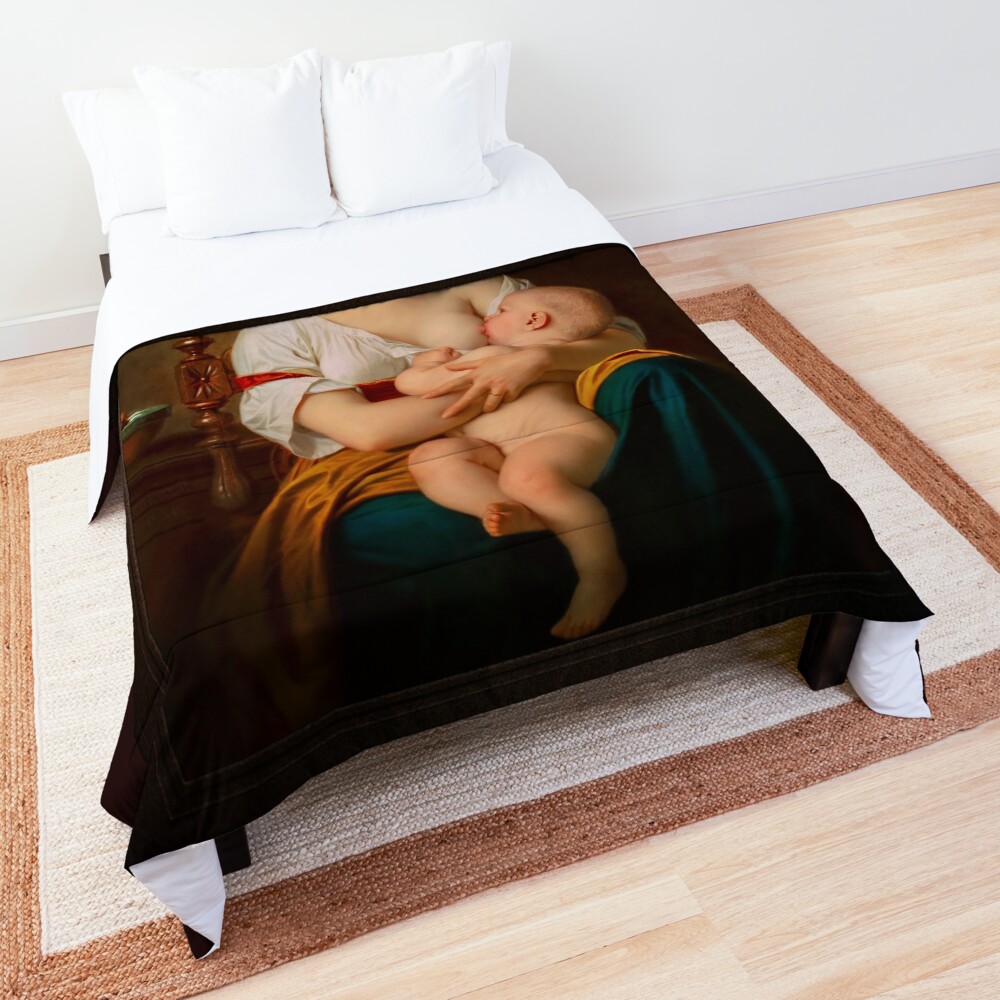
“Ung mamma som sköter sin baby,” målade in 1865 av den franska konstnären Hugues Merle (1822 – 1881), är ett föredömligt genremåleri som skildrar ett djupt intimt och ömt ögonblick mellan en mor och hennes barn. Koltrast, som var väl ansedd för sina känsliga och realistiska skildringar av mänskliga ämnen, använder sin karaktäristiska naturalism i denna målning, fånga både den fysiska och känslomässiga intimiteten i moderskapet. Scenen, helt fokuserat på mor och barn, exemplifierar konstnärens förmåga att framkalla en stillhet, men ändå gripande berättelse genom ett enkelt inhemskt ögonblick.
Innehållsförteckning
Huvudämne: Modern och barnet
I hjärtat av denna komposition är mamman, framställt som en ungdom, fridfull kvinna, ammar ömt sitt spädbarn. Her expression is one of deep affection, marked by a gentle smile as she gazes lovingly at her child, whose eyes remain closed in the bliss of nourishment.
The bond between the two is palpable, captured in the delicate way her hands cradle the child and guide it to her breast. Her slightly bowed head and the softness in her facial expression emphasize the maternal devotion that defines this moment. Barnet, in stark contrast, is a symbol of vulnerability and innocence, its plump form fully exposed in the close embrace of the mother. This contrast between the mother’s mature serenity and the baby’s trusting vulnerability highlights the theme of motherhood and its sacred, natural role in human life.
The composition exudes tenderness, and Merle’s careful attention to the details of their interaction serves to amplify the emotional resonance of the scene. The warm and harmonious connection between the figures is reinforced by their subtle poses and gestures. The mother’s soft, Ändå målmedvetet, embrace of her child suggests both strength and care, while the child, nestled in her arms, radiates a sense of peace and security. The quiet moment depicted here speaks volumes about the human condition—about the timeless and universal bond between mother and child.
Inställningen: Bakgrund och omgivning
Målningens bakgrund, though not as elaborate as the primary subjects, provides an atmospheric context to the intimate scene. A muted, soft-hued room creates a sense of domestic tranquility, with elements like the faint outlines of furniture and a distant, soft light that suggests the presence of a window, possibly offering a glimpse of natural light. The simplicity of the setting directs the viewer’s attention to the emotional weight of the moment between mother and child, highlighting the universal nature of the act of nursing in any time or place. The soft tones of the room contrast with the rich, more vibrant colors worn by the mother, particularly the luxurious red and green of her attire.
The scene is not bound by any grand historical or geographical reference but instead focuses on an intimate domestic world. The space is not filled with distractions; snarare, it is subdued, allowing the figures of the mother and child to dominate the composition. The sparse but intimate nature of the environment enhances the warmth and the closeness between the subjects.
Material och teknik
Merle’s technique in this painting is indicative of the academic style prevalent in mid-19th-century French art, particularly within the tradition of French realism. His approach to the handling of light and shadow is one of his defining features. The soft but rich lighting in this painting creates a glow around the figures, emphasizing the contours of the mother’s face, the softness of her skin, and the fleshy innocence of the baby’s form. The artist’s use of light not only creates depth but also adds an ethereal quality to the scene, almost as if the figures are glowing with maternal love and warmth.
The textures in the painting are rendered with a remarkable attention to detail. The folds of the mother’s clothing, the softness of the infant’s skin, and the glint of light on her hair are all painted with a careful, realistic touch. Merle’s brushwork creates an almost tactile sense of the materials, from the smoothness of the mother’s breast to the soft, baby-like form of the child. The fine detailing in the faces of both figures adds to the lifelike realism of the painting, grounding it in the tangible world while also conveying the emotional depth of the moment.
Stil, Tema, och humör
The style of the painting is rooted in the naturalistic tradition that dominated the academic art scene during Merle’s time. The artist employs a highly refined technique that reflects the precision and careful attention to anatomical accuracy that were hallmarks of academic training. The subjects are depicted realistically, with an emphasis on natural beauty and physical authenticity. The softness and warmth of the color palette, with its delicate flesh tones and rich fabrics, serve to emphasize the humanity and tenderness of the scene.
The theme of the painting centers around the intimate and sacred act of motherhood. Nursing, as depicted in the painting, is not just a physical act but also an emotional exchange between mother and child. The painting captures not only the physical nourishment being provided but also the emotional and psychological bond that is fostered during this moment. The scene embodies themes of care, sårbarhet, nurturing, and the deep connection between a mother and her infant, which transcend time and cultural boundaries.
The mood evoked by “Ung mamma som sköter sin baby” is one of peace, tenderness, and devotion. The viewer is invited to share in the private moment of motherhood, and through this quiet, intimate act, the artist speaks to the universal experience of love and care that defines the human condition. The serene expressions of both mother and child, paired with the gentle composition, convey a sense of warmth and tranquility, making the viewer feel as though they are peering into a sacred, timeless moment.
Slutsats
“Ung mamma som sköter sin baby” is a powerful portrayal of maternal love, captured through the refined brushstrokes and emotional depth characteristic of Hugues Merle’s work. The painting not only serves as an example of 19th-century academic realism but also offers a timeless reflection on the universal experience of motherhood. Through the depiction of this intimate moment, Merle invites the viewer to witness the profound connection between mother and child, emphasizing the beauty and purity of this human bond.
Behind the pair is a wooden table that has a green and brown ceramic bowl resting on top, with something in it.
Young Mother Nursing Her Baby is a retouched digital art old masters reproduction of a public domain image that is available as a canvastavla online.
Detta digitala konstskapande, som med alla konstverk som kan hittas på Xzendor7-webbplatsen finns att köpa online i en mängd olika materialformat inklusive canvastavlor, akryltryck, metalltryck, trätryck, inramade tryck, affischer, och som rullade canvastryck i en mängd olika storlekar från 12 tum till 72 tum beroende på storleken på det faktiska konstverket och den print on demand-butik du väljer att köpa konsten från.
Konstverket är också tillgängligt på ett brett utbud av herr- och damkläder, muggar, väskor, halsdukar, anteckningsböcker och tidskrifter och många heminredningsprodukter.
Konstnärsbio
Informationen nedan är härledd från Wikipedia.org och Rehs.com
Hugues Merle föddes i 1822 i La Sône, France and around the age of 21 arrived in Paris, France where he studied painting under the French Historical and Portrait Painter Léon Cogniet (1794 – 1880).
Though little is known of Hugues early life it is assumed that he received some degree of art education before he arrived in Paris in 1843; because he began exhibiting at the Paris Salon in 1847 with his piece Portrait de L’auteur and in 1848 he exhibited the piece Légende des Willis.
As time went on Hugues reputation as a portraitist grew substantially during the 1850s; and as a successful and prominent painter he was able to attract serious art lovers that were looking to build their art collections.
One of these early collectors of art was th 4th Marquess of Hertford, Richard Seymour-Conway (1800-1870); who purchased his salon submission Reading the Bible in 1859.
During the 1860s, Hugues client list of collectors included not only individuals from the European continent, but also American collectors, such as William Walters of Baltimore who commissioned The Scarlet Letter.