

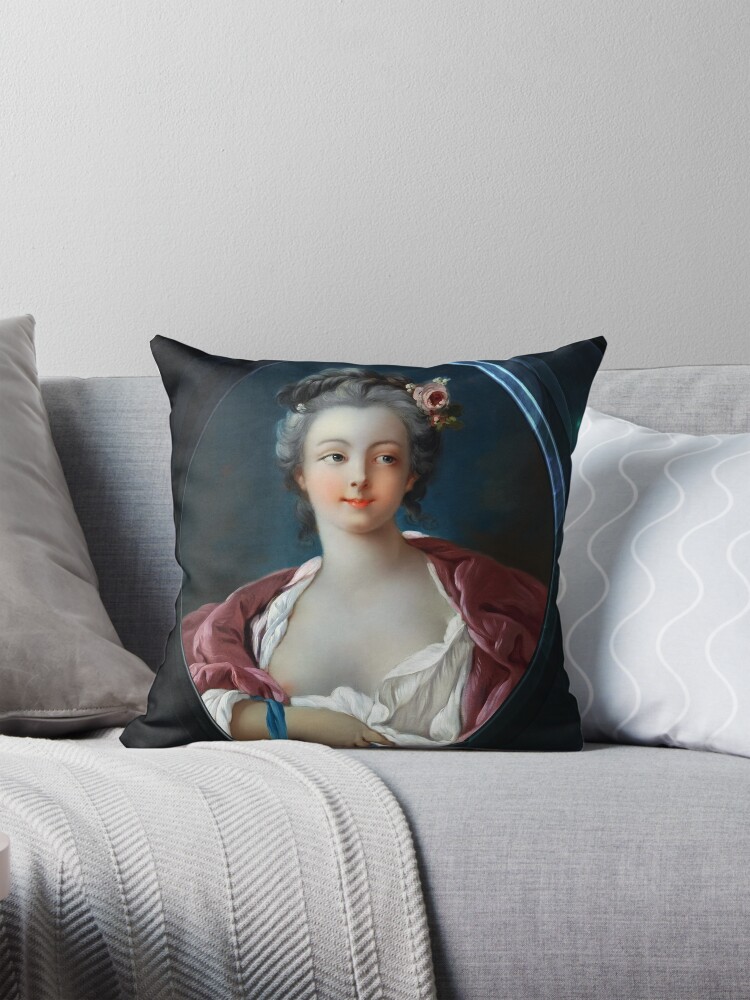
Young Woman with Flowers in Her Hair c1734
L'obra d'art Dona jove amb flors als cabells es va crear a 1734 by the renowned French painter Francois Boucher (1703 – 1770). Boucher, celebrated for his role in the Rococo movement, presents in this painting a portrait of youthful beauty and elegance, characteristic of his ability to capture both the grace and sensuality of his subjects. This work is a delicate and refined depiction of a young woman, bathed in soft light and surrounded by elements that evoke a sense of opulence and ease, typical of the Rococo era. The artist’s brushwork, combined with the vivid detail of the subject’s attire and facial features, places the painting firmly within the context of 18th-century French aristocracy and fashion.
Taula de continguts
El tema i la composició
En aquest retrat, Boucher expertly showcases a young woman dressed in a luxurious ensemble of flowing fabrics, with her face framed by soft curls and adorned with flowers. The woman is depicted in an intimate and almost wistful pose, her soft gaze directed slightly off-center, as if lost in contemplation. The simplicity of her pose, with one hand resting gently at her chest, invites the viewer to focus on her delicate features and the grace of her attire. The subtle contrast between the intricate folds of her luxurious robe and the softness of her skin enhances the natural elegance of the subject.
Els seus cabells, styled in an elaborate updo, is adorned with vibrant roses and delicate blossoms, a signature detail of Boucher’s work that celebrates both the natural world and the beauty of femininity. The arrangement of flowers in her hair, combined with the gentle expression on her face, speaks to the Rococo theme of idealized beauty and sensuality, set within a world of nature and grace.
The Use of Color and Light
Boucher’s use of color in this portrait is notable for its subtlety and richness. The soft pastel hues of her gown, composed of muted pinks, blancs, and creams, contrast beautifully with the deeper, darker tones of the background. These color choices serve to enhance the subject’s youthful beauty, as her face and attire seem to almost glow against the dark, blurred backdrop. The gentle play of light on her skin and fabric adds depth to the composition, highlighting the textures of her clothing and the soft contours of her face. The muted tones of the background also create a sense of ethereal space, focusing all attention on the subject’s figure and face.
The Rococo Style and Mood
François Boucher’s Dona jove amb flors als cabells encapsulates the defining characteristics of the Rococo style, which flourished in France during the early 18th century. rococó, marked by its ornate, playful, and often sensual aesthetic, sought to evoke lightness and pleasure, moving away from the more somber tones of the Baroque period. En aquesta pintura, the delicate treatment of the subject’s features, the flowing, almost billowy fabrics, and the soft color palette all exemplify Rococo’s emphasis on grace and beauty.
The mood of the portrait is one of calm and serenity, with a hint of coquettish charm. The subject’s gentle smile and distant gaze suggest an inner world of thoughtfulness, while her elegant pose exudes both confidence and femininity. The flowers in her hair act as a metaphor for youth and beauty, reinforcing the Rococo fascination with fleeting moments of pleasure and the cultivation of beauty.
Symbolism and Materiality
The young woman’s attire and the surrounding elements in the painting are not only a reflection of her social status but also a symbol of the prevailing tastes of the time. El seu vestit, made of luxurious fabrics such as silk or velvet, is depicted with great attention to texture, emphasizing the wealth and refinement of the subject. The folds and draping of the fabric are painted with precision, showcasing Boucher’s skill in rendering the material as though it were tangible.
The flowers in her hair carry additional meaning, often seen as symbols of youth, bellesa, and transience in 18th-century art. Roses, en particular, have long been associated with love and passion, and their inclusion here suggests a connection between the subject’s outward beauty and the emotions she may evoke. La composició global, with its focus on beauty and sensuality, aligns with the themes of ephemeral pleasure and the celebration of youth that were central to the Rococo movement.
Conclusió
François Boucher’s Dona jove amb flors als cabells is an exemplary work of Rococo portraiture, capturing the essence of the period through its delicate portrayal of feminine beauty and sensuality. The artist’s ability to blend texture, llum, and color creates an image that not only reflects the fashion and ideals of 18th-century French aristocracy but also invites the viewer into a world of serene grace and elegant charm. Through this painting, Boucher immortalizes the subject’s youth, bellesa, i feminitat, while also showcasing the opulent tastes and refined aesthetics of the time.
Dona jove amb flors als cabells és una reproducció d'art digital retocada d'una imatge de domini públic.
Artista Bio
Informació a continuació derivada de Wikipedia.org
Natiu de París, Boucher era fill d'un pintor menys conegut Nicolas Boucher, que li va donar la seva primera formació artística. Als disset anys, un quadre de Boucher va ser admirat pel pintor François Lemoyne. Més tard, Lemoyne va nomenar Boucher com a aprenent, però després de només tres mesos, va anar a treballar per al gravador Jean-François Cars.
En 1720, va guanyar el Gran Premi d'elit de Roma de pintura, però no va aprofitar la conseqüent oportunitat per estudiar a Itàlia fins cinc anys després, per problemes econòmics de la Reial Acadèmia de Pintura i Escultura.[1] En tornar dels estudis a Itàlia va ser admès a la refundada Académie de peinture et de sculpture on 24 de novembre 1731. La seva peça de recepció (peça de recepció) va ser el seu Rinaldo i Armida de 1734.
Boucher es va casar amb Marie-Jeanne Buzeau a 1733. La parella va tenir tres fills junts. Boucher es va convertir en membre de la facultat 1734 i la seva carrera es va accelerar a partir d'aquest punt, ja que va ser ascendit a Professor i després Rector de l'Acadèmia, esdevenint inspector de la Royal Gobelins Manufactory i finalment Premier Peintre du Roi (Primer Pintor del Rei) dins 1765. Retrat de Marie-Louise O'Murphy c. 1752
Boucher va morir 30 maig 1770 al seu París natal. El seu nom, juntament amb la de la seva patrona Madame de Pompadour, s'havia convertit en sinònim de l'estil rococó francès, conduint els germans Goncourt a escriure: “Boucher és un d'aquells homes que representen el gust d'un segle, que expressen, personificar-lo i encarnar-lo.”
Boucher és famós per dir que la natura ho és “massa verd i poc il·luminat” (massa verd i mal il·luminat).
Boucher estava associat amb el gravador de pedres precioses Jacques Guay, a qui va ensenyar a dibuixar. També va ser mentor del pintor moràu-austríac Martin Ferdinand Quadal així com del pintor neoclàssic Jacques-Louis David a 1767.[4] Més tard, Boucher va fer una sèrie de dibuixos d'obres de Guay que Madame de Pompadour va gravar i va distribuir com un volum ben enquadernat als cortesans preferits.