

Bean Óg le Hydrangeas
Bean Óg le Hydrangeas (Bean Óg Le Hydrangeas) leis an bPéintéir Francach Élisabeth Sonrel (1874 – 1953); agus maisitheoir ar stíl Art Nouveau; I measc na saothar a bhí aige bhí ábhair chomhréireacha, misteachas agus siombalachas, portráidí agus tírdhreacha.
The painting Young Woman with Hydrangeas (c. 1900) by the French artist Elisabeth Sonrel presents a delicate and contemplative scene, one that radiates the essence of late 19th-century European sensibilities and aesthetic charm. Through her thoughtful use of soft, natural tones, gentle lighting, and classical themes, Sonrel offers a portrayal of beauty that captures the spirit of the Belle Époque era, a period marked by its appreciation for nature, femininity, and delicate elegance.
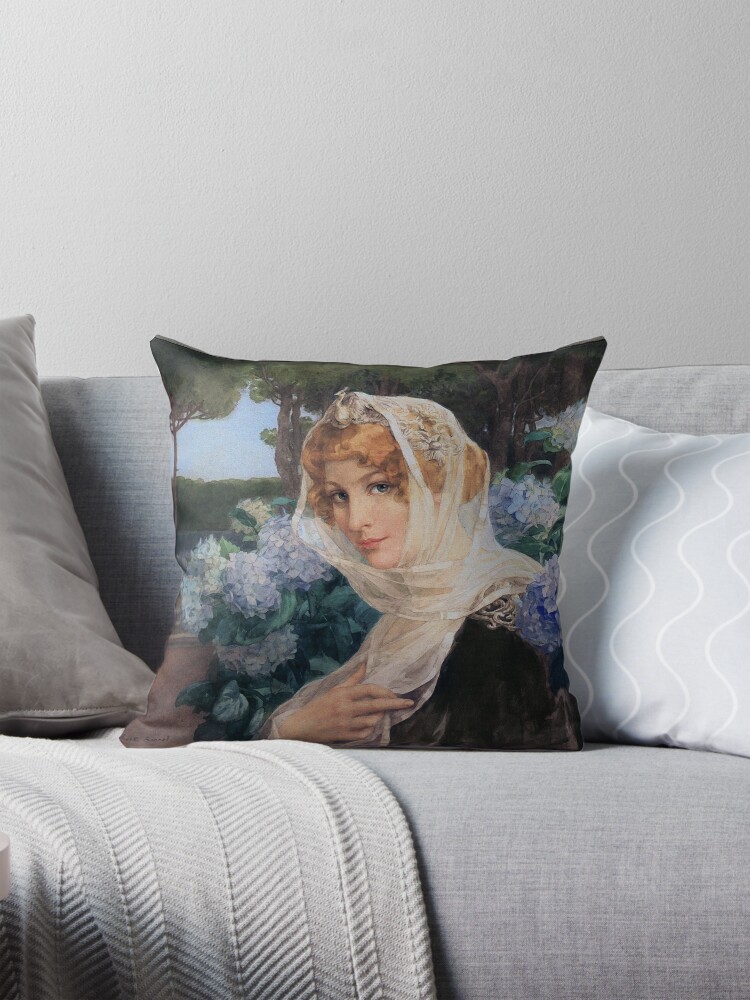
At the heart of this artwork is a bean óg, poised with grace and serenity. She occupies the foreground of the composition, the viewer’s gaze immediately drawn to her as the central figure. The woman’s face is framed by soft, wavy hair that spills gently down her shoulders, with subtle hints of warmth in the light brown and auburn hues.
A radharc, though not directed outward, carries an air of introspection, as if she is lost in a private, peaceful reverie. Her eyes are soft and her expression serene, conveying a deep sense of tranquility. This sense of calm is enhanced by her posture; she is seated with one hand delicately holding a cluster of hydrangeas, their intricate, multi-toned petals painted with precision and grace.
The hydrangeas, a symbol of beauty, grásta, and abundance, are not merely decorative in this piece but rather serve as a reflection of the subject’s character and the mood of the composition. They are rendered with exquisite detail, each flower appearing to bloom under a soft, solas comhthimpeallach.
The colors range from rich, deep purples to soft pinks and blues, creating a vivid contrast with the more muted tones of the young woman’s attire. These flowers seem to breathe life into the portrait, making them an essential component in conveying the overall theme of natural beauty and the fleeting, ephemeral nature of youth and femininity.
The woman’s clothing also plays a key role in the narrative of the painting. A gúna, adorned with subtle lace and floral patterns, evokes the restrained elegance typical of the late 19th century. The soft hues of her dress—pale creams and whites—complement the colors of the hydrangeas, creating a harmonious relationship between the figure and her floral surroundings. The fabric of her gown is portrayed with remarkable texture, conveying its delicacy and fine quality.
The drapery falls in soft folds around her body, further enhancing the sense of grace that pervades the entire composition. A gúna, with its refined cut and high collar, suggests a degree of modesty, in keeping with the values of the time, yet the soft detailing allows for an undercurrent of sensuality and softness to emerge.
Taobh thiar den ábhar, the background provides a serene, natural landscape that enhances the intimate, peaceful mood of the painting. The artist has opted for a slightly blurred and ethereal rendering of the surrounding foliage, with the soft light filtering through the trees and casting a warm, diffused glow over the figure.
The background is not overpowering but serves to frame the young woman in a gentle embrace of nature, suggesting a deep connection between the subject and her environment. The interplay of light and shadow on the leaves and flowers subtly echoes the light touch and serenity that pervades the figure, creating a seamless balance between subject and surroundings.
The artist’s choice to depict the woman against this natural backdrop also suggests a celebration of the harmony between human life and nature. The quietude of the landscape complements the figure’s pensive demeanor, evoking themes of renewal, fás, and cyclical beauty. An bog, muted greens of the foliage, together with the delicate tones of the hydrangeas, contribute to the painting’s overall sense of stillness and calm.
The palette used in Young Woman with Hydrangeas is another important feature of the artwork. Sonrel’s use of light, pastel tones—pale blues, pinks, glasaigh, and soft yellows—creates an atmosphere of ethereal elegance, lending the scene a dreamlike quality. The composition is bathed in a soft, almost golden light, lending a sense of timelessness to the scene.
The colors are not bold or jarring but rather gentle and soothing, contributing to a sense of peace and refinement. These soft hues are paired with more subdued, natural colors, creating a perfect balance between warmth and coolness, light and shadow.
In terms of style, Sonrel’s painting reflects the highly refined academic tradition that was popular in France during the late 19th century. Her work demonstrates technical mastery, especially in the detailed rendering of the hydrangeas and the folds of the woman’s gown. An bog, almost luminous quality of the work, achieved through the artist’s nuanced application of paint, demonstrates an intimate knowledge of how to capture light and texture.
There is an emphasis on fine detail, particularly in the treatment of the flowers and the fabric of the woman’s dress, which invites the viewer to appreciate the careful craftsmanship behind the scene. At the same time, the soft blending of colors and the gentle modeling of light create an almost impressionistic atmosphere, with an emphasis on mood rather than strict realism.
The theme of the painting is one of natural beauty, neamhchiontacht, and introspection. The hydrangeas, symbolizing both abundance and the transience of life, are paired with the figure of the young woman, who seems to embody the fleeting nature of youth and beauty. An bog, glowing light and gentle colors emphasize the theme of fragility, reminding the viewer of the ephemeral nature of time and the beauty it bestows. The mood of the painting is calm and contemplative, suggesting a moment of stillness in which the subject is lost in thought or quietly appreciating the beauty of her surroundings.
Mar fhocal scoir, Young Woman with Hydrangeas by Elisabeth Sonrel is a work that captures the delicate interplay between beauty, nádúr, and the passage of time. Through her meticulous attention to detail, the artist has created a piece that speaks to the viewer on both an emotional and aesthetic level, evoking a sense of serenity and timelessness that transcends the boundaries of the canvas.
Young Woman with Hydrangeas is a retouched digital art old masters reproduction of a public domain image.
Eolas Thíos Ó Wikipedia.org
Elisabeth Sonrel (1874 Turais - 1953 Séalaí) péintéir agus maisitheoir Francach i stíl Art Nouveau a bhí ann. I measc a cuid saothar bhí ábhair chomhréireacha, misteachas agus siombalachas, portráidí agus tírdhreacha.
Ba iníon í le Nicolas Stéphane Sonrel, péintéir ó Turais, agus fuair sí a luathoiliúint uaidh. Le haghaidh tuilleadh staidéir chuaigh sí ar aghaidh go Páras mar mhac léinn le Jules Lefebvre ag an Ecole des Beaux-Arts.
I 1892 phéinteáil sí a cuid oibre dioplóma, ‘Pax et Labour’, saothar le feiceáil ag an Musée des Beaux-Arts de Tours. As sin amach chuir sí taispeántas ag an Salon des Artistes Français idir 1893 agus 1941, uiscedhathanna móra a bhí ina píosaí sínithe ar bhealach Réamh-Raphaelite, a ghlac sí tar éis turas go Florence agus an Róimh, ag fáil amach péintéirí na hAthbheochana – cuid de a cuid oibre le huaireanta soiléire Botticelli. Ba mhinic a spreag a cuid pictiúr rómánsaíocht Airtéanach, Coiméide Dhiaga Dante Alighieri’ agus 'An Saol Nua', téamaí Bhíobla, agus finscéalta meánaoiseacha. I measc a cuid saothar mistéireach tá ‘Ames errantes’ (Salon de 1894) agus ‘Biotáille an Abyss’ (Salon de 1899) agus "Bean óg leis an taipéis".
Ag an Exposition Universelle de 1900, Art Nouveau an príomhthéama a bhí aige, léi 1895 ag péinteáil ‘Codladh na Maighdine’ (Codladh na Maighdine), bronnadh bonn cré-umha air, agus duais Henri Lehmann de 3000 franc le Acadamh na nEalaíon Mín.[3] Ó 1900 ar aghaidh chuir sí a péintéireacht teoranta do phortráidí, tírdhreacha áille sa Bhriotáin, agus an staidéar bláthanna ó am go chéile.
Thug sí turais phéintéireachta rialta go dtí an Bhriotáin, spreagtha ag foraois Brocéliande, agus ó 1910 chuig áiteanna éagsúla ar an gcósta mar Concarneau, Plougastel, Pont-l'Abbé agus Loctudy, go minic ag fanacht i dtithe ósta agus in éineacht le mac léinn nó dhó. Phéinteáil sí roinnt saothar i Le Faouët sular thóg sí Villa i La Baule sna 1930idí. Ag obair go príomha i uiscedhath agus gouache, fuair sí soláthar réidh samhlacha i measc cailíní óga an cheantair, agus fuair siad go raibh Bretons cairdiúil go ginearálta, macánta agus féinmhuiníneach.
Bhí a taispeántas deiridh ag an Salon i 1941 ag aois 67. Tá taifead ann freisin gur thaispeáin sí i Learpholl. Ina blianta tosaigh chuir Sonrel póstaeir ar fáil, cártaí poist agus léaráidí, i stíl Art Nouveau.