

Ung kona með hortensia
Ung kona með hortensia (Ung kona með hortensia) eftir franska málarann Élisabeth Sonrel (1874 – 1953); og teiknari Art Nouveau stíl; verk hvers innihéldu allegórísk efni, dulspeki og táknfræði, portrett og landslag.
The painting Young Woman with Hydrangeas (c. 1900) by the French artist Elisabeth Sonrel presents a delicate and contemplative scene, one that radiates the essence of late 19th-century European sensibilities and aesthetic charm. Through her thoughtful use of soft, natural tones, mild lýsing, and classical themes, Sonrel offers a portrayal of beauty that captures the spirit of the Belle Époque era, a period marked by its appreciation for nature, kvenleika, and delicate elegance.
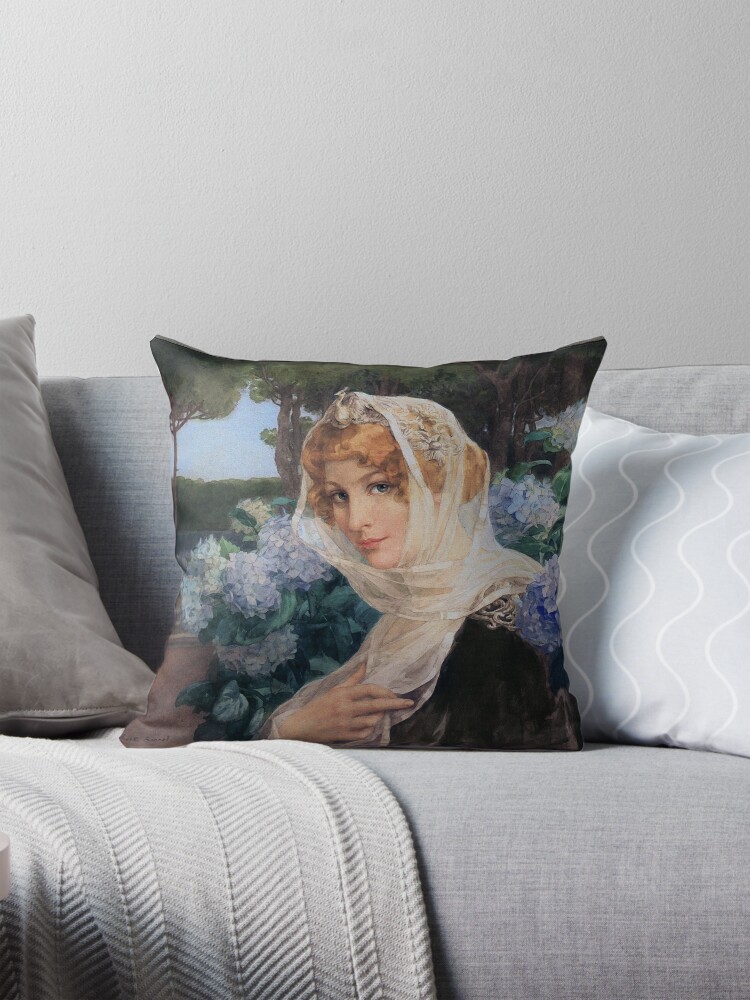
At the heart of this artwork is a ung kona, poised with grace and serenity. She occupies the foreground of the composition, the viewer’s gaze immediately drawn to her as the central figure. The woman’s face is framed by soft, wavy hair that spills gently down her shoulders, with subtle hints of warmth in the light brown and auburn hues.
Augnaráð hennar, though not directed outward, carries an air of introspection, as if she is lost in a private, peaceful reverie. Her eyes are soft and her expression serene, conveying a deep sense of tranquility. This sense of calm is enhanced by her posture; she is seated with one hand delicately holding a cluster of hydrangeas, their intricate, multi-toned petals painted with precision and grace.
The hydrangeas, tákn fegurðar, Grace, and abundance, are not merely decorative in this piece but rather serve as a reflection of the subject’s character and the mood of the composition. They are rendered with exquisite detail, each flower appearing to bloom under a soft, ambient light.
The colors range from rich, deep purples to soft pinks and blues, creating a vivid contrast with the more muted tones of the young woman’s attire. These flowers seem to breathe life into the portrait, making them an essential component in conveying the overall theme of natural beauty and the fleeting, ephemeral nature of youth and femininity.
The woman’s clothing also plays a key role in the narrative of the painting. Her gown, adorned with subtle lace and floral patterns, evokes the restrained elegance typical of the late 19th century. The soft hues of her dress—pale creams and whites—complement the colors of the hydrangeas, creating a harmonious relationship between the figure and her floral surroundings. The fabric of her gown is portrayed with remarkable texture, conveying its delicacy and fine quality.
The drapery falls in soft folds around her body, further enhancing the sense of grace that pervades the entire composition. Kjóllinn hennar, with its refined cut and high collar, suggests a degree of modesty, in keeping with the values of the time, yet the soft detailing allows for an undercurrent of sensuality and softness to emerge.
Behind the subject, the background provides a serene, natural landscape that enhances the intimate, peaceful mood of the painting. The artist has opted for a slightly blurred and ethereal rendering of the surrounding foliage, with the soft light filtering through the trees and casting a warm, diffused glow over the figure.
The background is not overpowering but serves to frame the young woman in a gentle embrace of nature, sem gefur til kynna djúp tengsl milli viðfangsefnisins og umhverfisins. Samspil ljóss og skugga á laufblöðum og blómum endurómar lúmskur létt snerting og æðruleysi sem gegnir myndinni, skapa óaðfinnanlegt jafnvægi milli myndefnis og umhverfis.
Val listamannsins að sýna konuna gegn þessu náttúrulega bakgrunni bendir einnig til þess að fagnað sé samhljómi mannlífs og náttúru.. Kyrrð landslagsins bætir við íhugandi framkomu myndarinnar, kalla fram þemu endurnýjunar, vöxtur, og hringlaga fegurð. Mjúkt, þögguð grænu laufblaðanna, ásamt viðkvæmum tónum hortensíanna, stuðla að heildartilfinningu málverksins um kyrrð og ró.
Litatöfluna sem notuð er í Young Woman with Hydrangeas er annar mikilvægur eiginleiki listaverksins. Ljósnotkun Sonrel, pastel tones—pale blues, Bleikir, grænu, and soft yellows—creates an atmosphere of ethereal elegance, lending the scene a dreamlike quality. The composition is bathed in a soft, almost golden light, lending a sense of timelessness to the scene.
The colors are not bold or jarring but rather gentle and soothing, contributing to a sense of peace and refinement. These soft hues are paired with more subdued, náttúrulegir litir, creating a perfect balance between warmth and coolness, ljós og skugga.
Hvað varðar stíl, Sonrel’s painting reflects the highly refined academic tradition that was popular in France during the late 19th century. Her work demonstrates technical mastery, especially in the detailed rendering of the hydrangeas and the folds of the woman’s gown. Mjúkt, almost luminous quality of the work, achieved through the artist’s nuanced application of paint, sýnir nána þekkingu á því hvernig á að fanga ljós og áferð.
Það er lögð áhersla á fín smáatriði, sérstaklega í meðhöndlun á blómum og efni kjól konunnar, sem býður áhorfandanum að meta vandað handverkið á bakvið tjöldin. Á sama tíma, mjúk blöndun lita og mild mótun ljóss skapa nánast impressjónískt andrúmsloft, með áherslu á skap frekar en strangt raunsæi.
Þema málverksins er náttúrufegurð, sakleysi, og sjálfsskoðun. The hydrangeas, táknar bæði gnægð og hverfulleika lífsins, eru pöruð við mynd ungu konunnar, sem virðist fela í sér hverfult eðli æskunnar og fegurðar. Mjúkt, glóandi ljós og mildir litir leggja áherslu á viðkvæmni, að minna áhorfandann á hverfulleika tímans og fegurðina sem hann veitir. Stemningin í málverkinu er róleg og íhugul, sem gefur til kynna kyrrðarstund þar sem viðfangsefnið er glatað í hugsun eða að meta í hljóði fegurð umhverfisins.
Að lokum, Young Woman with Hydrangeas eftir Elisabeth Sonrel er verk sem fangar viðkvæmt samspil fegurðar, Náttúran, og liðinn tíma. Í gegnum nákvæma athygli hennar á smáatriðum, listamaðurinn hefur búið til verk sem talar til áhorfandans á bæði tilfinningalegu og fagurfræðilegu stigi, vekur tilfinningu um æðruleysi og tímaleysi sem fer yfir mörk striga.
Young Woman with Hydrangeas er lagfærð stafræn list af gömlum meistara eftirgerð af mynd sem er almenningseign.
Upplýsingar að neðan Frá Wikipedia.org
Elisabeth Sonrel (1874 Ferðir - 1953 innsigli) var franskur málari og myndskreytir í Art Nouveau stíl. Verk hennar innihéldu allegórísk efni, dulspeki og táknfræði, portrett og landslag.
Hún var dóttir Nicolas Stéphane Sonrel, málari frá Tours, og fékk snemma þjálfun hennar frá honum. Til frekara náms fór hún til Parísar sem nemandi Jules Lefebvre við Ecole des Beaux-Arts.
Í 1892 hún málaði diplómavinnuna sína, "Friður og vinna", verk sem verður að sjá í Musée des Beaux-Arts de Tours. Upp frá því sýndi hún á Salon des Artistes Français á milli 1893 og 1941, Undirskriftarverkin hennar eru stórar vatnslitamyndir á pre-rafaelískum hætti, sem hún ættleiddi eftir ferð til Flórens og Rómar, að uppgötva endurreisnarmálarana – sum verk hennar hafa skýran yfirtón Botticelli. Málverk hennar voru oft innblásin af Arthurian rómantík, „Guðdómleg gamanmynd Dante Alighieri’ og 'La Vita Nuova', biblíuleg þemu, og miðaldasagnir. Dulræn verk hennar eru meðal annars 'Ames errantes’ (Salon af 1894) og „Andar undirdjúpsins’ (Salon af 1899) og „Ung kona með veggteppi“.
Á Exposition Universelle í 1900, aðalþema þess var Art Nouveau, henni 1895 málverkið „The Sleep of the Virgin“’ (Svefn meyjar), hlaut bronsverðlaun, og Henri Lehmann verðlaunin fyrir 3000 frönkum frá Listaakademíunni.[3] Frá 1900 áfram einskorðaði hún málverk sitt við portrett, fallegt Bretagnelandslag, og einstaka blómarannsókn.
Hún fór reglulega í málaraferðir til Bretagne, innblásin af skóginum í Brocéliande, og frá 1910 til ýmissa staða við ströndina eins og Concarneau, Plougastel, Pont-l'Abbé og Loctudy, gjarnan gist á gistihúsum og í fylgd með einum eða tveimur nemendum. Hún málaði nokkur verk í Le Faouët áður en hún byggði einbýlishús í La Baule á þriðja áratugnum.. Vinnur aðallega í vatnslitum og gouache, hún uppgötvaði tilbúið framboð af fyrirsætum meðal ungra stúlkna á svæðinu, og fannst Bretónar almennt vera vinalegir, heiðarlegur og sjálfsöruggur.
Lokasýning hennar á stofunni var í 1941 á aldrinum 67. Það er líka heimild um að hún hafi sýnt í Liverpool. Á fyrstu árum sínum framleiddi Sonrel veggspjöld, póstkort og myndskreytingar, í Art Nouveau stíl.