

A Boyarina Beauty
A Boyarina Beauty by Russian Painter Konstantin Makovskij (1839 – 1915); specialiĝanta pri rusaj Historiaj pentraĵoj montrantaj idealigitan vidon de rusa vivo en pasintaj jarcentoj.
This exquisite portrait of a beautiful young Boyarina, shows a young girl from a noble Russian family dressed in the attire that a young lady would have worn in the19th century.
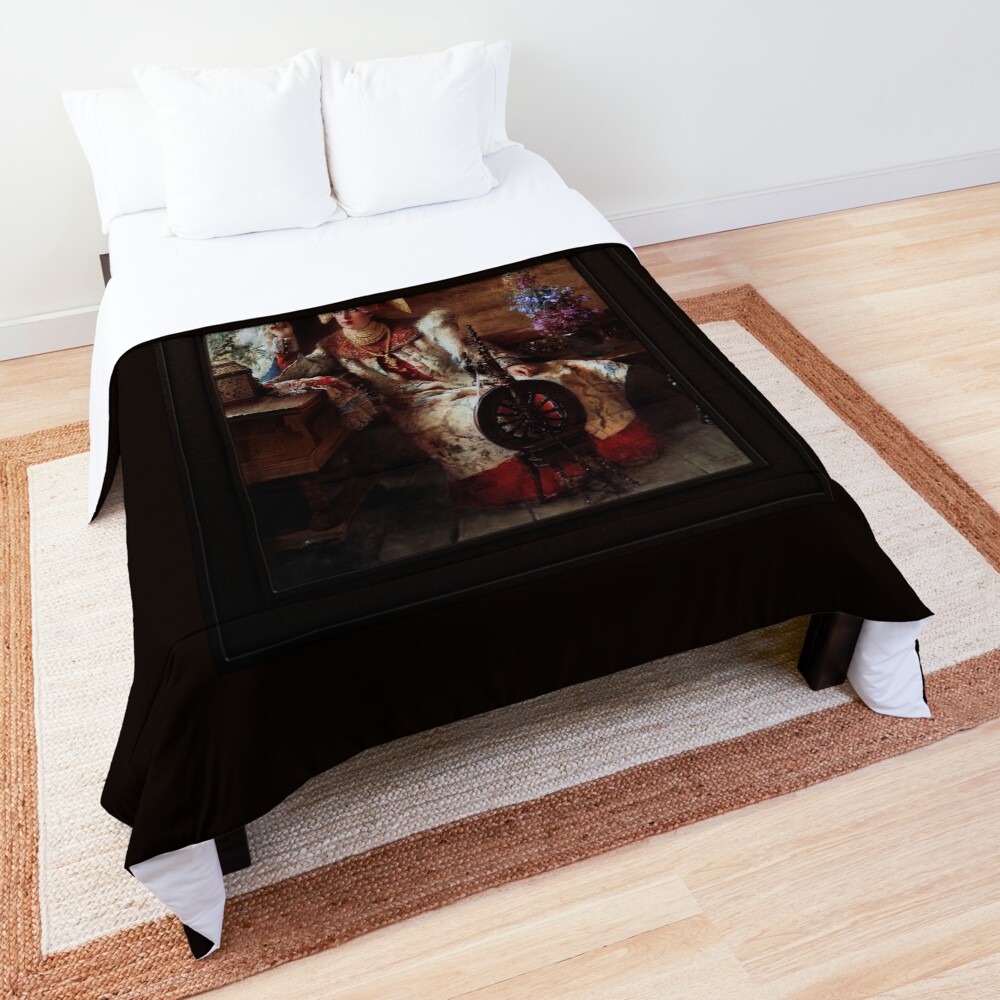
The young lady is wearing a large gold kokoshnik on her head and a venchik over her hair, with a matching rope choker around her neck that has a gold Christian Cross hanging from its end.
Resting on her shoulders is thick red woolen shoulder plate withe floral embroidery, which itself rest on an indoor white-yellow heavy woolen coat with colorful floral designs.
Beneath her coat is a heavy floor length red dress that has three gold buttons on the front; and on both of her wrist she has very large and wide cuff like decorated silver bracelets.
The young lady is seated on a wooden bench, by a wooden table that is situated by a window that she is looking out of; as she has moved the curtain covering it to the side with her right hand which she has her elbow placed.
On the table is a flower pot with a growing green plant, a decorative wooden box and a piece of decorative cloth and jewelry that is leaning over the table.
On the decorative bench she is seated on is a class vase that has four types of flowers composed of violet flowers, Bluaj Floroj, green flowers and yellow flowers.
Behind and above her is a decorative wooden panel ledge that has a small burning candle on it that is in front of what appears to be some sort of metal frame; while in front of her is a spinning wheel that she was using to spin yarn.
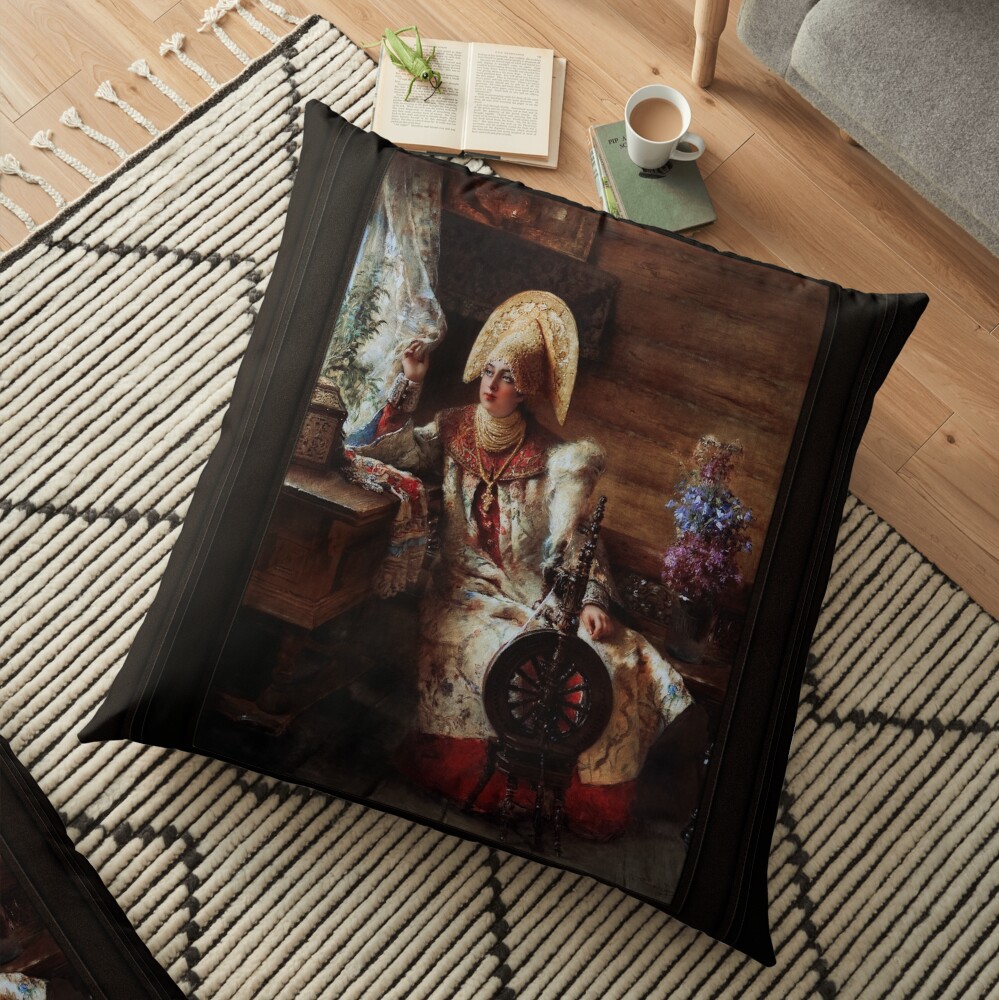
A Boyarina Beauty is a remastered digital art old masters reproduction of a public domain image that is available as a canvas print online.
Informoj Malsupre Derivita De Vikipedio.org
Konstantin Makovsky estis influa rusa farbisto, aligita kun la “Peredvizhniki (Vagantoj)”. Multaj el liaj historiaj pentraĵoj, kiel ekzemple Sub la Krono (1889) ankaŭ konata kiel La Rusa Novedzino Vesto kaj Antaŭ la Geedziĝo, montris idealigitan vidon de rusa vivo de antaŭaj jarcentoj. Li ofte estas konsiderita reprezentanto de Akademia arto.
Konstantin Makovsky naskiĝis en Moskvo. Lia patro estis la rusa artfiguro kaj amatora farbisto, Jegor Ivanoviĉ Makovskij. Lia patrino estis komponisto, kaj ŝi esperis, ke ŝia filo iam sekvos ŝiajn paŝojn. Liaj pli junaj fratoj Vladimir kaj Nikolay kaj lia fratino Alexandra ankaŭ daŭriĝis por iĝi farbistoj.
En 1851 Makovsky eniris la Moskvan Lernejon de Pentraĵo, Skulptaĵo kaj Arkitekturo kie li iĝis la ĉefa studento, facile ricevi ĉiujn disponeblajn premiojn. Liaj instruistoj estis Karl Bryullov kaj Vasilij Tropinin. La inklinoj de Makovsky al Romantikismo kaj dekoraciaj efikoj povas esti klarigitaj per la influo de Bryullov.

Kvankam arto estis lia pasio, li ankaŭ pripensis kion lia patrino volis ke li faru. Li ekiris serĉi komponistojn, kiujn li povus rilati, kaj unue iris al Francio. Antaŭe, li ĉiam estis klasika muzikamanto, kaj aŭskultis multajn pecojn. Li ofte deziris ke li povu ŝanĝi la melodion, aŭ stilo de kelkaj el ili por igi ilin pli ĝuaj. Poste en lia vivo ĝi realiĝis.
En 1858 Makovsky membrigis la Imperian Akademion de Arto en Sankt-Peterburgo. De 1860 li partoprenis la ekspoziciojn de la Akademio kun pentraĵoj kiel Curing of the Blind (1860) kaj Agentoj de la Falsa Dmitry mortigas la filon de Boris Godunov (1862). En 1863 Makovsky kaj dek tri aliaj studentoj okazigis proteston kontraŭ la fikso de la Akademio de temoj de skandinava mitologio en la konkurso por la Granda Ora Medalo de Akademio.; ĉiuj forlasis la akademion sen formala diplomo.
Makovskij iĝis membro de kooperativo (artel) de artistoj gvidataj de Ivan Kramskoi, tipe produktante Wanderers-pentraĵojn pri ĉiutageco (Vidvino 1865, Haringo-vendisto 1867, ktp.). De 1870 li estis fondmembro de la Society for Traveling Art Exhibitions kaj daŭre laboris pri pentraĵoj dediĉitaj al ĉiutaga vivo.. Li ekspoziciis siajn verkojn ĉe kaj la Academia-ekspozicioj kaj la Vojaĝantaj Artekspozicioj de la Vagantoj.
Signifa ŝanĝo en lia stilo okazis post vojaĝado al Egiptujo kaj Serbio en la mez-1870-aj jaroj. Liaj interesoj ŝanĝiĝis de sociaj kaj psikologiaj problemoj al la artaj problemoj de koloroj kaj formo.
En la 1880-aj jaroj li iĝis moda aŭtoro de portretoj kaj historiaj pentraĵoj. En la Monda Ekspozicio de 1889 en Parizo li ricevis la Grandan Oran Medalon pro siaj pentraĵoj Morto de Ivano la Terura, La Juĝo de Parizo, kaj Demono kaj Tamara. Li estis unu el la plej alte aprezitaj kaj tre pagitaj rusaj artistoj de la tempo. Multaj demokrataj kritikistoj konsideris lin renegato de la Vagantoj’ idealoj, produktante (kiel Henryk Siemiradzki) frapantaj sed malprofundaj verkoj, dum aliaj vidas lin kiel antaŭulo de rusa impresionismo.
Makovskij estis mortigita en 1915 kiam lia kaleŝo estis trafita per elektra tramo en Sankt-Peterburgo.