

A Boyarina Beauty
A Boyarina Beauty by Russian Painter Konstantin Makovsky (1839 – 1915); specializing in Russian Historical paintings showing an idealized view of Russian life in past centuries.
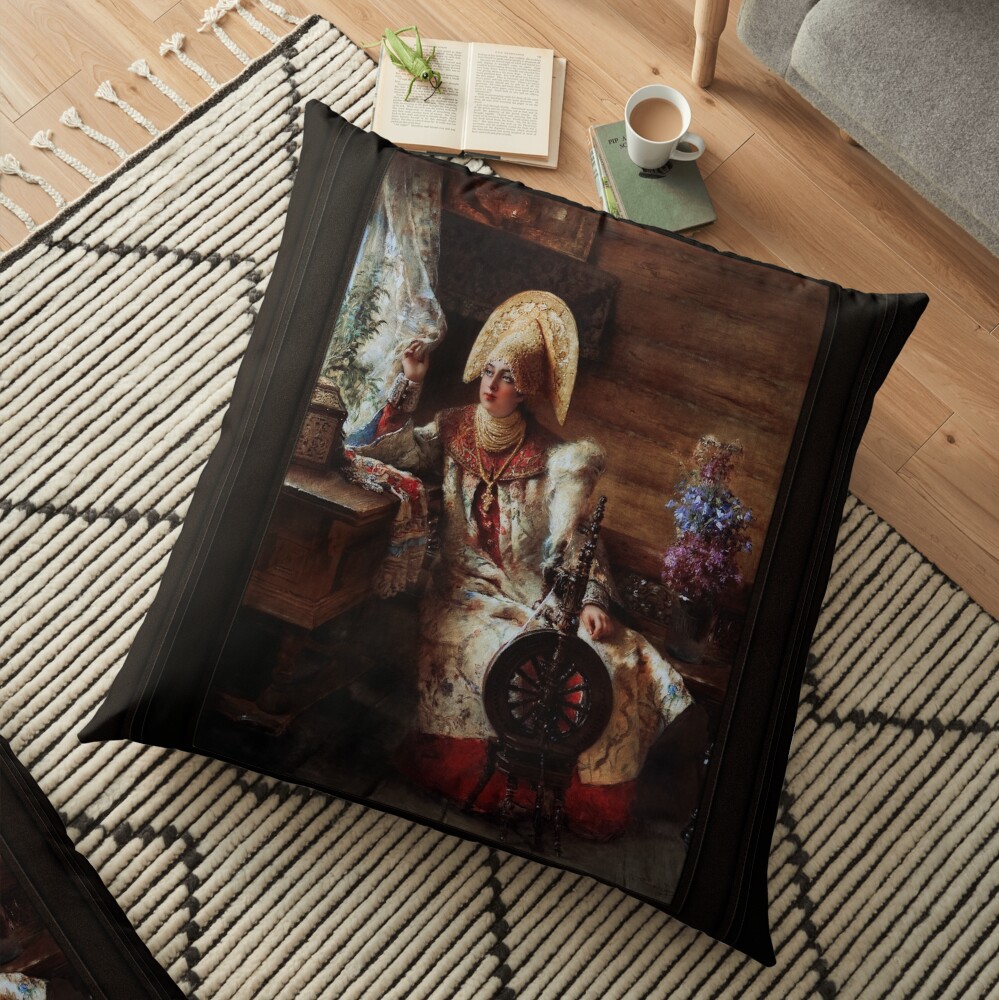
This exquisite portrait of a beautiful young Boyarina, shows a young girl from a noble Russian family dressed in the attire that a young lady would have worn in the19th century.
The young lady is wearing a large gold kokoshnik on her head and a venchik over her hair, with a matching rope choker around her neck that has a gold Christian Cross hanging from its end.
Resting on her shoulders is thick red woolen shoulder plate withe floral embroidery, which itself rest on an indoor white-yellow heavy woolen coat with colorful floral designs.
Beneath her coat is a heavy floor length red dress that has three gold buttons on the front; and on both of her wrist she has very large and wide cuff like decorated silver bracelets.
The young lady is seated on a wooden bench, by a wooden table that is situated by a window that she is looking out of; as she has moved the curtain covering it to the side with her right hand which she has her elbow placed.
On the table is a flower pot with a growing green plant, a decorative wooden box and a piece of decorative cloth and jewelry that is leaning over the table.
On the decorative bench she is seated on is a class vase that has four types of flowers composed of violet flowers, blue flowers, green flowers and yellow flowers.
Behind and above her is a decorative wooden panel ledge that has a small burning candle on it that is in front of what appears to be some sort of metal frame; while in front of her is a spinning wheel that she was using to spin yarn.
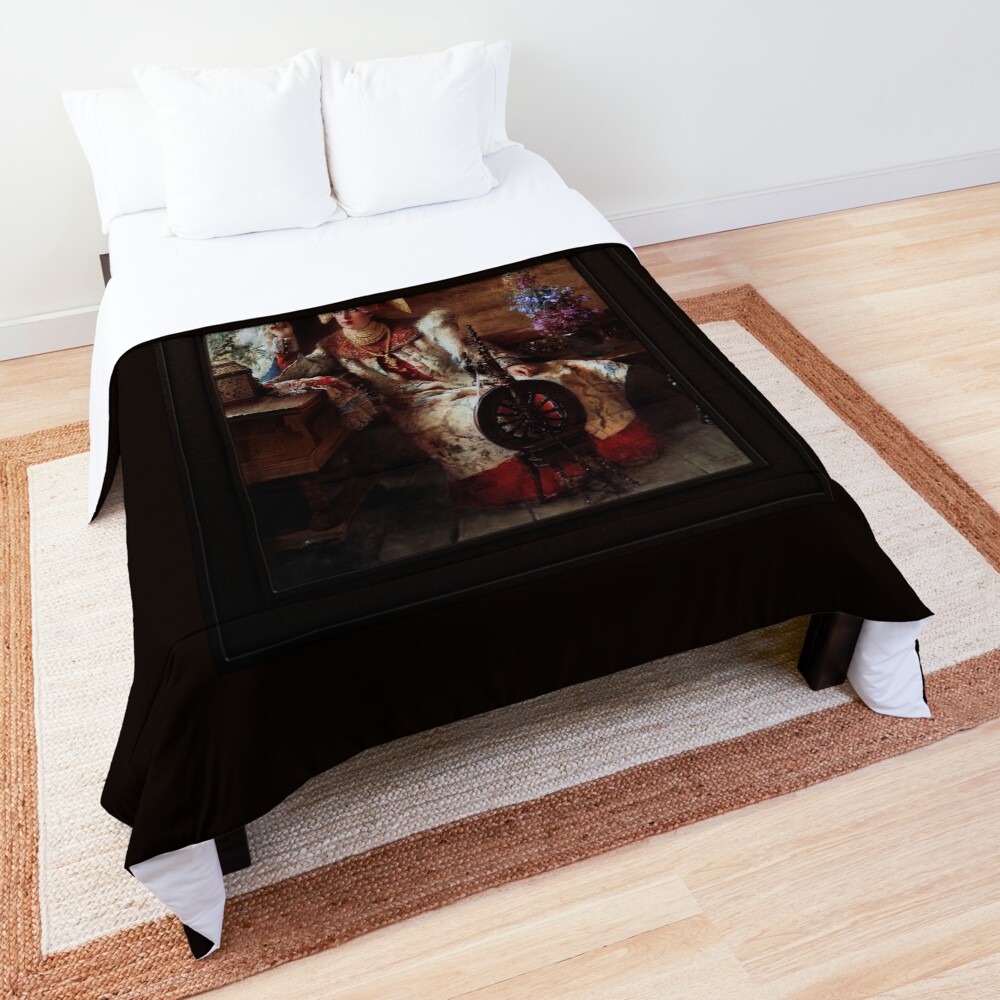
A Boyarina Beauty is a remastered digital art old masters reproduction of a public domain image that is available as a canvas print online.
Informações abaixo derivadas de Wikipédia.org
Konstantin Makovsky was an influential Russian painter, affiliated with the “Peredvizhniki (Wanderers)”. Many of his historical paintings, such as Beneath the Crown (1889) also known as The Russian Bride’s Attire and Before the Wedding, showed an idealized view of Russian life of prior centuries. He is often considered a representative of Academic art.
Konstantin Makovsky was born in Moscow. His father was the Russian art figure and amateur painter, Yegor Ivanovich Makovsky. His mother was a composer, and she hoped her son would one day follow in her footsteps. His younger brothers Vladimir and Nikolay and his sister Alexandra also went on to become painters.
Em 1851 Makovsky entered the Moscow School of Painting, Sculpture and Architecture where he became the top student, easily getting all the available awards. His teachers were Karl Bryullov and Vasily Tropinin. Makovsky’s inclinations to Romanticism and decorative effects can be explained by the influence of Bryullov.

Although art was his passion, he also considered what his mother had wanted him to do. He set off to look for composers he could refer to, and first went to France. Before, he had always been a classical music lover, and listened to many pieces. He often wished he could change the tune, or style of some of them to make them more enjoyable. Later in his life it came true.
Em 1858 Makovsky entered the Imperial Academy of Arts in Saint Petersburg. De 1860 he participated in the Academy’s exhibitions with paintings such as Curing of the Blind (1860) and Agents of the False Dmitry kill the son of Boris Godunov (1862). Em 1863 Makovsky e outros treze estudantes protestaram contra a definição de tópicos da mitologia escandinava pela Academia na competição pela Grande Medalha de Ouro da Academia; todos saíram da academia sem diploma formal.
Makovsky became a member of a co-operative (artel) of artists led by Ivan Kramskoi, normalmente produzindo pinturas de Wanderers sobre a vida cotidiana (Viúva 1865, Vendedor de arenque 1867, etc.). De 1870 foi membro fundador da Society for Travelling Art Exhibitions e continuou a trabalhar em pinturas dedicadas à vida quotidiana. Expôs seus trabalhos tanto nas exposições da Academia quanto nas Mostras de Arte Itinerantes dos Andarilhos..
Uma mudança significativa em seu estilo ocorreu depois de viajar para o Egito e a Sérvia em meados da década de 1870.. Seus interesses mudaram dos problemas sociais e psicológicos para os problemas artísticos de cores e formas..
Na década de 1880, ele se tornou um autor da moda de retratos e pinturas históricas.. Na Feira Mundial de 1889 em Paris recebeu a Grande Medalha de Ouro por suas pinturas Morte de Ivan, o Terrível, O Julgamento de Paris, e Demônio e Tamara. He was one of the most highly appreciated and highly paid Russian artists of the time. Many democratic critics considered him as a renegade of the Wanderers’ ideals, producing (like Henryk Siemiradzki) striking but shallow works, while others see him as a forerunner of Russian Impressionism.
Makovsky foi morto em 1915 quando sua carruagem foi atropelada por um bonde elétrico em São Petersburgo.