

A Capriccio Of Roman Ruins and the Arch of Constantine
A Capriccio Of Roman Ruins and the Arch of Constantine c1755 by Giovanni Paolo Pannini (1691 – 1765); known as an architect and painter of his vistas of Rome, detailing the antiquities of that great city.
This architectural fantasy among Roman Ruins and the Arch of Constantine shows men women and children gathered near a fountain that have come to listen to a profit speak.
Questa hè una ripruduzzione di l'antichi maestri di l'arti digitale ritoccata di una maghjina di duminiu publicu.
Info sottu Derivatu da Wikipedia.org
Giovanni Paolo Panini ou Giovanni Paolo Pannini était un peintre et architecte qui a travaillé à Rome et est principalement connu comme l'un des vedutisti (“view painters”).
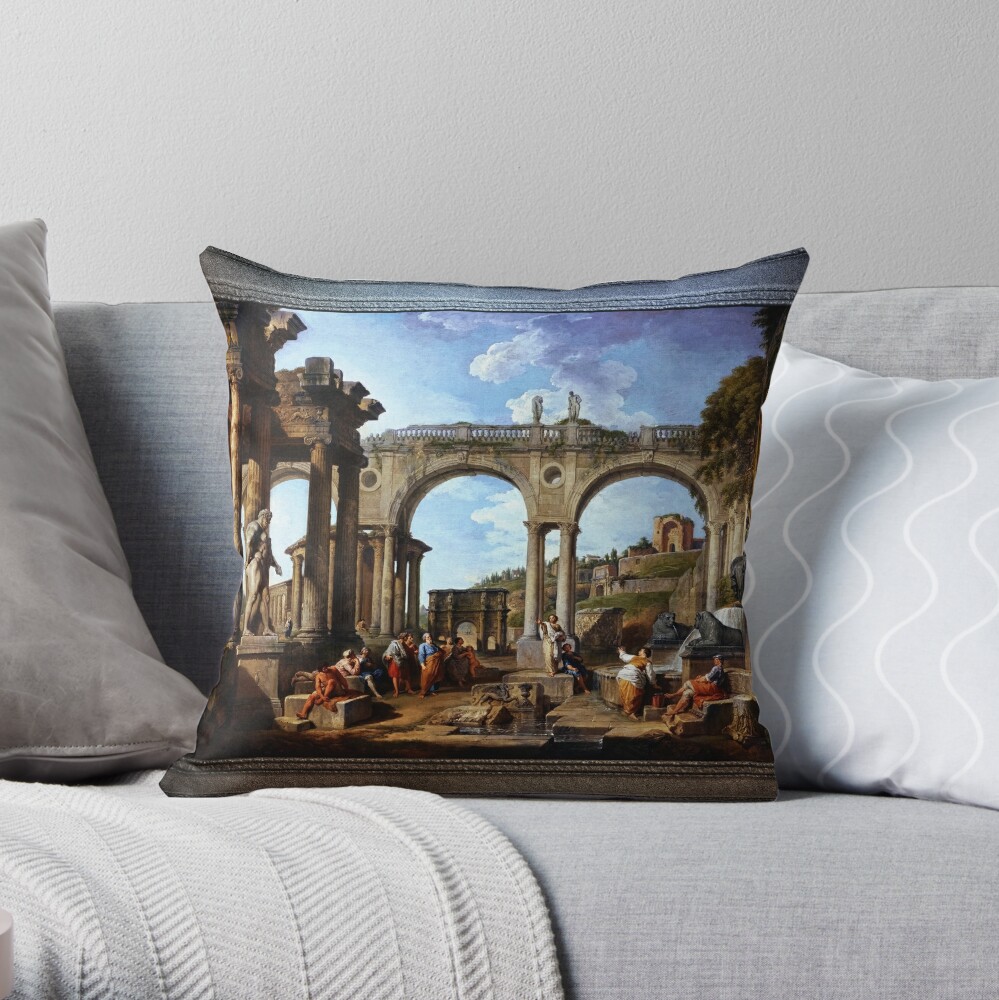
Cum'è un pittore, Pannini hè più cunnisciutu per e so vedute di Roma, in which he took a particular interest in the city’s antiquities.
Trà i so opere più famose sò a so vista di l'internu di u Pantheon (au nom de Francesco Algarotti 1712 – 1764 – Un polimaticu venezianu), è i so pitture vedute di galerie di pittura chì cuntenenu vedute di Roma.
A maiò parte di e so opere, in particulare quelli di ruvine, hannu un embellishment fantasiosa è irreale carattiristichi di temi capricciu. En cela ils ressemblent aux capricci du peintre et graveur italien Marco Ricci (1676 – 1730).
Panini hà ancu fattu ritratti, cumpresu unu di u Papa Benedettu XIV (né Prospero Lorenzo Lambertini 1675 – 1758 – Capu di a Chiesa Cattolica da 1740 – 1758).
In Roma, Panini hà guadagnatu un nome per ellu stessu cum'è decoratore di palazzi. Parmi ses œuvres figure la Villa Patrizi c1719/25, u Palazzo de Carolis c1720, è u Seminariu Rumanu c1721 / 22).
In 1719, Panini hè statu ammissu à a Cungregazione di i Virtuosi al Pantheon. Il a enseigné à Rome à l'Accademia di San Luca et à l'Académie de France, induve si dice chì hà influenzatu Jean-Honoré Fragonard. In 1754, serviu cum'è principe (direttore) de l'Accademia di San Luca.