

Kapriko de la Roma Forumo c1741
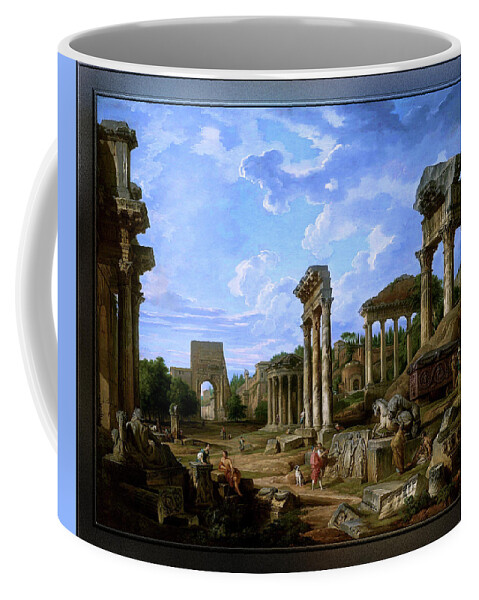
“Kapriko de la Roma Forumo” estas rimarkinda pentraĵo kreita en 1741 de la estimata itala artisto Giovanni Paolo Pannini (1691 – 1765). Konata pro lia majstrado en arkitektura kaj pejzaĝo, La laboro de Pannini enkapsuligas kaj la grandiozecon kaj la melankolion de la pasinteco, miksante historiajn elementojn kun vigla imagiva aliro. Ĉi tiu aparta peco, a “kaprico,” funkcias kiel arta interpreto de la Roma Forumo, elvokante senton de klasika antikveco dum ankaŭ elmontrante la karakterizan stilon de Pannini de kombinado de realaj kaj imagaj elementoj en kohezia sed mirinda kunmetaĵo..
Enhavtabelo
Temo kaj Stilo
La temo de “Kapriko de la Roma Forumo” revolves around the notion of historical ruin and nostalgia for a bygone civilization. It evokes the spirit of the Grand Tour, a traditional journey undertaken by young European aristocrats to explore the cultural and architectural heritage of ancient Rome. Pannini, well-versed in the visual language of Rome’s architectural splendor, captures the Roman Forum in a dramatic, almost theatrical manner. His painting fuses the past and present, incorporating elements of historical accuracy alongside a certain level of artistic license. This capriccio, which was popular during the 18th century, often included anachronisms and artistic embellishments, creating a romanticized version of architectural ruins.
The style of the painting aligns with the Rococo period, marked by a lighter, more decorative approach compared to the baroque. Although Pannini’s work possesses the detailed realism typical of the baroque, there is an underlying grace and fluidity to his composition, indicative of the Rococo influence. The grandiose ruins of the Roman Forum are presented with a sense of elegance and poetic beauty, underlined by the calmness of the sky and the serenity of the figures within the scene.
Ĉefa temo kaj konsisto
At the center of this work is the Roman Forum itself, the once vibrant heart of ancient Roman life, now reduced to crumbling ruins. Pannini captures the architectural elements in extraordinary detail, showcasing a variety of columns, arkoj, and statues that were iconic to the Roman Empire. These structures are depicted with a sense of scale and perspective that invites the viewer to explore the scene from multiple angles, enhancing the immersive quality of the painting.
The foreground is rich with artifacts, such as broken columns and stone blocks, as well as classical sculptures. Ĉi tiuj elementoj, although fragmented and damaged, convey the idea of a civilization that has left behind a lasting cultural legacy. Several figures, dressed in 18th-century clothing, populate the scene, contrasting the ruins with contemporary life. These figures, likely tourists or scholars, are portrayed in various poses, some deep in conversation, while others gaze at the ruins in awe. This interaction between modern people and ancient architecture serves to emphasize the idea of continuity and the passage of time.
Maldekstren, a majestic arch stands in partial ruin, with fragments scattered around its base, suggesting the ravages of time and the erosion of history. The arch is likely a representation of one of the famous Roman triumphal arches, evoking the grandeur of the Roman Empire’s military victories. On the right side, more ruins emerge from the landscape, with large stone blocks and the remnants of statuary. The figures that inhabit the space are placed thoughtfully, leading the viewer’s eye across the scene, guiding them from one architectural fragment to the next.
Tereno kaj Materialoj
The terrain depicted in the painting is characteristic of the Roman Forum, with its uneven surfaces, rocky ground, and broken columns. Pannini’s treatment of the earth beneath the ruins is both realistic and detailed, with patches of grass and trees emerging from between the stone fragments. The sky above is expansive and luminous, painted with soft, diffused light that contrasts with the darker, shadowed areas of the ruins below. This treatment of light and shadow enhances the dramatic effect of the scene, creating a sense of timelessness that envelops the viewer.
Pannini’s use of oil paints allows for a nuanced rendering of textures and surfaces. The stone appears solid and tangible, with the varying tones of grey, beige, and ochre capturing the natural decay of time. The sky is rendered with delicate brushstrokes, with soft clouds drifting above, providing a serene contrast to the monumental structures below. The figures are painted with an acute attention to detail, their clothing rendered in a way that suggests the materiality of the fabrics, further drawing the viewer into the scene. The overall composition conveys a sense of both grandeur and desolation, creating an emotional connection with the viewer that transcends mere architectural representation.
Humoro kaj Atmosfero
La humoro de “Kapriko de la Roma Forumo” is one of reflection and nostalgia. There is a sense of awe that permeates the work, evoked both by the monumental scale of the ruins and by the presence of the figures, who seem to be lost in thought as they engage with the past. The ancient ruins speak of lost civilizations, their grandeur now reduced to fragments and memories. Tamen, there is also a quiet reverence in the scene, a celebration of the enduring legacy of the Roman Empire.
The sky, with its soft hues of blue and white, adds to the overall tranquility of the scene, enhancing the feeling of peace that accompanies the ruins. Despite the crumbling nature of the structures, estas beleco en ilia kadukiĝo, kvazaŭ ili atingis sentempan ekvilibron kun la naturo. Ĉi tiu interagado inter la daŭra forto de la Romia Imperio kaj la neevitebla tempopaso enigas la pentraĵon per melankolia sed serena atmosfero..
Konkludo
Tiu de Giovanni Paolo Pannini “Kapriko de la Roma Forumo” estas majstra verko, kiu kaptas la belecon kaj malfortikecon de antikva Romo. Tra lia zorgema interpreto de arkitekturaj detaloj, la apudmeto de modernaj figuroj kaj antikvaj ruinoj, kaj la elvokiva etoso, Pannini kreas scenon kiu estas kaj tributo al la pasinteco kaj reflektado sur la paso de tempo. La pentraĵo funkcias kiel vida meditado pri la rilato inter historio, memoro, kaj la fizikaj restaĵoj de iam granda civilizacio.
This is a retouched digital art reproduction of a public domain image that is available online on a many produktoj por hejma dekoracio.
Artisto Bio derivita de Vikipedio.org
Giovanni Paolo Panini aŭ Giovanni Paolo Pannini estis farbisto kaj arkitekto kiu laboris en Romo kaj estas ĉefe konata kiel unu el la vedutisti. (“Vidi pentristojn”).
Kiel pentristo, Pannini estas plej konata por siaj vidoj de Romo, en kiu li okupis apartan intereson pri la antikvaĵoj de la urbo.
Inter liaj plej famaj verkoj estas lia vido de la interno de la Panteono (nome de Francesco Algarotti 1712 – 1764 – Venecia Polimatikisto), kaj liaj vedute pentraĵoj de bildgalerioj enhavantaj vidojn de Romo.
La plej multaj el liaj verkoj, precipe tiuj de ruinoj, havas fantazian kaj nerealan plibeligon karakterizan de kapriĉaj temoj. En tio ili similas la kapricci de itala farbisto kaj presaĵfaristo Marco Ricci (1676 – 1730).
Panini ankaŭ pentris portretojn, inkluzive de unu el papo Benedikto la 14-a (naskita Prospero Lorenzo Lambertini 1675 – 1758 – Estro de la Katolika Eklezio de 1740 – 1758).
En Romo, Panini gajnis nomon por li mem kiel dekoraciisto de palacoj. Kelkaj el liaj verkoj inkludis la Villa Patrizi c1719/25, la Palaco de Carolis c1720, kaj la Roma Seminario c1721/22).
En 1719, Panini estis allasita al la Parokanaro de la Virtuosi al Panteono. Li instruis en Romo ĉe la Accademia di San Luca kaj la Académie de France, kie li laŭdire influis Jean-Honoré Fragonard. En 1754, li servis kiel la princo (direktoro) de la Accademia di San Luca.