

A Girl With A Dead Canary
“A Girl With A Dead Canary,” painted by French artist Jean-Baptiste Greuze (1725 – 1805), is a poignant and thought-provoking work that reflects the artist’s skill in capturing human emotion through delicate and detailed expressions. Created in the latter half of the 18th century, this piece exemplifies the Rococo and early Neoclassical styles that defined much of Greuze’s career. The emotional intensity of the painting, paired with its subject matter, explores themes of loss, Senkulpeco, and the fragile nature of life, common concerns of the time.
Enhavtabelo
La Ĉefa Temo
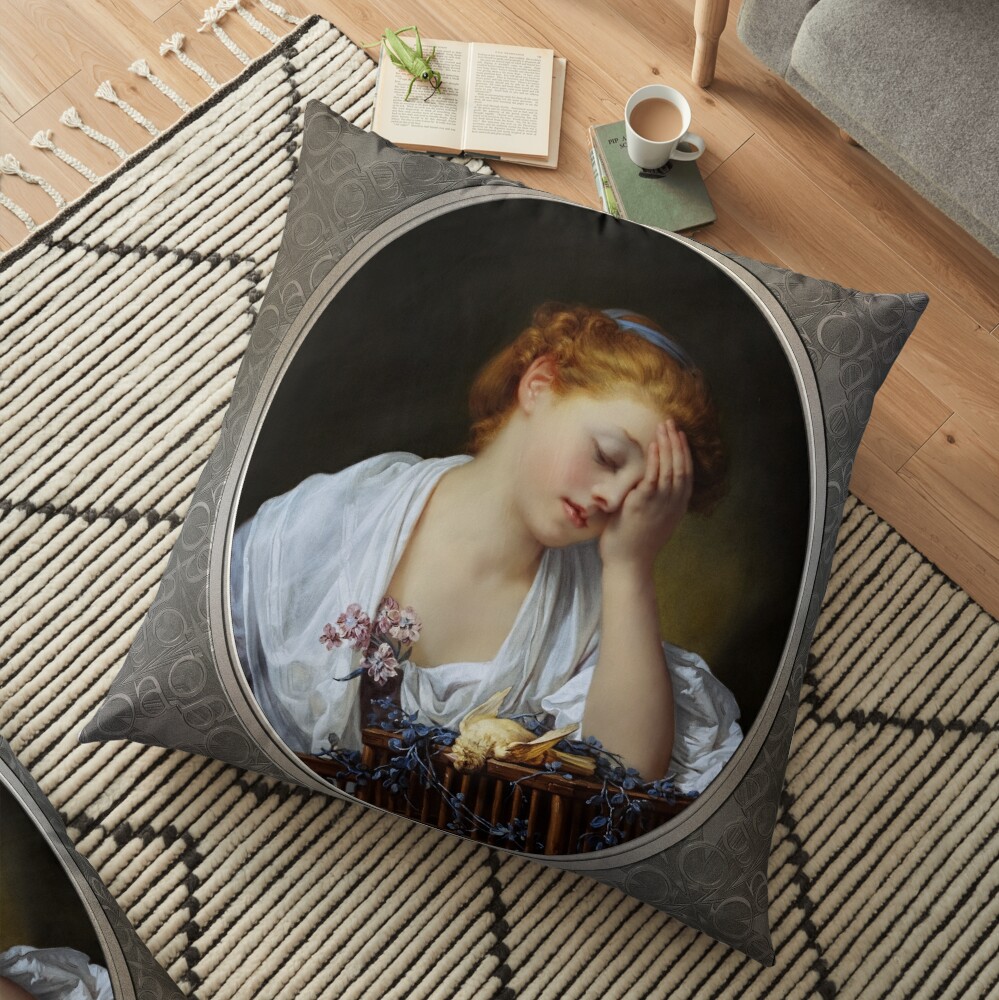
At the heart of this piece is the image of a young girl, her face marked by a deep sense of sorrow and contemplation. The girl is depicted with a naturalistic yet idealized beauty, characteristic of the Rococo style, kun mola, delicate features and smooth skin. Her posture is languid yet graceful, with her right hand placed gently against her forehead, as if overwhelmed by grief or distress. The girl’s eyes are partially closed, her gaze directed downward in a moment of quiet sorrow, lending an air of introspection and melancholy to the scene.
La temo, though youthful and tender in appearance, conveys a mature emotional depth. The girl’s expression is filled with quiet resignation, possibly a reflection on the death of the canary in her hand, which becomes the central motif of the artwork. The girl’s lips are slightly parted, suggesting an inward focus or the beginning of a sigh, reinforcing the sense of loss that pervades the composition. She is dressed in simple yet elegant white attire, which enhances her ethereal quality and focuses the viewer’s attention on her expression and the symbolism surrounding her.
The Dead Canary
In the girl’s left hand rests a dead canary, its small body lifeless and limp, positioned delicately alongside the girl’s skin. The bird’s natural beauty contrasts sharply with its death, and its fragility is emphasized by the tender handling of its form. The canary, a symbol of innocence and fragility, was often associated with themes of loss during the 18th century, particularly in works of art where death or suffering was a focal point. The bird’s delicate feathers and vivid yellow hue, though faded in death, are stark against the girl’s pale skin and the muted tones of the background.
The placement of the canary in the composition creates a balance between the girl’s sorrow and the physical object she holds. It is almost as if the girl’s grief is intertwined with the fate of the bird, serving as an emotional metaphor for her own youth and innocence, now marred by the irreversible passage of time or the inevitability of mortality. The canary’s death becomes a poignant symbol of life’s impermanence, a theme that resonates deeply within the context of 18th-century art and culture.
The Terrain and Materials
The background of the painting is dark and unobtrusive, with a smooth gradient of deep brown and black tones that do not distract from the central subject. This subtle backdrop creates a stark contrast to the girl’s delicate skin tones and the bright yellow feathers of the canary, focusing all attention on the emotional expression and the symbolism conveyed through the subject and her gesture. The artist’s use of light and shadow emphasizes the softness of the girl’s features and the texture of her attire, adding to the overall atmosphere of fragility and vulnerability.
The artist’s material choice of oil paint allows for a smooth, almost velvety finish, with every detail of the girl’s skin, haroj, and the canary rendered in exquisite realism. The texture of the girl’s white dress is particularly notable, its fine folds and delicate creases painted with careful attention to light and shadow. This technique reflects Greuze’s mastery in rendering fabrics and textures, which was a hallmark of his work. The oils also serve to capture the subtle play of light on the girl’s skin, lending her a soft, luminous quality that enhances the overall emotional impact of the piece.
The materials and the use of light within the painting create an almost lifelike sense of presence, drawing the viewer into the intimate moment captured by Greuze. The attention to detail in the girl’s facial expression and the posture of her hands further invites contemplation, making this artwork a deeply moving and introspective piece.
Stilo, Temo, kaj humoro
The Rococo style, known for its emphasis on grace, Eleganteco, kaj emocia intenseco, is apparent in the lightness of the girl’s attire and the fine detail of the canary. Tamen, Greuze’s painting moves beyond mere Rococo frivolity, with the artist adopting a more serious, reflective tone that aligns with the emerging Neoclassical interest in moral and emotional themes. The artist’s focus on human emotion, particularly the complex and often painful feelings associated with loss, suggests a transition from the lighter, more decorative themes of Rococo art to a more somber and introspective approach.
The mood of the painting is one of quiet sorrow, with the girl’s contemplation and the symbolism of the dead canary serving as a meditation on mortality, Senkulpeco, and the fragility of life. The painting evokes a sense of empathy and introspection in the viewer, as the expression on the girl’s face suggests both vulnerability and the inevitability of loss. This emotional depth and subtlety are characteristic of Greuze’s work, which often sought to evoke strong, sentimental reactions from the viewer, particularly through the portrayal of youthful figures in moments of emotional intensity.
The theme of loss in “A Girl With A Dead Canary” speaks to the human experience of grief and the way in which small moments of sorrow can be amplified by emotional reflection. The girl’s sorrowful expression, paired with the delicate stillness of the dead bird, forms a visual metaphor for the fragility of innocence, youth, and life itself. It is a contemplative piece, encouraging the viewer to reflect on the transient nature of existence and the inevitable passage of time.
Konkludo
“A Girl With A Dead Canary” is a masterful example of Jean-Baptiste Greuze’s ability to evoke deep emotion and reflection through his detailed and expressive portraits. Through the use of light, teksturo, kaj simboleco, Greuze captures the delicate balance between beauty and loss, innocence and mortality. The painting’s somber mood, paired with its exquisite technical execution, makes it a remarkable representation of the human experience and a poignant meditation on the fragility of life.
Ĉi tio estas readaptita cifereca arto malnova majstra reproduktaĵo de publika domajna bildo aĉetebla interrete kiel a ruliĝinta tolo presaĵo.
Ĉi tiu cifereca arta kreaĵo, kiel kun ĉiuj artaĵoj, kiuj troveblas en la retejo de Xzendor7, estas aĉetebla interrete en diversaj materialaj formatoj inkluzive de kanvasaj presaĵoj., akrilaj presaĵoj, metalaj presaĵoj, lignaj presaĵoj, enkadrigitaj presaĵoj, afiŝoj, kaj kiel rulitaj kanvasaj presaĵoj en diversaj grandecoj de 12 colojn al 72 coloj depende de la grandeco de la reala artaĵo kaj la presaĵo laŭpeta butiko, de kiu vi elektas aĉeti la arton.
La artaĵo ankaŭ haveblas sur larĝa gamo de vestaĵoj de viroj kaj virinoj, tasoj, totoj, koltukoj, kajeroj kaj ĵurnaloj kaj multaj hejmornamaj produktoj.
Photo Retouching Of Portrait Of A Girl With A Dead Canary
Pri La Artisto
La Subaj Informoj Devenas NGA.gov
Jean estis naskita en Tournus, Francio en 1725 kiel la sesa filo de majstro kahelisto kiu rekonis sian talenton en tre frua aĝo; sendante lin al Liono, Francio por studi kun la franca portretisto Charles Grandon (1691 – 1762).
Ĉirkaŭ la aĝo de 30 li forlasis Lionon, kaj vojaĝis al Parizo, Francio por studi ĉe la Académie Royale de peinture et de sculpture aŭ la Reĝa Akademio de Pentraĵo kaj Skulptaĵo; kiu tiutempe estis la ĉefranga artinstitucio de Francio dum ĉi-lasta parto de la Ancien Régime (Malnova Regimo ~1500 al 1789), ĝis ĝi estis abolita en 1793 dum la Franca Revolucio.
Kvankam tre talenta kaj tre sukcesa dum la 1760-aj jaroj kaj 1770-aj jaroj, havante patronojn de similaĵoj de la markizino de Pompadour (1721 – 1764), Imperiestrino Katarina la 2-a de Rusio (r. 1762 – 1796), kaj Ange Laurent de La Live de Jully (1725 – 1779); lia ribelema naturo kaj konfliktoj kun Akademio- kaj Salon-oficialuloj pruvus esti lia misfortuno; precipe post lia geedziĝo kun Anne Marie Babuty en 1759; kio montriĝus por li katastrofo, ĉar ŝi estis konata ke ŝi havis diversajn amaferojn kun liaj studentoj kaj sidantoj, kiu kaŭzis al li perdon de enspezo kaj publikan humiligon.
Kiam la geedziĝo finiĝis 34 jarojn poste lia edzino ricevis grandan kompromison, kiu lasis lin en teruraj financaj rektaĵoj kaj antaŭ la tempo de lia morto en 1805 en la aĝo de 80 li estis preskaŭ rompita.