

A Heart Working Girl
Artwork Title, Date, and Artist
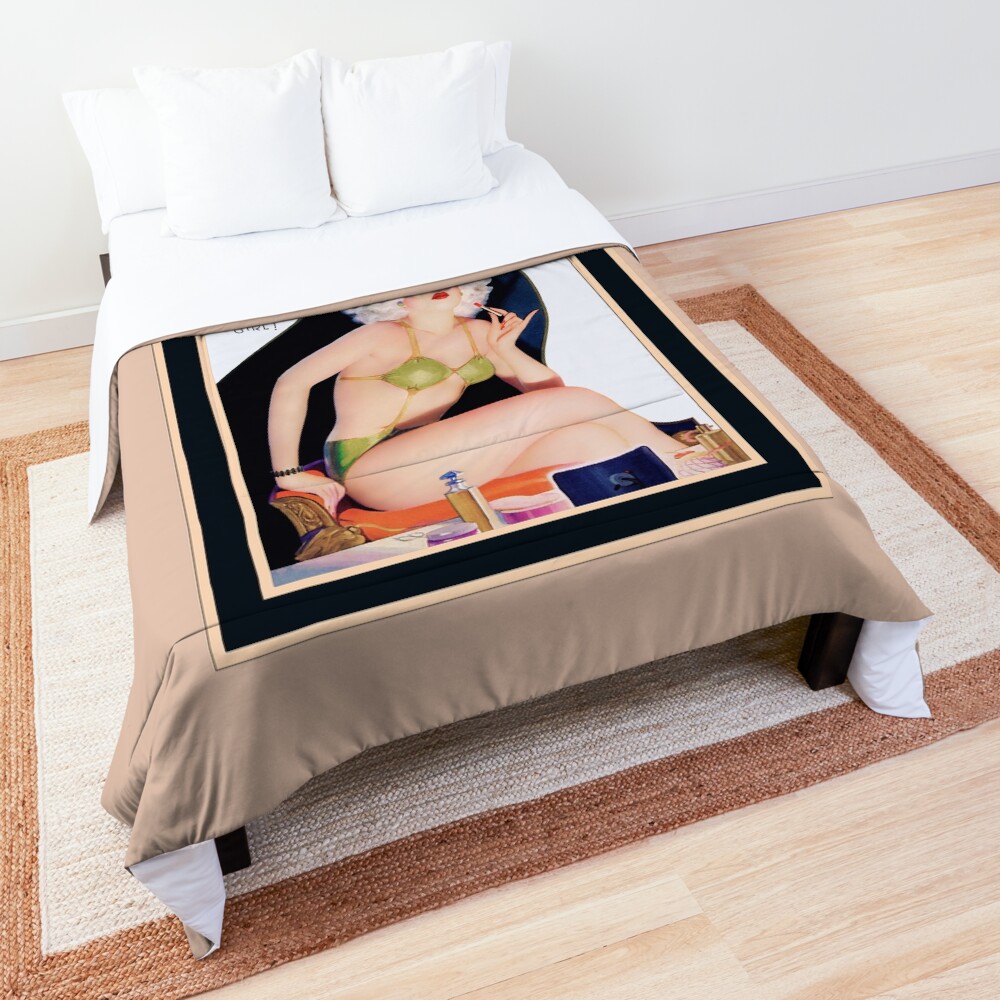
“A Heart Working Girl,” created by American painter Ĥanoĥ Bolles (1883-1976), presents a captivating and daring portrait from the early 20th century. The painting showcases a glamorous woman, adorned in vibrant green lingerie, striking an almost cinematic pose. Bolles, known for his pin-up art and advertisements, crafts an image filled with allure, Eleganteco, and subtly flirtatious energy, a true reflection of his signature style. The work exudes the sensibilities of the 1920s and 1930s, a time when such depictions of women in artwork were both celebrated and controversial.
Enhavtabelo
La Ĉefa Temo
The central figure of the artwork is a beautiful woman whose gaze is direct and self-assured, exuding an air of confidence. Her platinum blonde hair is styled in soft waves, reminiscent of Hollywood star Jean Harlow, a notable figure of the era. The model is dressed in a simple yet striking green lingerie set that emphasizes both her form and her daring, bold personality. The contrast between the playful, provocative pose and the soft, delicate quality of her features captures a moment frozen in time, where the woman asserts both strength and vulnerability.
The expression on her face is one of contemplative allure; her lips are painted red, kaj ŝiaj okuloj, lined with a touch of glamour, seem to hold a story untold. She holds a cigarette delicately in one hand, reinforcing the image of independence, moderneco, and rebellion that was often associated with the flapper era. The slight tilt of her head and the pose of her body speak to the art of seduction, yet the mood is neither overt nor aggressive but rather relaxed and nonchalant.
The Setting and Composition
Behind the model, there is a stark, almost minimal background with a gentle, curved black area that forms an almost abstract contrast to her figure. The background works to isolate the subject and emphasize her presence, ensuring that her figure stands out as the main focal point of the composition. The painting’s smooth, almost silky textures contribute to its intimate, sensual feel, drawing attention to the curves and lines of the woman’s body, her posture, and her expressions.
The setting is simplified, allowing the viewer to focus entirely on the model herself. The absence of excessive props or intricate scenery leaves the woman as the center of attention, reinforcing the idea of her as both a person and an icon. Her pose is relaxed, but the elements of the painting, such as her attire and facial expression, suggest that she occupies a world of her own, one where she defines her own success and autonomy. This treatment of the figure is typical of Bolles’ work, where the emphasis on the subject’s personality and boldness takes precedence over the external world.
Color Palette and Materials
Enoch Bolles is known for his vibrant use of color, kaj “A Heart Working Girl” ne estas escepto. The artist employs a lively color scheme, with the green of the woman’s lingerie contrasting sharply against the black background. The warm tones in her skin and the bright reds of her lipstick and fingernail polish further accentuate the beauty and the sensuality of her form. The bright, almost exaggerated use of color gives the image a dynamic energy, inviting the viewer to engage with the subject on a visual and emotional level.
The soft textures that Bolles has painted onto the woman’s skin suggest a smooth, almost porcelain quality. This helps emphasize the sense of glamour and high society, reflecting the idealized notion of femininity that was prevalent in the 1930s. The contrast between the vibrant hues of her lingerie and the muted background makes the model appear even more radiant, as though she is almost floating in a dreamlike state. The overall effect is one of both elegance and modernity.
Themes and Mood
“A Heart Working Girl” evokes a mood that is both playful and confident. The artwork captures the essence of the flapper culture of the 1920s, a time when women were beginning to assert their independence and explore new forms of self-expression. The painting’s title, “A Heart Working Girl,” alludes to the notion of a woman who is not only working hard in a literal sense, but also working her charm and confidence in a world where societal expectations of women were beginning to shift.
The mood is light-hearted but also carries a sense of empowerment, showcasing the woman as an active, self-reliant figure. There is an element of fantasy in the way she is portrayed, as if she is a vision of an idealized, almost untouchable beauty who exists outside the conventional constraints of society. Tamen, the painting’s sensual undertones also suggest that there is more to her than mere appearance—she is an individual with depth, konfido, and control over her own destiny.
The Legacy of Enoch Bolles
Ĥanoĥ Bolles’ works are a hallmark of the early 20th century pin-up style, kaj “A Heart Working Girl” stands as a fine example of this genre. His works often combined the glamour of Hollywood with the allure of pin-up art, kaj ĉi tiu peco ne estas escepto. The painting speaks to the cultural moment of the 1930s, a time of shifting societal norms and the rise of women in the workforce and public life. In Bolles’ hands, the subject of the pin-up was not just an object of desire, but a symbol of a more progressive, liberated woman.
Bolles’ artistic choices helped define the visual language of the era, blending realistic portraiture with the idealized images of femininity that dominated advertisements, afiŝoj, and illustrations of the time. His work remains a touchstone for understanding the intersection of art, culture, and society in the early 20th century, particularly in its depiction of women.
A Heart Working Girl by American Painter Ĥanoĥ Bolles (1883 – 1976); known as a glamour style pin-up art illustrator.
This is a sexy pinup girl illustration from the Art Deco era that features a beautiful platinum blonde in a one piece lime green bikini sitting by her makeup table; that has perfume bottles on it, a powder puff, a face cream jar, a bottle of perfume, a perfume sprayer, scissors, other accessories and a cosmetic mirror lamp that is illuminating her.
The model looks like it might be Jean Harlow (1911 – 1937) an American actress and Sex Symbol that was often referred to as the Platinum Blonde or Blonde Bombshell.
She is holding an open red lipstick tube in her left hand and wearing bracelet on her right wrist with her right hand supporting her by resting on the back of waist high chair she is sitting on.
Ĉi tio estas retuŝita cifereca arto malnova majstra reproduktaĵo de publika domajno bildo.
Ĉi tiu cifereca arta kreaĵo, kiel kun ĉiuj artaĵoj, kiuj troveblas en la retejo de Xzendor7, estas aĉetebla interrete en diversaj materialaj formatoj inkluzive de kanvasaj presaĵoj., akrilaj presaĵoj, metalaj presaĵoj, lignaj presaĵoj, enkadrigitaj presaĵoj, afiŝoj, kaj kiel rulitaj kanvasaj presaĵoj en diversaj grandecoj de 12 colojn al 72 coloj depende de la grandeco de la reala artaĵo kaj la presaĵo laŭpeta butiko, de kiu vi elektas aĉeti la arton.
La artaĵo ankaŭ haveblas sur larĝa gamo de vestaĵoj de viroj kaj virinoj, tasoj, totoj, koltukoj, kajeroj kaj ĵurnaloj kaj multaj hejmornamaj produktoj.
Artisto Bio
Informoj Malsupre Derivita De Vikipedio.org
Ĥanoĥo estis naskita al parfuma apotekisto Enoch Bolles, Jr kaj Catherine Keep en Marion County, Florido en marto 3, 1883.
Li studis ĉe la New York Nacia Akademio de Dezajno (estas. 1825), kaj publikigis sian unuan ilustraĵon sur la kovroj de humurrevuoj; Juĝisto kaj Puck enen 1914; iĝante plej konata por ilustrado de la pulpa revuo Film Fun.
Tiam en 1923 li iĝis la ekskluziva kovrilartisto por Film Magazine kaj daŭrus en tiu pozicio ĝis 1943, when the magazine became a victim of the then Postmaster General’s campaign against salacious material.
During Enoch’s time with Film Fun Magazine he created 200 pecoj kovras arton, kaj almenaŭ 300 kromaj kovriloj por aliaj spicaj pulpaj revuoj, inkluzive de Breezy Stories, Pep kaj Novjorkaj Noktoj.
Enoch’s monthly lineup of the All-American Beauty precisely posed in imaginative costume is responsible for defining the art of American Pin Up Illustration. Li ankaŭ estis multflanka ilustristo kiu kreis reklamarton por multaj produktoj de la tempo kiel ekzemple Sun-Maid Raisins kaj Zippo Lighters..
En la aĝo de 60, en 1943 Ĥanoĥ devis fini sian profesian karieron pro psikologiaj problemoj, kaj estis enŝlosita lin al Greystone Park Psychiatric Hospital en Nov-Ĵerzejo por la plej granda parto de la resto de lia vivo; sed li daŭre pentris menditajn portretojn kaj por persona ĝuo.
Li estis poste liberigita de la Greystone Parka Psikiatria Hospitalo en 1969 kaj li forpasis sep jarojn poste pro korinsuficienco en la aĝo de 93.