

A Heart Working Girl
Título da obra, Date, and Artist
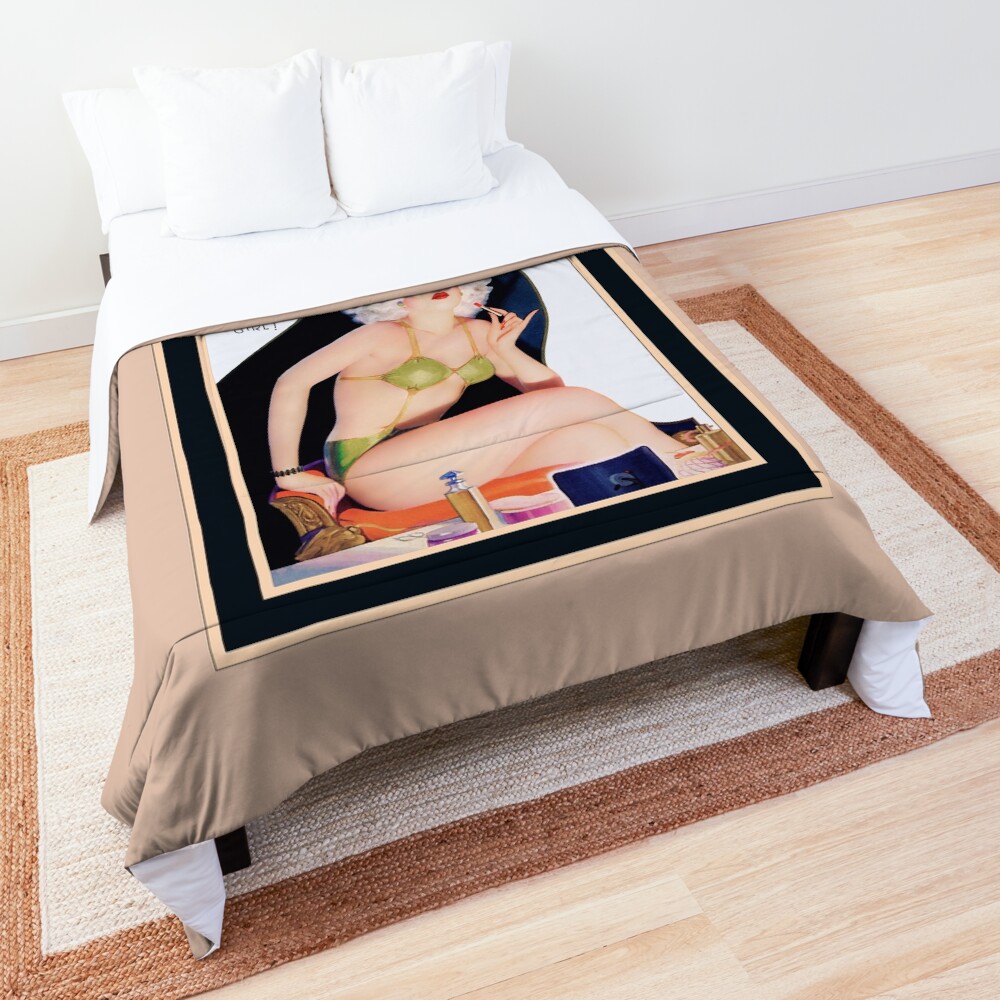
“A Heart Working Girl,” created by American painter Enoque Bolles (1883-1976), presents a captivating and daring portrait from the early 20th century. The painting showcases a glamorous woman, adorned in vibrant green lingerie, striking an almost cinematic pose. Bolles, known for his pin-up art and advertisements, crafts an image filled with allure, elegância, and subtly flirtatious energy, a true reflection of his signature style. The work exudes the sensibilities of the 1920s and 1930s, a time when such depictions of women in artwork were both celebrated and controversial.
Índice
O assunto principal
The central figure of the artwork is a beautiful woman whose gaze is direct and self-assured, exuding an air of confidence. Her platinum blonde hair is styled in soft waves, reminiscent of Hollywood star Jean Harlow, a notable figure of the era. The model is dressed in a simple yet striking green lingerie set that emphasizes both her form and her daring, bold personality. The contrast between the playful, provocative pose and the soft, delicate quality of her features captures a moment frozen in time, where the woman asserts both strength and vulnerability.
The expression on her face is one of contemplative allure; her lips are painted red, and her eyes, lined with a touch of glamour, seem to hold a story untold. She holds a cigarette delicately in one hand, reinforcing the image of independence, modernity, and rebellion that was often associated with the flapper era. The slight tilt of her head and the pose of her body speak to the art of seduction, yet the mood is neither overt nor aggressive but rather relaxed and nonchalant.
The Setting and Composition
Behind the model, there is a stark, almost minimal background with a gentle, curved black area that forms an almost abstract contrast to her figure. The background works to isolate the subject and emphasize her presence, ensuring that her figure stands out as the main focal point of the composition. The painting’s smooth, almost silky textures contribute to its intimate, sensual feel, drawing attention to the curves and lines of the woman’s body, her posture, and her expressions.
The setting is simplified, allowing the viewer to focus entirely on the model herself. A ausência de adereços excessivos ou cenários intrincados deixa a mulher como centro das atenções, reforçando a ideia dela como pessoa e ícone. Sua pose é relaxada, mas os elementos da pintura, como seu traje e expressão facial, sugerem que ela ocupa um mundo próprio, aquele onde ela define seu próprio sucesso e autonomia. Este tratamento da figura é típico de Bolles’ trabalhar, onde a ênfase na personalidade e ousadia do sujeito tem precedência sobre o mundo externo.
Color Palette and Materials
Enoch Bolles é conhecido por seu uso vibrante de cores, e “A Heart Working Girl” não é exceção. O artista emprega um esquema de cores vivas, com o verde da lingerie da mulher contrastando fortemente com o fundo preto. Os tons quentes de sua pele e os vermelhos brilhantes de seu batom e esmalte acentuam ainda mais a beleza e a sensualidade de suas formas.. O brilhante, o uso quase exagerado da cor confere à imagem uma energia dinâmica, convidando o espectador a se envolver com o assunto em um nível visual e emocional.
As texturas suaves que Bolles pintou na pele da mulher sugerem um toque suave, qualidade quase porcelana. Isso ajuda a enfatizar a sensação de glamour e da alta sociedade, refletindo a noção idealizada de feminilidade que prevalecia na década de 1930. O contraste entre os tons vibrantes de sua lingerie e o fundo suave deixa a modelo ainda mais radiante, como se ela estivesse quase flutuando em um estado de sonho. O efeito geral é de elegância e modernidade.
Themes and Mood
“A Heart Working Girl” evokes a mood that is both playful and confident. The artwork captures the essence of the flapper culture of the 1920s, a time when women were beginning to assert their independence and explore new forms of self-expression. The painting’s title, “A Heart Working Girl,” alludes to the notion of a woman who is not only working hard in a literal sense, but also working her charm and confidence in a world where societal expectations of women were beginning to shift.
The mood is light-hearted but also carries a sense of empowerment, showcasing the woman as an active, self-reliant figure. There is an element of fantasy in the way she is portrayed, as if she is a vision of an idealized, almost untouchable beauty who exists outside the conventional constraints of society. Ainda, the painting’s sensual undertones also suggest that there is more to her than mere appearance—she is an individual with depth, confidence, and control over her own destiny.
The Legacy of Enoch Bolles
Enoque Bolles’ works are a hallmark of the early 20th century pin-up style, e “A Heart Working Girl” stands as a fine example of this genre. His works often combined the glamour of Hollywood with the allure of pin-up art, and this piece is no exception. The painting speaks to the cultural moment of the 1930s, a time of shifting societal norms and the rise of women in the workforce and public life. In Bolles’ hands, the subject of the pin-up was not just an object of desire, but a symbol of a more progressive, liberated woman.
Bolles’ artistic choices helped define the visual language of the era, blending realistic portraiture with the idealized images of femininity that dominated advertisements, cartazes, and illustrations of the time. His work remains a touchstone for understanding the intersection of art, cultura, and society in the early 20th century, particularly in its depiction of women.
A Heart Working Girl by American Painter Enoque Bolles (1883 – 1976); known as a glamour style pin-up art illustrator.
This is a sexy pinup girl illustration from the Art Deco era that features a beautiful platinum blonde in a one piece lime green bikini sitting by her makeup table; that has perfume bottles on it, a powder puff, a face cream jar, a bottle of perfume, a perfume sprayer, scissors, other accessories and a cosmetic mirror lamp that is illuminating her.
The model looks like it might be Jean Harlow (1911 – 1937) an American actress and Sex Symbol that was often referred to as the Platinum Blonde or Blonde Bombshell.
She is holding an open red lipstick tube in her left hand and wearing bracelet on her right wrist with her right hand supporting her by resting on the back of waist high chair she is sitting on.
Esta é uma reprodução retocada de arte digital de antigos mestres de uma imagem de domínio público.
Esta criação de arte digital, assim como todas as obras de arte que podem ser encontradas no site do Xzendor7 estão disponíveis para compra on-line em uma variedade de formatos de materiais, incluindo impressões em tela, impressões acrílicas, impressões metálicas, gravuras em madeira, impressões emolduradas, cartazes, e como impressões em tela enrolada em vários tamanhos, desde 12 polegadas para 72 polegadas, dependendo do tamanho da obra de arte real e da loja de impressão sob demanda em que você escolher comprar a arte.
A arte também está disponível em uma ampla variedade de roupas masculinas e femininas, canecas, bolsas, lenços, cadernos e diários e muitos produtos de decoração para casa.
Biografia do artista
Informações abaixo derivadas de Wikipédia.org
Enoch was born to perfume chemist Enoch Bolles, Jr and Catherine Keep in Marion County, Florida on March 3, 1883.
He studied at the New York National Academy of Design (est. 1825), and published his first illustration on the covers of humor magazines; Judge and Puck in 1914; becoming best known for illustrating the pulp magazine Film Fun.
Então em 1923 he became the exclusive cover artist for Film Magazine and would continue in that position until 1943, when the magazine became a victim of the then Postmaster General’s campaign against salacious material.
During Enoch’s time with Film Fun Magazine he created 200 pieces cover art, and at least 300 additional covers for other spicy pulp magazines, including Breezy Stories, Pep and New York Nights.
Enoch’s monthly lineup of the All-American Beauty precisely posed in imaginative costume is responsible for defining the art of American Pin Up Illustration. He was also a versatile illustrator that created advertising art for many products of the time such as Sun-Maid Raisins and Zippo Lighters.
Na idade de 60, em 1943 Enoch had to end is professional career due to psychological problems, and was confined him to Greystone Park Psychiatric Hospital in New Jersey for most of the rest of his life; but he continued to paint commissioned portraits and for personal enjoyment.
He was eventually released from the Greystone Park Psychiatric Hospital in 1969 and he passed away seven years later of heart failure at the age of 93.