

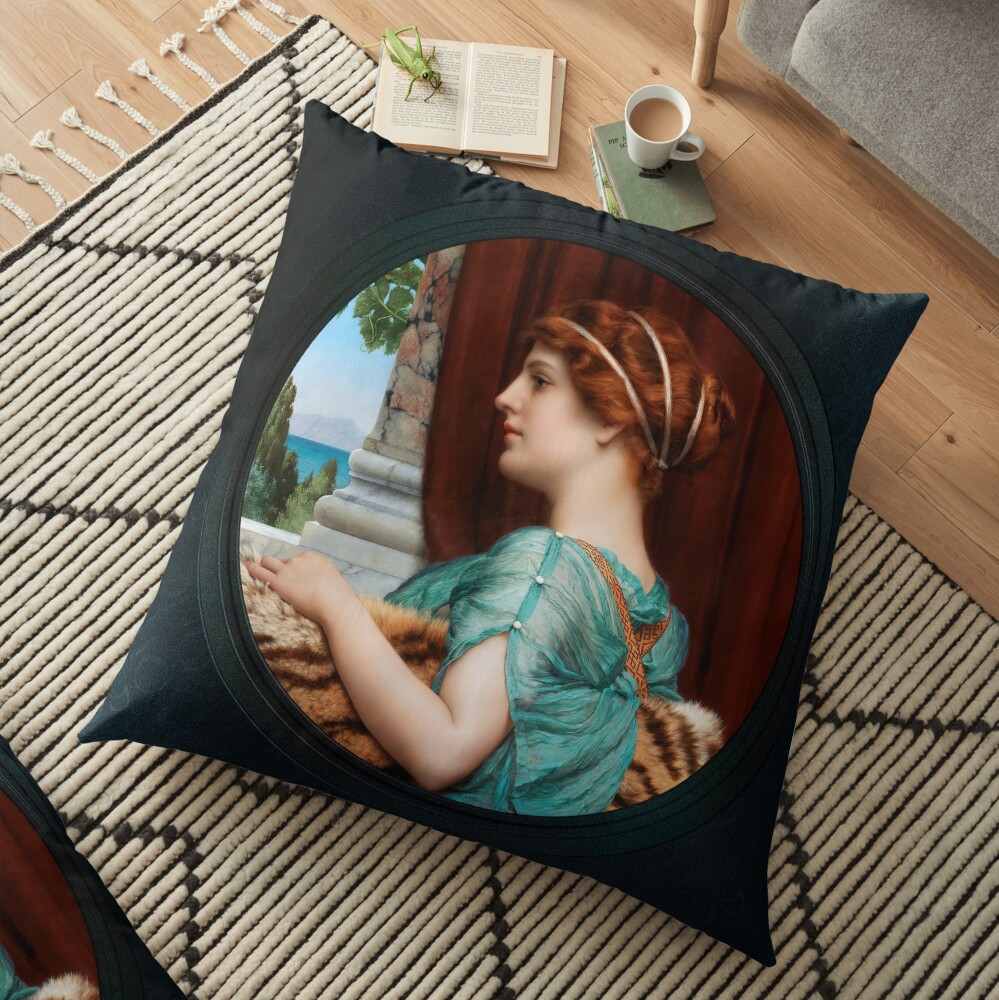
A Pompeian Lady c1904
L'obra d'art titulada “A Pompeian Lady c1904” by the British painter John William Godward (1861 – 1922) is a captivating example of the neoclassical style that was prevalent during the late 19th and early 20th centuries. Godward was renowned for his portraits of women in classical attire, often placed within luxurious, ancient Roman or Greek settings. Aquesta peça concreta, pintat al voltant 1904, encapsulates his meticulous attention to detail and his skill in capturing the elegance of the human form. It exemplifies the artist’s dedication to classical antiquity, with his subjects often portrayed in serene and introspective moods.
Taula de continguts
El tema de l'obra d'art
En “A Pompeian Lady c1904,” the main subject is a young woman dressed in an opulent, bata fluïda. Her attire is distinctly ancient Roman or Pompeian in style, reminiscent of the classical draped garments seen in the frescoes and sculptures from Pompeii. The woman’s posture is elegant and contemplative, as she gazes into the distance with a slight turn of her head. This pose exudes a sense of grace, while her expression remains calm and serene. The soft waves of her auburn hair are intricately styled, adorned with delicate headbands that emphasize the classical aesthetic of the time.
Her gaze is directed towards the natural beauty that lies outside the frame of the painting, suggesting a moment of quiet reflection. The painting’s composition draws attention to the delicate interplay between the figure’s posture and the surrounding environment. The softness of her features is contrasted against the sharp and detailed depiction of the materials in her attire, the textures of the background, and the natural elements in the landscape.
The Setting and Landscape
The setting of the painting features an outdoor terrace with a view of a lush, serene landscape. The woman is placed against a grand column made of marble, which serves to frame her figure while simultaneously grounding her within the classical world of ancient Rome. The background reveals an idyllic view of a coastal scene, where the sea meets the horizon under a clear, soft blue sky. Verdant trees and a tranquil landscape suggest a peaceful, secluded place, contributing to the overall sense of calm and elegance that pervades the work.
The architectural elements of the setting further emphasize the classical influence, with Roman-style columns and arches that evoke the grandeur of ancient structures. These elements are skillfully rendered, with Godward’s attention to detail in the textures of the stone, el joc de llums i ombres, and the intricate detailing on the column itself. The warm tones of the stone, combined with the cool colors of the sky and the distant sea, create a harmonious atmosphere that enhances the timeless beauty of the figure.
The Mood and Themes of the Painting
L'estat d'ànim de “A Pompeian Lady c1904” is one of tranquil elegance and quiet introspection. The woman’s serene expression, coupled with her elegant posture, conveys a sense of peace and grace. There is no urgency or tension in her demeanor; una mica, the painting invites the viewer to appreciate the moment and the beauty of the scene. El suau, natural light illuminating her face and gown enhances this peaceful mood, with subtle gradients that highlight her delicate features.
The themes of classical beauty, tranquil·litat, and the idealized femininity of ancient Rome are central to the painting. Godward often portrayed women as the epitome of grace and purity, and this painting is no exception. The subject is not just a woman in classical attire; she represents an ideal of feminine beauty that transcends time and place. Her thoughtful expression and poised stance suggest a woman who is at peace with herself and her surroundings, embodying the refined elegance of a bygone era.
The landscape also plays a vital role in setting the tone of the painting. The natural elements—lush greenery, clear skies, and calm seas—serve as a backdrop that complements the subject’s calm demeanor. The connection between the figure and the natural world creates a sense of harmony and balance, reinforcing the classical theme of unity between humanity and nature.
Materials i Tècniques
John William Godward’s use of oil paints is evident in the depth and richness of the colors throughout the painting. His technique is highly detailed, with a particular emphasis on texture and realism. The woman’s gown is rendered in exquisite detail, with each fold and drape carefully painted to capture the movement of the fabric. The translucency of the fabric adds a sense of lightness to the figure, contrasting with the solidity of the stone column and the softness of the natural landscape.
Godward’s brushwork is smooth and controlled, allowing him to create delicate textures such as the soft sheen of the woman’s hair, the smoothness of her skin, and the intricate patterns on her gown. The realism with which he captures light and shadow is particularly striking, as it adds dimension and depth to the figure and the surrounding environment. The artist’s skillful use of light also enhances the sense of realism, with highlights on the woman’s face and gown giving the impression of sunlight filtering through the space.
Conclusió
A Pompeian Lady c1904 by John William Godward is a quintessential example of the neoclassical style, showcasing the artist’s mastery in portraying idealized femininity, classical attire, and serene landscapes. The painting exudes a sense of tranquility and grace, capturing a moment of timeless beauty in the ancient world.
The careful rendering of the figure, her attire, and the surrounding environment reveals Godward’s technical skill and his deep appreciation for the classical world. This artwork not only reflects the artist’s personal style but also his reverence for the classical ideals that inspired much of his work. Through this painting, Godward immortalizes the elegance and beauty of the ancient world, inviting viewers to step into a space where time stands still.
A Pompeian Lady is a remastered digital art old masters reproduction of a public domain image that is available as a tela, fusta, acrylic and metal print online.
Aquesta creació d'art digital, com amb totes les obres d'art que es poden trobar al lloc web de Xzendor7, es poden comprar en línia en una varietat de formats de material, incloses impressions de llenç, impressions acríliques, estampes de metall, estampes de fusta, impressions emmarcades, cartells, i com impressions de llenços enrotllats en una varietat de mides de 12 polzades a 72 polzades depenent de la mida de l'obra d'art real i de la botiga d'impressió sota demanda on trieu comprar l'art.
L'obra d'art també està disponible en una àmplia gamma de roba d'home i dona, tasses, bosses, mocadors, quaderns i revistes i molts productes de decoració de la llar.
Artista Bio
Informació a continuació de Wikipedia.org
John William Godward era el més gran de cinc fills, i va rebre el nom del seu pare John i del seu avi William.
Va exposar a la Royal Academy des de 1887. Quan es va traslladar a Itàlia amb una de les seves models 1912, la seva família va trencar tot contacte amb ell i fins i tot va tallar la seva imatge de les imatges familiars. Godward va tornar a Anglaterra 1921, va morir en 1922, i està enterrat al cementiri de Brompton, Oest de Londres.
Un dels seus quadres més coneguts és Dolce far Niente (1904), que es va comprar per a la col·lecció d'Andrew Lloyd Webber a 1995. Com en el cas de diverses altres pintures, Godward va pintar més d'una versió; en aquest cas, un anterior (i menys coneguda) 1897 versió amb una altra 1906 versió.
Es va suïcidar als anys 61 i es diu que va escriure a la seva nota de suïcidi que “el món no és prou gran [tots dos] jo mateix i un Picasso”.
La seva família alienada, que havia desaprovat que esdevingués artista, es van avergonyir del seu suïcidi i van cremar els seus papers. Només se sap que sobreviu una fotografia de Godward.
Godward era un neoclàssic victorià, i per tant, en teoria, seguidor de Frederic Leighton. malgrat això, està més estretament aliat estilísticament a Sir Lawrence Alma-Tadema, amb qui va compartir una inclinació per la representació de l'arquitectura clàssica, en particular, característiques del paisatge estàtica construïdes amb marbre.
La gran majoria de les imatges actuals de Godward presenten dones amb vestits clàssics posades contra característiques del paisatge; encara que hi ha algunes figures seminues i totalment nues incloses a la seva obra, un exemple notable és “Al Tepidarium c1913”.
Un títol compartit amb un polèmic quadre d'Alma-Tadema del mateix tema que resideix en el “Galeria d'art Lady Lever”. Els títols reflecteixen la font d'inspiració de Godward; que era la civilització clàssica, sobretot el de l'antiga Roma; un tema que uneix Godward estretament amb Alma-Tadema artísticament.
Tenint en compte que la beca clàssica estava més estesa entre el públic potencial de les seves pintures durant la seva vida que en l'actualitat., La recerca meticulosa dels detalls era important per assolir una posició com a artista en aquest gènere.
Alma-Tadema va ser arqueòloga i també pintora, que va assistir a llocs històrics i va col·leccionar artefactes que més tard va utilitzar en les seves pintures: cap a Déu, també, va estudiar detalls com l'arquitectura i el vestit, per tal d'assegurar que les seves obres porten el segell d'autenticitat.
A més, Godward va representar minuciosament i meticulosament altres trets importants en les seves pintures, pells d'animals de les quals les pintures “Descans del migdia c1910” i “Un refugi fresc c1910” conté exemples d'aquesta interpretació, així com flors silvestres “Nerissa c1906” i “Flors d'estiu c1903”.
L'aparició de dones boniques en posicions estudiades en molts dels llenços de Godward fa que molts nouvinguts a les seves obres el classifiquen erròniament com a prerrafaelita., sobretot perquè la seva paleta és sovint de colors vibrants. L'elecció del tema (civilització antiga versus, per exemple, Llegenda artúrica) és més pròpiament la del neoclàssic victorià.
En comú amb nombrosos pintors contemporanis amb ell, Godward era un "somiador victorià alt", produint imatges d'un món idealitzat i romanticitzat que, tant en el cas de Godward com d'Alma-Tadema, va arribar a ser criticat com una visió del món dels victorians amb togues.
cap a Déu “Ràpidament es va fer una reputació per les seves pintures de dones joves en un entorn clàssic i la seva capacitat per transmetre amb sensibilitat i domini tècnic la sensació de textures contrastades de carn., marbre, pells i teixits.
La inclinació de Godward per crear obres d'art ambientades en el període clàssic probablement prové del període en què va néixer.; ja que va ser l'últim renaixement clàssic a gran escala de les pintures occidentals, que va florir a Anglaterra des de la dècada de 1860 fins a la de 1890.