

A Pompeian Lady c1904
L'opera d'arte intitulata “A Pompeian Lady c1904” by the British painter Ghjuvanni Guglielmu Godward (1861 – 1922) is a captivating example of the neoclassical style that was prevalent during the late 19th and early 20th centuries. Godward was renowned for his portraits of women in classical attire, often placed within luxurious, ancient Roman or Greek settings. This particular piece, painted around 1904, encapsulates his meticulous attention to detail and his skill in capturing the elegance of the human form. It exemplifies the artist’s dedication to classical antiquity, with his subjects often portrayed in serene and introspective moods.
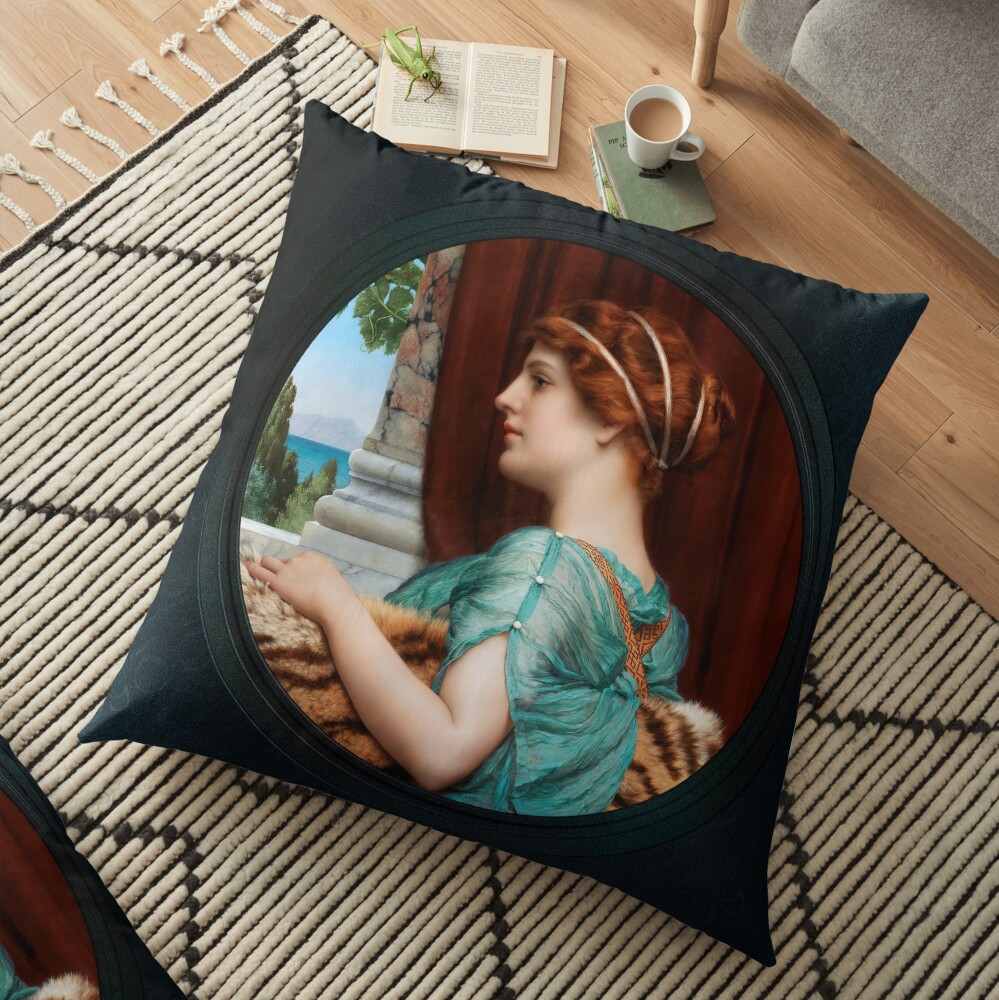
Table of Contents
The Subject of the Artwork
In “A Pompeian Lady c1904,” the main subject is a young woman dressed in an opulent, flowing gown. Her attire is distinctly ancient Roman or Pompeian in style, reminiscent of the classical draped garments seen in the frescoes and sculptures from Pompeii. The woman’s posture is elegant and contemplative, as she gazes into the distance with a slight turn of her head. This pose exudes a sense of grace, while her expression remains calm and serene. The soft waves of her auburn hair are intricately styled, adorned with delicate headbands that emphasize the classical aesthetic of the time.
Her gaze is directed towards the natural beauty that lies outside the frame of the painting, suggesting a moment of quiet reflection. The painting’s composition draws attention to the delicate interplay between the figure’s posture and the surrounding environment. The softness of her features is contrasted against the sharp and detailed depiction of the materials in her attire, the textures of the background, and the natural elements in the landscape.
The Setting and Landscape
The setting of the painting features an outdoor terrace with a view of a lush, serene landscape. The woman is placed against a grand column made of marble, which serves to frame her figure while simultaneously grounding her within the classical world of ancient Rome. The background reveals an idyllic view of a coastal scene, where the sea meets the horizon under a clear, soft blue sky. Verdant trees and a tranquil landscape suggest a peaceful, secluded place, contributing to the overall sense of calm and elegance that pervades the work.
The architectural elements of the setting further emphasize the classical influence, with Roman-style columns and arches that evoke the grandeur of ancient structures. These elements are skillfully rendered, with Godward’s attention to detail in the textures of the stone, the play of light and shadow, and the intricate detailing on the column itself. The warm tones of the stone, combined with the cool colors of the sky and the distant sea, create a harmonious atmosphere that enhances the timeless beauty of the figure.
The Mood and Themes of the Painting
L'umore di “A Pompeian Lady c1904” is one of tranquil elegance and quiet introspection. The woman’s serene expression, coupled with her elegant posture, conveys a sense of peace and grace. There is no urgency or tension in her demeanor; piuttostu, the painting invites the viewer to appreciate the moment and the beauty of the scene. U molle, natural light illuminating her face and gown enhances this peaceful mood, with subtle gradients that highlight her delicate features.
The themes of classical beauty, tranquility, and the idealized femininity of ancient Rome are central to the painting. Godward often portrayed women as the epitome of grace and purity, and this painting is no exception. The subject is not just a woman in classical attire; she represents an ideal of feminine beauty that transcends time and place. Her thoughtful expression and poised stance suggest a woman who is at peace with herself and her surroundings, embodying the refined elegance of a bygone era.
The landscape also plays a vital role in setting the tone of the painting. The natural elements—lush greenery, clear skies, and calm seas—serve as a backdrop that complements the subject’s calm demeanor. The connection between the figure and the natural world creates a sense of harmony and balance, reinforcing the classical theme of unity between humanity and nature.
Materiali è tecniche
John William Godward’s use of oil paints is evident in the depth and richness of the colors throughout the painting. His technique is highly detailed, with a particular emphasis on texture and realism. The woman’s gown is rendered in exquisite detail, with each fold and drape carefully painted to capture the movement of the fabric. The translucency of the fabric adds a sense of lightness to the figure, contrasting with the solidity of the stone column and the softness of the natural landscape.
Godward’s brushwork is smooth and controlled, allowing him to create delicate textures such as the soft sheen of the woman’s hair, the smoothness of her skin, and the intricate patterns on her gown. The realism with which he captures light and shadow is particularly striking, as it adds dimension and depth to the figure and the surrounding environment. The artist’s skillful use of light also enhances the sense of realism, with highlights on the woman’s face and gown giving the impression of sunlight filtering through the space.
Cunclusione
A Pompeian Lady c1904 by John William Godward is a quintessential example of the neoclassical style, showcasing the artist’s mastery in portraying idealized femininity, classical attire, and serene landscapes. The painting exudes a sense of tranquility and grace, capturing a moment of timeless beauty in the ancient world.
The careful rendering of the figure, her attire, and the surrounding environment reveals Godward’s technical skill and his deep appreciation for the classical world. This artwork not only reflects the artist’s personal style but also his reverence for the classical ideals that inspired much of his work. Through this painting, Godward immortalizes the elegance and beauty of the ancient world, inviting viewers to step into a space where time stands still.
A Pompeian Lady is a remastered digital art old masters reproduction of a public domain image that is available as a tela, legnu, acrylic and metal print online.
Questa creazione d'arte digitale, cum'è cù tutte l'opere d'arte chì ponu esse truvate nantu à u situ web di Xzendor7 hè dispunibule per cumprà in linea in una varietà di formati di materiale cumprese stampe di tela., stampe acriliche, stampe metalliche, stampe di lignu, stampe in cornice, manifesti, è cum'è stampe su tela rolled in una varietà di dimensioni da 12 centimetri à 72 centimetri secondu a dimensione di l'opera d'arte attuale è a stampa nantu à a tenda chì sceglite di cumprà l'arte da.
L'opera d'arte hè ancu dispunibule nantu à una larga gamma di vestiti di l'omi è di e donne, mugs, tote, sciarpe, quaderni è ghjurnali è parechji prudutti di decoru di casa.
Biografia di l'artista
Info sottu Da Wikipedia.org
John William Godward era u maiò di cinque figlioli, è fù chjamatu dopu à u so babbu Ghjuvanni è u missiavu Guglielmu.
Hà esibitu à l'Accademia Reale da 1887. Quandu si trasfirìu in Italia cù unu di i so mudelli 1912, a so famiglia rumpiu ogni cuntattu cù ellu è ancu tagliatu a so maghjina da i ritratti di famiglia. Godward hà tornatu in Inghilterra 1921, mortu in 1922, è hè intarratu in u cimiteru di Brompton, West London.
Unu di i so pitturi più cunnisciuti hè Dolce far Niente (1904), chì hè stata acquistata per a cullizzioni di Andrew Lloyd Webber in 1995. Cum'è in u casu di parechje altre pitture, Godward pintò più di una versione; in stu casu, un prima (è menu cunnisciuti) 1897 versione cù un altru 1906 versione.
Si suicidò à l'età di 61 è si dice chì hà scrittu in a so nota di suicidiu chì “u mondu ùn hè abbastanza grande per [tramindui] me è un Picasso”.
A so famiglia straniera, chì avia disappruvatu di diventà un artista, si vergognavanu di u so suicidiu è brusgiavanu i so carte. Solu una fotografia di Godward hè cunnisciuta per sopravvive.
Godward era un neo-classicista vittoriano, è dunque, in teoria, un seguitore di Frederic Leighton. Tuttavia, hè più strettamente alleatu stilisticu à Sir Lawrence Alma-Tadema, cù quale hà spartutu un incantu per a rendizione di l'architettura classica - in particulare, caratteristiche di u paisaghju staticu custruitu da marmaru.
A maiò parte di l'imaghjini esistenti di Godward presentanu e donne in vestiti classici posati contr'à e caratteristiche di u paisaghju; Bien qu'il y ait des figures semi-nues et entièrement nues incluses dans son œuvre, un esempiu notevoli essendu “In u Tepidarium c1913”.
Un titulu spartutu cù una pittura cuntruversa di Alma-Tadema di u stessu sughjettu chì reside in u “Galleria d'Arte Lady Lever”. I tituli riflettenu a fonte d'ispirazione di Godward; chì era a civiltà classica, in particulare quellu di l'Antica Roma; un sughjettu chì lia Godward strettamente à Alma-Tadema artisticamente.
Siccomu a borsa di studiu classica era più diffusa trà l'audienza potenziale per i so dipinti durante a so vita chè in l'oghje., A ricerca meticulosa di i dettagli era impurtante per ottene una reputazione cum'è artista in questu generu.
Alma-Tadema era un archeologu è ancu un pittore, chì hà assistitu à i siti storichi è cullighjava artefatti chì hà utilizatu dopu in i so pitture: Godward, ancu, studiatu tali dettagli cum'è l'architettura è u vestitu, per assicurà chì e so opere portanu u timbru di l'autenticità.
In più, Godward hà sbulicatu è meticulosamente rende altre caratteristiche impurtanti in i so pitture, pelli d'animali di cui i dipinti “Riposa à meziornu c1910” è “A Cool Retreat c1910” cuntene esempi di tali interpretazioni è ancu fiori salvatichi “Nerissa c1906” è “Fiori d'estate c1903”.
L'apparizione di belle donne in pose studiate in tanti di i tele di Godward face chì parechji novi vinuti à e so opere l'anu categurizatu erroneamente cum'è Pre-Raphaelite., in particulare chì a so paleta hè spessu una vibrante culurita. A scelta di u sughjettu (civiltà antica versus, per esempiu, legenda arturiana) hè più propriamente quellu di u neo-classicista vittorianu.
In cumunu cù numerosi pittori cuntimpuraniu cun ellu, Godward era un "High Dreamer Victorian", pruducia images di un mondu idealized è romanticized chì, in u casu di Godward è Alma-Tadema, hè vinutu à esse criticatu cum'è una visione di u mondu di i Vittoriani in togas.
Godward “hà rapidamente stabilitu una reputazione per i so dipinti di giovani donne in un ambiente classicu è a so capacità di trasmette cù sensibilità è maestria tecnica a sensazione di texture di carne cuntrastanti., marmura, pelliccia è tessuti.
L'inclinazione di Godward per a creazione d'opere d'arti ambientate in u periodu classicu hè probabilmente vinutu da u periodu di tempu in u quali era natu.; cum'è era l'ultimu rinascimentu classicu à grande scala in i pitture occidentali, chì fiorì in Inghilterra da l'anni 1860 finu à l'anni 1890.