

A Pompeian Lady c1904
Das Kunstwerk mit dem Titel “A Pompeian Lady c1904” by the British painter John William Godward (1861 – 1922) is a captivating example of the neoclassical style that was prevalent during the late 19th and early 20th centuries. Godward was renowned for his portraits of women in classical attire, often placed within luxurious, ancient Roman or Greek settings. This particular piece, herumgemalt 1904, encapsulates his meticulous attention to detail and his skill in capturing the elegance of the human form. It exemplifies the artist’s dedication to classical antiquity, with his subjects often portrayed in serene and introspective moods.
Inhaltsverzeichnis
The Subject of the Artwork
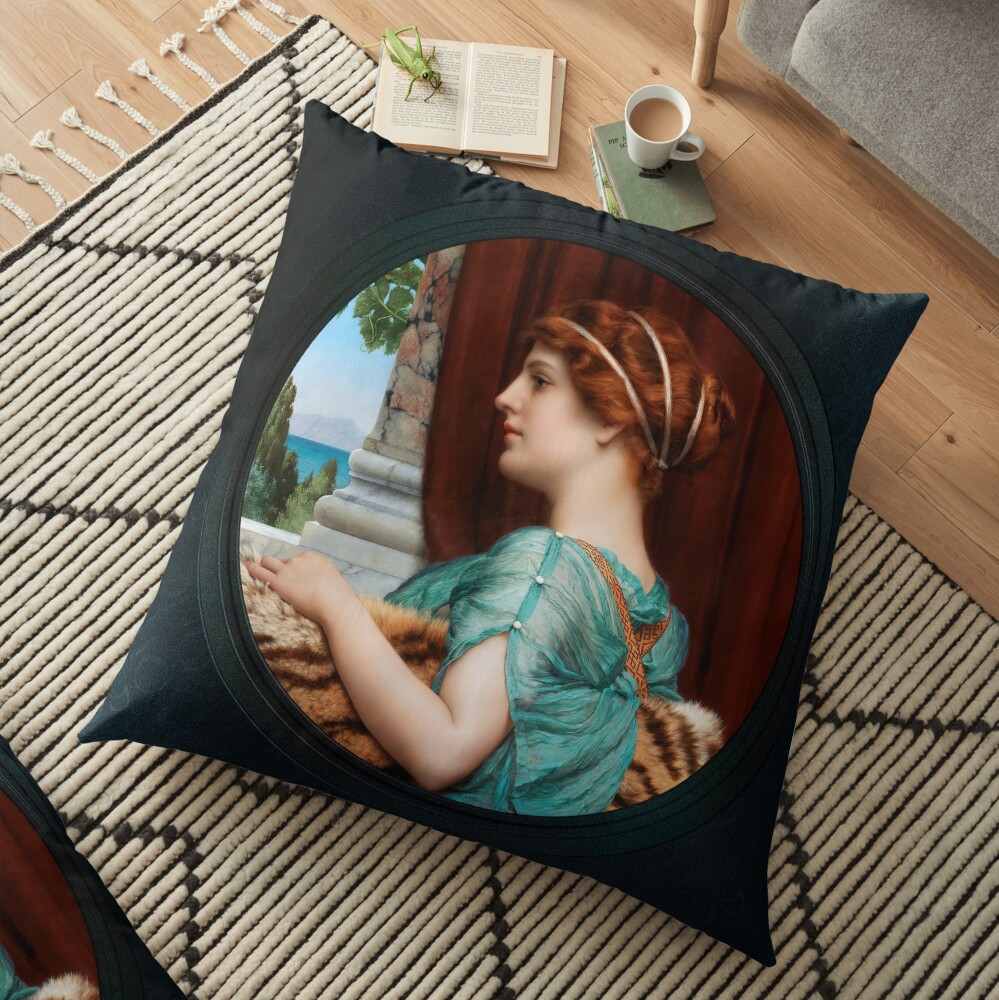
Im “A Pompeian Lady c1904,” the main subject is a young woman dressed in an opulent, flowing gown. Her attire is distinctly ancient Roman or Pompeian in style, reminiscent of the classical draped garments seen in the frescoes and sculptures from Pompeii. The woman’s posture is elegant and contemplative, as she gazes into the distance with a slight turn of her head. This pose exudes a sense of grace, while her expression remains calm and serene. The soft waves of her auburn hair are intricately styled, adorned with delicate headbands that emphasize the classical aesthetic of the time.
Her gaze is directed towards the natural beauty that lies outside the frame of the painting, suggesting a moment of quiet reflection. The painting’s composition draws attention to the delicate interplay between the figure’s posture and the surrounding environment. The softness of her features is contrasted against the sharp and detailed depiction of the materials in her attire, the textures of the background, and the natural elements in the landscape.
The Setting and Landscape
The setting of the painting features an outdoor terrace with a view of a lush, serene landscape. The woman is placed against a grand column made of marble, which serves to frame her figure while simultaneously grounding her within the classical world of ancient Rome. The background reveals an idyllic view of a coastal scene, where the sea meets the horizon under a clear, soft blue sky. Verdant trees and a tranquil landscape suggest a peaceful, secluded place, contributing to the overall sense of calm and elegance that pervades the work.
The architectural elements of the setting further emphasize the classical influence, with Roman-style columns and arches that evoke the grandeur of ancient structures. These elements are skillfully rendered, with Godward’s attention to detail in the textures of the stone, das Spiel von Licht und Schatten, and the intricate detailing on the column itself. The warm tones of the stone, combined with the cool colors of the sky and the distant sea, create a harmonious atmosphere that enhances the timeless beauty of the figure.
The Mood and Themes of the Painting
Die Stimmung von “A Pompeian Lady c1904” is one of tranquil elegance and quiet introspection. The woman’s serene expression, coupled with her elegant posture, conveys a sense of peace and grace. There is no urgency or tension in her demeanor; eher, Das Gemälde lädt den Betrachter ein, den Moment und die Schönheit der Szene zu genießen. Das Weiche, Natürliches Licht, das ihr Gesicht und Kleid beleuchtet, verstärkt diese friedliche Stimmung, mit subtilen Farbverläufen, die ihre zarten Gesichtszüge hervorheben.
Die Themen der klassischen Schönheit, Ruhe, und die idealisierte Weiblichkeit des antiken Roms stehen im Mittelpunkt des Gemäldes. Godward stellte Frauen oft als Inbegriff von Anmut und Reinheit dar, und dieses Gemälde ist keine Ausnahme. Das Thema ist nicht nur eine Frau in klassischer Kleidung; Sie repräsentiert ein Ideal weiblicher Schönheit, das Zeit und Ort überschreitet. Ihr nachdenklicher Gesichtsausdruck und ihre ausgeglichene Haltung lassen auf eine Frau schließen, die mit sich selbst und ihrer Umgebung im Reinen ist, verkörpert die raffinierte Eleganz einer vergangenen Ära.
Auch die Landschaft spielt eine entscheidende Rolle bei der Gestaltung des Bildtons. The natural elements—lush greenery, clear skies, and calm seas—serve as a backdrop that complements the subject’s calm demeanor. The connection between the figure and the natural world creates a sense of harmony and balance, reinforcing the classical theme of unity between humanity and nature.
Materialien und Techniken
John William Godward’s use of oil paints is evident in the depth and richness of the colors throughout the painting. His technique is highly detailed, with a particular emphasis on texture and realism. The woman’s gown is rendered in exquisite detail, with each fold and drape carefully painted to capture the movement of the fabric. The translucency of the fabric adds a sense of lightness to the figure, contrasting with the solidity of the stone column and the softness of the natural landscape.
Godward’s brushwork is smooth and controlled, allowing him to create delicate textures such as the soft sheen of the woman’s hair, the smoothness of her skin, and the intricate patterns on her gown. The realism with which he captures light and shadow is particularly striking, as it adds dimension and depth to the figure and the surrounding environment. The artist’s skillful use of light also enhances the sense of realism, with highlights on the woman’s face and gown giving the impression of sunlight filtering through the space.
Abschluss
A Pompeian Lady c1904 by John William Godward is a quintessential example of the neoclassical style, showcasing the artist’s mastery in portraying idealized femininity, classical attire, and serene landscapes. The painting exudes a sense of tranquility and grace, capturing a moment of timeless beauty in the ancient world.
The careful rendering of the figure, ihre Kleidung, and the surrounding environment reveals Godward’s technical skill and his deep appreciation for the classical world. This artwork not only reflects the artist’s personal style but also his reverence for the classical ideals that inspired much of his work. Through this painting, Godward immortalizes the elegance and beauty of the ancient world, inviting viewers to step into a space where time stands still.
A Pompeian Lady is a remastered digital art old masters reproduction of a public domain image that is available as a Leinwand, Holz, Acryl- und Metalldruck online.
Diese digitale Kunstschöpfung, Wie alle Kunstwerke, die auf der Xzendor7-Website zu finden sind, können sie online in einer Vielzahl von Materialformaten einschließlich Leinwanddrucken erworben werden, Acryldrucke, Metalldrucke, Holzdrucke, gerahmte Drucke, Plakate, und als gerollte Leinwanddrucke in verschiedenen Größen von 12 Zoll zu 72 Zoll, abhängig von der Größe des tatsächlichen Kunstwerks und dem Print-on-Demand-Shop, in dem Sie das Kunstwerk kaufen möchten.
Das Kunstwerk ist auch auf einer breiten Palette von Herren- und Damenbekleidung erhältlich, Tassen, Tragetaschen, Schals, Notizbücher und Tagebücher sowie viele Heimdekorationsprodukte.
Biografie des Künstlers
Info unten von Wikipedia.org
John William Godward war das älteste von fünf Kindern, und wurde nach seinem Vater John und Großvater William benannt.
Er stellte in der Royal Academy aus 1887. Als er mit einem seiner Models nach Italien zog 1912, seine Familie brach den Kontakt zu ihm ab und schnitt sogar sein Bild aus Familienbildern. Godward kehrte nach England zurück 1921, starb in 1922, und ist auf dem Brompton Cemetery begraben, West London.
Eines seiner bekanntesten Gemälde ist Dolce far Niente (1904), die für die Sammlung von Andrew Lloyd Webber in . gekauft wurde 1995. Wie bei mehreren anderen Gemälden, Godward hat mehr als eine Version gemalt; in diesem Fall, ein früherer (und weniger bekannt) 1897 Version mit einem weiteren 1906 Ausführung.
Er beging Selbstmord im Alter von 61 und soll in seinem Abschiedsbrief geschrieben haben, dass “die welt ist nicht groß genug für [beide] ich und ein Picasso”.
Seine entfremdete Familie, der es missbilligt hatte, Künstler zu werden, schämten sich für seinen Selbstmord und verbrannten seine Papiere. Nur ein Foto von Godward ist überliefert.
Godward war ein viktorianischer Neoklassizist, und deshalb, in der Theorie, ein Anhänger von Frederic Leighton. jedoch, er ist stilistisch enger mit Sir Lawrence Alma-Tadema verbunden, mit denen er eine Vorliebe für die Wiedergabe klassischer Architektur teilte – insbesondere, statische Landschaftselemente aus Marmor.
Die überwiegende Mehrheit der erhaltenen Bilder von Godward zeigt Frauen in klassischer Kleidung, die sich vor Landschaftselementen posieren; obwohl es einige halbnackte und vollständig nackte Figuren in seinem Oeuvre gibt, ein bemerkenswertes Beispiel ist “Im Tepidarium c1913”.
Ein Titel, der mit einem umstrittenen Alma-Tadema-Gemälde des gleichen Themas geteilt wird, das in der “Lady Lever Art Gallery”. Die Titel spiegeln Godwards Inspirationsquelle wider; das war die klassische Zivilisation, vor allem das des antiken Roms; ein Thema, das Godward künstlerisch eng an Alma-Tadema bindet.
Angesichts der Tatsache, dass die klassische Wissenschaft zu seinen Lebzeiten unter dem potenziellen Publikum seiner Gemälde weiter verbreitet war als heute, akribische Detailrecherche war wichtig, um sich als Künstler in diesem Genre zu behaupten.
Alma-Tadema war sowohl Archäologin als auch Malerin, der historische Stätten besuchte und Artefakte sammelte, die er später in seinen Gemälden verwendete: Gottwärts, auch, studierte Details wie Architektur und Kleidung, um sicherzustellen, dass seine Werke den Stempel der Authentizität tragen.
In Ergänzung, Godward hat in seinen Gemälden sorgfältig und akribisch andere wichtige Merkmale wiedergegeben, Tierhäute, deren Gemälde “Mittagsruhe c1910” und “Ein kühler Rückzug c1910” enthält Beispiele für eine solche Wiedergabe sowie Wildblumen “Nerissa c1906” und “Sommerblumen c1903”.
Das Erscheinen schöner Frauen in einstudierten Posen auf so vielen Gemälden von Godward führt dazu, dass viele Neulinge in seinen Werken ihn fälschlicherweise als Präraffaeliten einstufen, Zumal seine Palette oft eine leuchtend bunte ist. Die Themenwahl (alte Zivilisation versus, beispielsweise, Arthurianische Legende) ist eher die des viktorianischen Neoklassizisten.
Gemeinsam mit zahlreichen Malern seiner Zeit, Godward war ein „hoher viktorianischer Träumer“, Bilder einer idealisierten und romantisierten Welt zu produzieren, die, sowohl bei Godward als auch bei Alma-Tadema, wurde als Weltbild der Viktorianer in Togas kritisiert.
Gottwärts “machte sich schnell einen Namen für seine Gemälde junger Frauen in einem klassischen Ambiente und seine Fähigkeit, mit Sensibilität und technischer Meisterschaft das Gefühl kontrastierender Texturen von Fleisch zu vermitteln, Marmor, Fell und Stoffe.
Godwards Vorliebe, Kunstwerke der Klassik zu schaffen, stammt wahrscheinlich aus der Zeit, in der er geboren wurde; da es die letzte umfassende klassische Wiederbelebung in der westlichen Malerei war, die in England von den 1860er bis in die 1890er Jahre blühte.