

A Pompeian Lady c1904
A obra intitulada “A Pompeian Lady c1904” by the British painter John William Godward (1861 – 1922) is a captivating example of the neoclassical style that was prevalent during the late 19th and early 20th centuries. Godward was renowned for his portraits of women in classical attire, often placed within luxurious, ancient Roman or Greek settings. This particular piece, pintado ao redor 1904, encapsulates his meticulous attention to detail and his skill in capturing the elegance of the human form. It exemplifies the artist’s dedication to classical antiquity, with his subjects often portrayed in serene and introspective moods.
Índice
The Subject of the Artwork
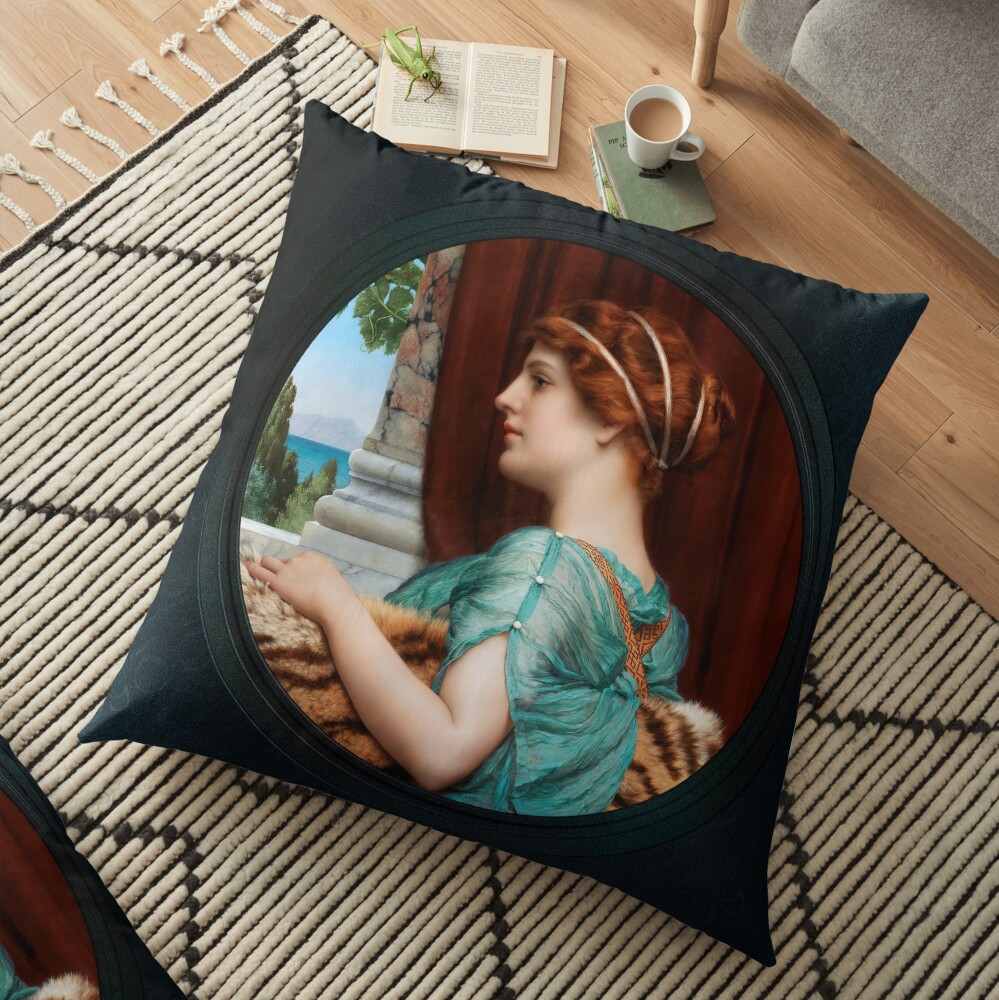
Em “A Pompeian Lady c1904,” the main subject is a young woman dressed in an opulent, flowing gown. Her attire is distinctly ancient Roman or Pompeian in style, reminiscent of the classical draped garments seen in the frescoes and sculptures from Pompeii. The woman’s posture is elegant and contemplative, as she gazes into the distance with a slight turn of her head. This pose exudes a sense of grace, while her expression remains calm and serene. The soft waves of her auburn hair are intricately styled, adorned with delicate headbands that emphasize the classical aesthetic of the time.
Her gaze is directed towards the natural beauty that lies outside the frame of the painting, suggesting a moment of quiet reflection. The painting’s composition draws attention to the delicate interplay between the figure’s posture and the surrounding environment. The softness of her features is contrasted against the sharp and detailed depiction of the materials in her attire, the textures of the background, and the natural elements in the landscape.
The Setting and Landscape
The setting of the painting features an outdoor terrace with a view of a lush, serene landscape. The woman is placed against a grand column made of marble, which serves to frame her figure while simultaneously grounding her within the classical world of ancient Rome. The background reveals an idyllic view of a coastal scene, where the sea meets the horizon under a clear, soft blue sky. Verdant trees and a tranquil landscape suggest a peaceful, secluded place, contributing to the overall sense of calm and elegance that pervades the work.
The architectural elements of the setting further emphasize the classical influence, with Roman-style columns and arches that evoke the grandeur of ancient structures. These elements are skillfully rendered, with Godward’s attention to detail in the textures of the stone, o jogo de luz e sombra, and the intricate detailing on the column itself. The warm tones of the stone, combined with the cool colors of the sky and the distant sea, create a harmonious atmosphere that enhances the timeless beauty of the figure.
The Mood and Themes of the Painting
O humor de “A Pompeian Lady c1904” is one of tranquil elegance and quiet introspection. The woman’s serene expression, coupled with her elegant posture, conveys a sense of peace and grace. There is no urgency or tension in her demeanor; em vez de, the painting invites the viewer to appreciate the moment and the beauty of the scene. O macio, natural light illuminating her face and gown enhances this peaceful mood, with subtle gradients that highlight her delicate features.
The themes of classical beauty, tranqüilidade, and the idealized femininity of ancient Rome are central to the painting. Godward often portrayed women as the epitome of grace and purity, and this painting is no exception. The subject is not just a woman in classical attire; she represents an ideal of feminine beauty that transcends time and place. Her thoughtful expression and poised stance suggest a woman who is at peace with herself and her surroundings, embodying the refined elegance of a bygone era.
The landscape also plays a vital role in setting the tone of the painting. The natural elements—lush greenery, clear skies, and calm seas—serve as a backdrop that complements the subject’s calm demeanor. The connection between the figure and the natural world creates a sense of harmony and balance, reinforcing the classical theme of unity between humanity and nature.
Materiais e Técnicas
John William Godward’s use of oil paints is evident in the depth and richness of the colors throughout the painting. His technique is highly detailed, with a particular emphasis on texture and realism. The woman’s gown is rendered in exquisite detail, with each fold and drape carefully painted to capture the movement of the fabric. The translucency of the fabric adds a sense of lightness to the figure, contrasting with the solidity of the stone column and the softness of the natural landscape.
Godward’s brushwork is smooth and controlled, allowing him to create delicate textures such as the soft sheen of the woman’s hair, the smoothness of her skin, and the intricate patterns on her gown. The realism with which he captures light and shadow is particularly striking, as it adds dimension and depth to the figure and the surrounding environment. The artist’s skillful use of light also enhances the sense of realism, with highlights on the woman’s face and gown giving the impression of sunlight filtering through the space.
Conclusão
A Pompeian Lady c1904 by John William Godward is a quintessential example of the neoclassical style, showcasing the artist’s mastery in portraying idealized femininity, classical attire, and serene landscapes. The painting exudes a sense of tranquility and grace, capturing a moment of timeless beauty in the ancient world.
The careful rendering of the figure, her attire, and the surrounding environment reveals Godward’s technical skill and his deep appreciation for the classical world. This artwork not only reflects the artist’s personal style but also his reverence for the classical ideals that inspired much of his work. Through this painting, Godward immortalizes the elegance and beauty of the ancient world, inviting viewers to step into a space where time stands still.
A Pompeian Lady is a remastered digital art old masters reproduction of a public domain image that is available as a canvas, madeira, acrylic and metal print online.
Esta criação de arte digital, assim como todas as obras de arte que podem ser encontradas no site do Xzendor7 estão disponíveis para compra on-line em uma variedade de formatos de materiais, incluindo impressões em tela, impressões acrílicas, impressões metálicas, gravuras em madeira, impressões emolduradas, cartazes, e como impressões em tela enrolada em vários tamanhos, desde 12 polegadas para 72 polegadas, dependendo do tamanho da obra de arte real e da loja de impressão sob demanda em que você escolher comprar a arte.
A arte também está disponível em uma ampla variedade de roupas masculinas e femininas, canecas, bolsas, lenços, cadernos e diários e muitos produtos de decoração para casa.
Biografia do artista
Informações abaixo de Wikipédia.org
John William Godward era o mais velho de cinco filhos, e recebeu o nome de seu pai John e de seu avô William.
Expôs na Royal Academy de 1887. Quando ele se mudou para a Itália com uma de suas modelos em 1912, sua família rompeu todo contato com ele e até cortou sua imagem das fotos de família. Godward retornou à Inglaterra em 1921, morreu em 1922, e está enterrado no Cemitério de Brompton, Oeste de Londres.
Uma de suas pinturas mais conhecidas é Dolce far Niente (1904), que foi adquirido para a coleção de Andrew Lloyd Webber em 1995. Como no caso de várias outras pinturas, Godward pintou mais de uma versão; nesse caso, um anterior (e menos conhecido) 1897 versão com mais 1906 versão.
Suicidou-se com a idade de 61 e diz-se que escreveu em sua nota de suicídio que “o mundo não é grande o suficiente para [ambos] eu e um Picasso”.
Sua família distante, que desaprovava que ele se tornasse um artista, ficaram com vergonha de seu suicídio e queimaram seus papéis. Sabe-se que apenas uma fotografia de Godward sobreviveu.
Godward era um neoclassicista vitoriano, e portanto, em teoria, um seguidor de Frederic Leighton. No entanto, ele é mais aliado estilisticamente de Sir Lawrence Alma-Tadema, com quem partilhou uma propensão para a representação da arquitectura clássica – em particular, características estáticas da paisagem construídas em mármore.
A grande maioria das imagens existentes de Godward apresentam mulheres em trajes clássicos posadas contra elementos da paisagem.; embora existam algumas figuras semi-nuas e totalmente nuas incluídas em sua obra, sendo um exemplo notável “No Tepidário c1913”.
Um título partilhado com uma controversa pintura de Alma-Tadema do mesmo tema que reside no “Galeria de Arte Lady Lever”. Os títulos refletem a fonte de inspiração de Deus; que foi a civilização clássica, mais notavelmente o da Roma Antiga; um assunto que liga Deus intimamente a Alma-Tadema artisticamente.
Dado que os estudos clássicos eram mais difundidos entre o público potencial de suas pinturas durante sua vida do que nos dias atuais, a pesquisa meticulosa de detalhes foi importante para se posicionar como artista neste gênero.
Alma-Tadema foi arqueólogo e também pintor, que visitou locais históricos e colecionou artefatos que mais tarde usou em suas pinturas: Em direção a Deus, também, estudou detalhes como arquitetura e vestimenta, a fim de garantir que suas obras tivessem o selo de autenticidade.
Além disso, Godward representou meticulosa e meticulosamente outras características importantes em suas pinturas., peles de animais das quais as pinturas “Meio-dia de descanso c1910” e “Um retiro legal c1910” contém exemplos de tal representação, bem como flores silvestres “Nerissa c1906” e “Flores de verão c1903”.
A aparição de belas mulheres em poses estudadas em tantas telas de Godward faz com que muitos recém-chegados às suas obras o classifiquem erroneamente como sendo pré-rafaelita., particularmente porque sua paleta costuma ser de cores vibrantes. A escolha do assunto (civilização antiga versus, por exemplo, Lenda arturiana) é mais propriamente o do neoclassicismo vitoriano.
Em comum com numerosos pintores contemporâneos dele, Godward era um ‘alto sonhador vitoriano’, produzindo imagens de um mundo idealizado e romantizado que, no caso de Godward e Alma-Tadema, passou a ser criticado como uma visão de mundo dos vitorianos em togas.
Em direção a Deus “rapidamente estabeleceu uma reputação por suas pinturas de mulheres jovens em um cenário clássico e por sua capacidade de transmitir com sensibilidade e domínio técnico a sensação de texturas contrastantes de carne, mármore, peles e tecidos.
A propensão de Godward para criar obras de arte ambientadas no período clássico provavelmente veio da época em que ele nasceu; pois foi o último renascimento clássico em grande escala nas pinturas ocidentais, que floresceu na Inglaterra da década de 1860 até a década de 1890.