

A Quartet In Concert by Jean Raoux
A Moment of Refined Leisure: Examining Jean Raoux’s “A Quartet In Concert”
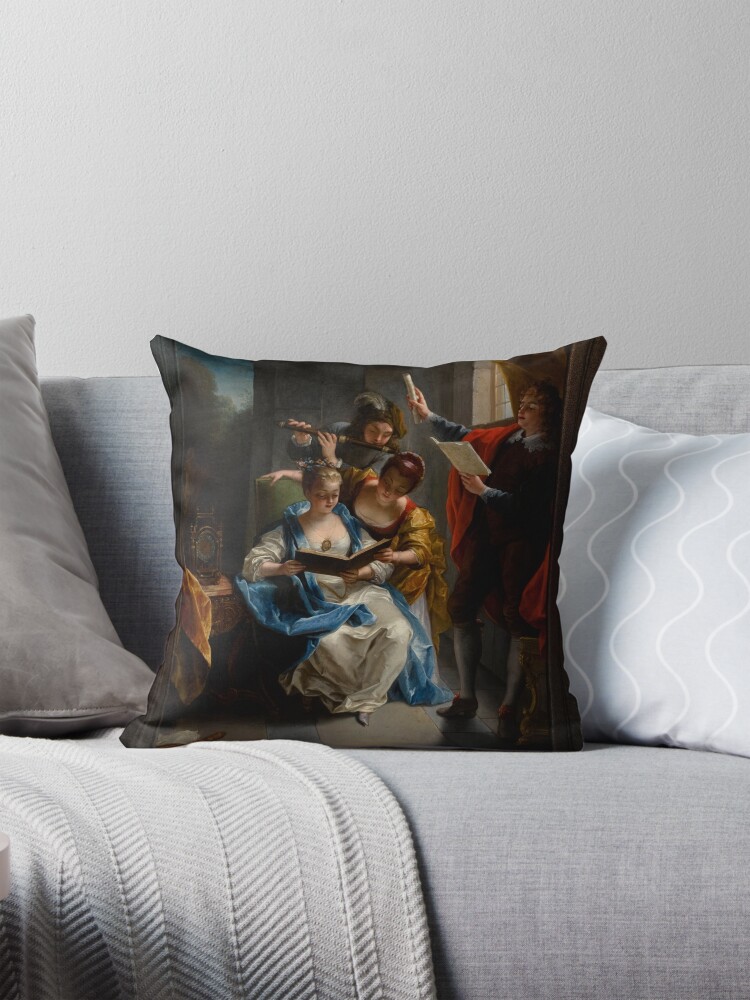
Jean Raoux«S “A Quartet in Concert,” painted during the early 18th century, offers a glimpse into the refined leisure activities enjoyed by the French aristocracy. The artwork depicts a quartet – two women and two men – engaged in an intimate musical performance within a stately interior setting. Raoux’s skillful rendering of fabrics, expressions, and architectural details creates a scene of elegant charm and understated sophistication.
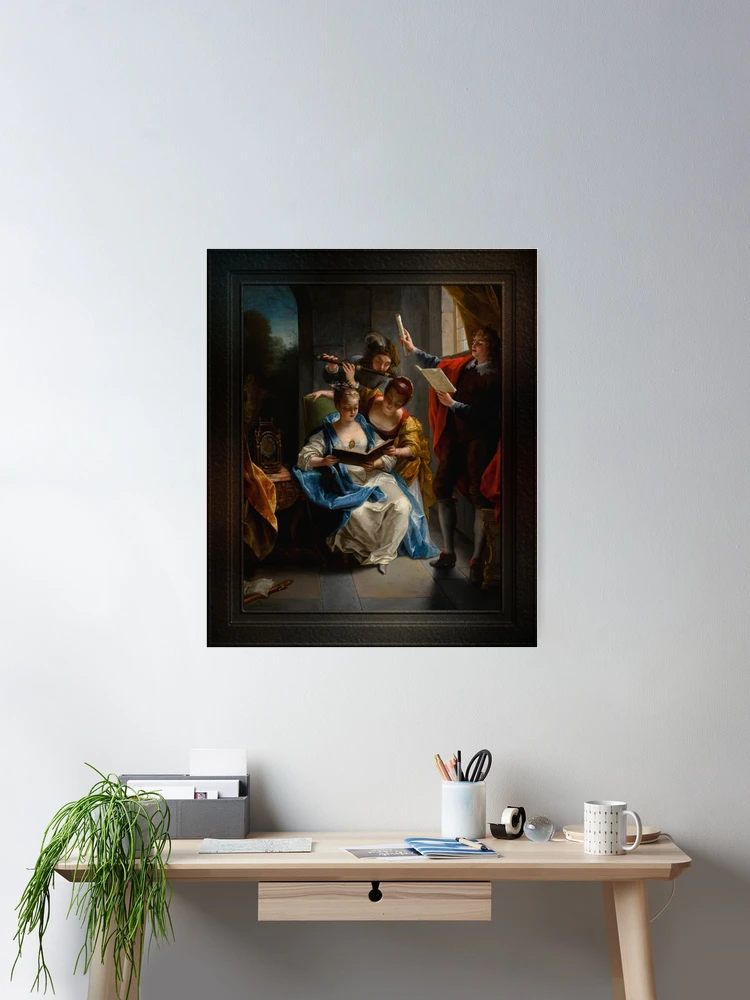
Table des matières
Structure de composition & Spatial Arrangement
The composition is carefully structured to emphasize the intimacy of the gathering. The two women are centrally positioned, seated on an ornate chair and engrossed in reading sheet music while being serenaded by the musicians flanking them. The men, one playing a flute and the other singing, stand attentively beside the women, their postures conveying respect and attentiveness. A window behind the scene provides soft natural light that illuminates the figures and highlights the rich textures of their clothing. The placement of objects within the room—a clock, a table with scattered papers, and draped fabrics—adds depth and visual interest to the composition.
Palette de couleurs & Effets d'éclairage
La palette de couleurs dans “A Quartet In Concert” is dominated by warm, muted tones – golds, crèmes, and soft blues – which evoke a sense of elegance and refinement. The women’s gowns are rendered in luxurious fabrics with intricate details, highlighted by the interplay of light and shadow. Raoux masterfully uses chiaroscuro—the contrast between light and dark—to create depth and volume within the scene. Soft natural light filters through the window, casting gentle shadows that accentuate the figures’ features and enhance the overall sense of tranquility.
The Musical Performance: Symbolisme & Contexte
The musical performance itself is central to understanding the artwork’s significance. Music was a highly valued form of entertainment and social interaction among the French aristocracy during the 18th century. It represented refinement, education, and cultural sophistication. The quartet’s intimate setting suggests a private gathering amongst close friends or family members, fostering an atmosphere of relaxed elegance. The sheet music held by the singers indicates that they are performing a composed piece, further emphasizing the formality and artistry of the occasion.
Character Portraits: Expressions & Tenue
Each character in “A Quartet In Concert” is rendered with distinct personality and grace. Elodie de Valois, seated reading, possesses an air of quiet contemplation and refined intelligence. Her blue gown, adorned with delicate lace details, reflects her social standing and impeccable taste. The other woman displays a similar sense of elegance, while the musicians are portrayed as attentive and skilled performers. Their attire—the man playing the flute in a silver-grey wig and the singer in a red coat—is characteristic of the fashion trends of the period.
Influences artistiques & Héritage
Jean Raoux was a prominent French painter known for his genre scenes depicting aristocratic life, pastoral landscapes, and mythological subjects. His work reflects the influence of classical art and the Rococo style, characterized by its elegance, grâce, and attention to detail. “A Quartet In Concert” illustre ces qualités; it’s a testament to Raoux’s skill as an observer of human behavior and his ability to capture the essence of 18th-century French society. His legacy lies in his contribution to the development of genre painting and his portrayal of aristocratic life with both realism and charm.
Détails techniques & Matériels
L'œuvre est exécutée avec des peintures à l'huile sur toile, Permettre une saturation des couleurs riches et des gradations subtiles de ton. Raoux’s technique involves meticulous attention to detail, particularly evident in the rendering of fabrics, bijoux, et éléments architecturaux. Un examen proche révèle une maîtrise du pinceau; C'est lisse et contrôlé, contribuant au sentiment global de l'élégance et du raffinement. La toile elle-même semble bien préparée, Fournir une surface appropriée pour l'application habile de la peinture par l'artiste.
Biographie de l'artiste dérivée de Wikipedia.org
Après la formation habituelle, Jean Raoux est devenu membre de l'Académie en 1717 en tant que peintre historique.
Sa réputation avait été établie auparavant par les décorations acclamées exécutées pendant ses trois années en Italie sur le palais de Giustiniani Solini à Venise, et par quelques peintures de chevalet, les quatre âges de l'homme (galerie nationale), commande du grand prieur de Vendôme.
A cette dernière classe de sujets, Raoux s'est consacré, refusant de peindre des portraits sauf dans le caractère.
La liste de ses œuvres est une longue série de décors des Saisons, des heures, des éléments, ou de ces scènes d'amusement et de galanterie dans la représentation desquelles il était infiniment dépassé par son jeune rival Watteau.
Après son séjour en Angleterre (1720) il a beaucoup vécu au Temple, où il a décoré plusieurs pièces. Il est mort à Paris en 1734. Ses meilleurs élèves furent Chevalier et Montdidier. Ses oeuvres ont été beaucoup gravées par Poilly, Moyreau, Dupuis,et d'autres.
Cette création d'art numérique, comme toutes les œuvres d'art disponibles sur le site Web Xzendor7, elles sont disponibles à l'achat en ligne dans une variété de formats de matériaux, y compris des impressions sur toile., impressions acryliques, impressions métalliques, gravures sur bois, impressions encadrées, affiches, et comme roulé impressions sur toile dans une variété de tailles de 12 pouces à 72 pouces en fonction de la taille de l'œuvre d'art réelle et de la boutique d'impression à la demande auprès de laquelle vous choisissez d'acheter l'art.
L’œuvre d’art est également disponible sur une large gamme de vêtements pour hommes et femmes., tasses, fourre-tout, écharpes, cahiers et journaux et de nombreux produits de décoration intérieure.