

Una rubia reveladora
Introducción
Peter Driben’s (1903 – 1968) artwork “Una rubia reveladora” captures the vivacious charm and sensuous elegance characteristic of mid-20th-century pin-up art. Renowned as one of the foremost illustrators of his time, Driben brings to life a captivating image of femininity, confidence, y encanto, set against a strikingly minimal yet effective backdrop. This piece exemplifies the golden age of pin-up art, donde la belleza, cheekiness, and glamour were interwoven into every stroke.
Tabla de contenido
El sujeto: A Timeless Pin-Up Beauty
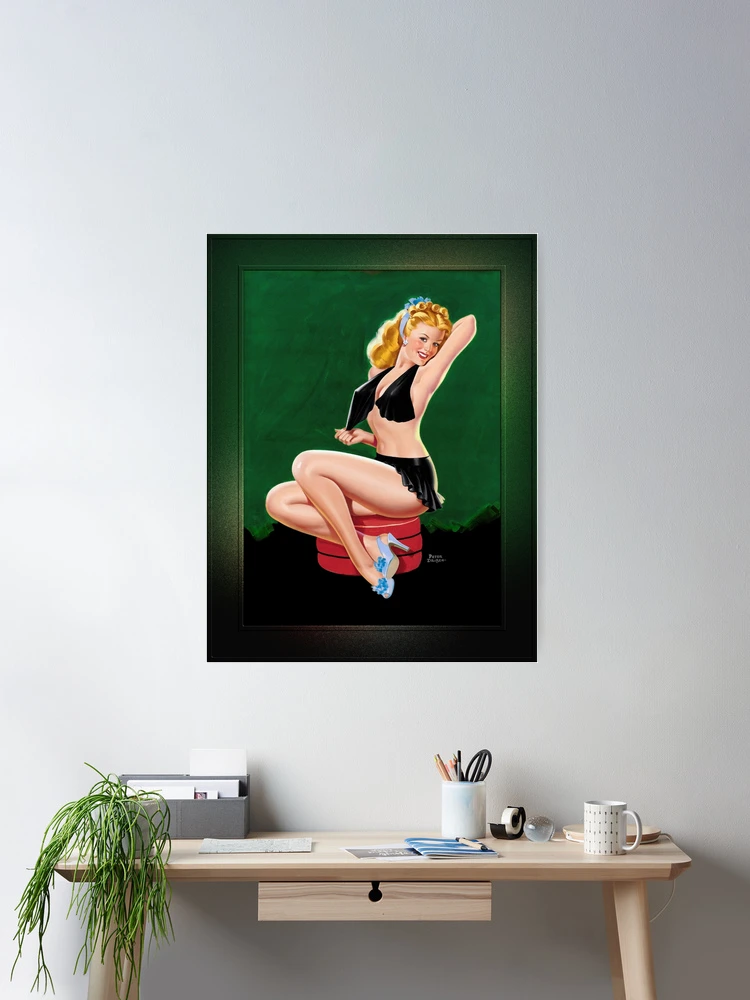
At the heart of the composition is a vibrant blonde woman, depicted with a radiant smile and an air of effortless confidence. Her pose is dynamic and playful, with one arm gracefully arched behind her head while the other tugs lightly at her cropped black top, lending an air of flirtation and spontaneity. The woman’s golden curls cascade over her shoulders, accentuated by a blue ribbon that adds a touch of innocence to her otherwise sultry demeanor. Her features are meticulously detailed, from her sparkling eyes and rosy cheeks to her perfectly sculpted smile, embodying the idealized beauty standards of the era.
Su atuendo, Aunque mínimo, is purposeful in its design. The black bikini top and ruffled skirt balance simplicity and sophistication, highlighting her figure while maintaining a sense of tasteful allure. Completing her outfit are light blue heels adorned with floral embellishments, an elegant detail that enhances the overall harmony of the image.
Background and Color Palette
The background is an expanse of rich green, a choice that creates a vivid contrast against the subject’s golden hair and fair skin. This bold use of color not only draws attention to the central figure but also emphasizes her liveliness and energy. The green backdrop is smooth and devoid of intricate detail, allowing the viewer to focus entirely on the subject while evoking a sense of timeless sophistication.
The subtle shadowing beneath the figure anchors her to the scene, giving a three-dimensional quality to the otherwise flat composition. The vibrant colors, clean lines, and lack of extraneous elements underscore Driben’s mastery in distilling a scene to its essence, ensuring the subject remains the focal point.
The Composition and Style
Driben’s style is emblematic of the classic pin-up genre, blending elements of realism with stylized exaggeration to create an idealized representation of femininity. The contours of the subject’s body are carefully crafted to accentuate her curves, a hallmark of the pin-up aesthetic. The overall composition is balanced and symmetrical, with the circular stool and her poised posture serving as grounding elements amidst the vivid dynamism of her pose.
The technique employed here is unmistakably painterly, with smooth gradients and bold, well-defined lines. This reflects the influence of commercial illustration of the time, where clarity and visual impact were paramount. Driben’s brushwork, while refined, retains a sense of warmth and accessibility, inviting the viewer to engage with the artwork on a personal level.
Estado de ánimo y tema
El estado de ánimo de “Una rubia reveladora” is lighthearted and playful, encapsulating the optimistic spirit of post-war America. There is an undeniable sense of joy and self-assurance in the subject’s demeanor, celebrating femininity without pretense or inhibition. The flirtatious nature of her pose and expression, coupled with the bright and vibrant color palette, evokes feelings of nostalgia and admiration.
The theme of the artwork aligns with the broader cultural fascination with glamour, belleza, and entertainment during the mid-20th century. Pin-up art, as epitomized by Driben’s work, was not just a celebration of beauty but also an expression of individuality and charm. esta pieza, En particular, captures the playful yet empowering essence of the genre, offering a window into a bygone era where artistry and popular culture seamlessly intertwined.
Conclusión
“Una rubia reveladora” by Peter Driben is a quintessential example of classic pin-up art, combining technical excellence with a sense of fun and allure. The meticulous attention to detail in the subject’s features, atuendo, and pose, paired with the simplicity of the background, highlights Driben’s ability to create works that are both visually striking and emotionally resonant. This piece stands as a testament to the enduring appeal of pin-up art, celebrating the beauty, confidence, and charm that defined an era.
Esta es una reproducción de maestros antiguos de arte digital remasterizada de una imagen de dominio público que está disponible como Esta es una elegante chica de glamour art deco vintage..
Sobre el artista
Información debajo de Wikipedia.org
Peter Driben nació en Boston, y estudió en Vesper George Art School antes de trasladarse a París en 1925. Mientras tomaba clases en la Sorbona en 1925, comenzó una serie de dibujos a pluma y tinta muy populares de las coristas de la ciudad.
en marzo de 1934 Driben creó su primer pin-up conocido, que fue la portada de La Paree Stories.; y por 1935, estaba produciendo portadas para Snappy, Energía, Noches de Nueva York, Vida Nocturna Francesa y Capricho.
A medida que la popularidad de Driben siguió aumentando a finales de los años treinta, creó más portadas para otras publicaciones periódicas, incluidas Silk Stocking Stories., Movie Merry-Go-Round y Real Screen Fun.
La carrera de Driben se expandió a la publicidad cuando se mudó a Nueva York a fines 1936. Aquí creó escaparates tridimensionales troquelados originales para Philco Radios., Toallas de baño Cannon, y la Weber Baking Company.
Quizás su trabajo más famoso son los carteles originales y la obra de arte publicitaria de The Maltese Falcon.. Peter Driben también era un amigo cercano del editor Robert Harrison., y en 1941 fue contratado para producir las portadas de la nueva revista Beauty Parade de Harrison.
A partir de ahí, Peter pasó a pintar cientos de portadas para esa publicación y para los otros siete títulos que Harrison iba a lanzar. – Ligar, Susurro, Mirando, Guiño, Eyeful, Risitas, y Joker.
Driben solía publicar hasta seis o siete de sus portadas cada mes.. El trabajo de Driben para Harrison lo estableció como uno de los artistas pin-up y glamour más reconocidos y exitosos de Estados Unidos.. Justo antes de que comenzara a trabajar para Harrison, Driben se casó con el artista, actriz y poeta, Louise Kirby.
En 1944 se le ofreció la oportunidad inusual, para un artista pin-up; que se convertiría en el director de arte del New York Sun, un puesto que conservó hasta 1946. Durante la guerra, Su pintura popular de soldados estadounidenses izando la bandera en Iwo Jima despertó una considerable cantidad de atención de los medios..
En 1956, Driben y Louise se mudaron a Miami Beach, donde pasó sus años de retiro pintando retratos (incluyendo uno de Dwight D. Eisenhower) y otras obras de arte, que fueron organizados en exposiciones exitosas por su esposa. Driben murió en 1968, Louise en 1984.