

A Revealing Blonde
Introduction
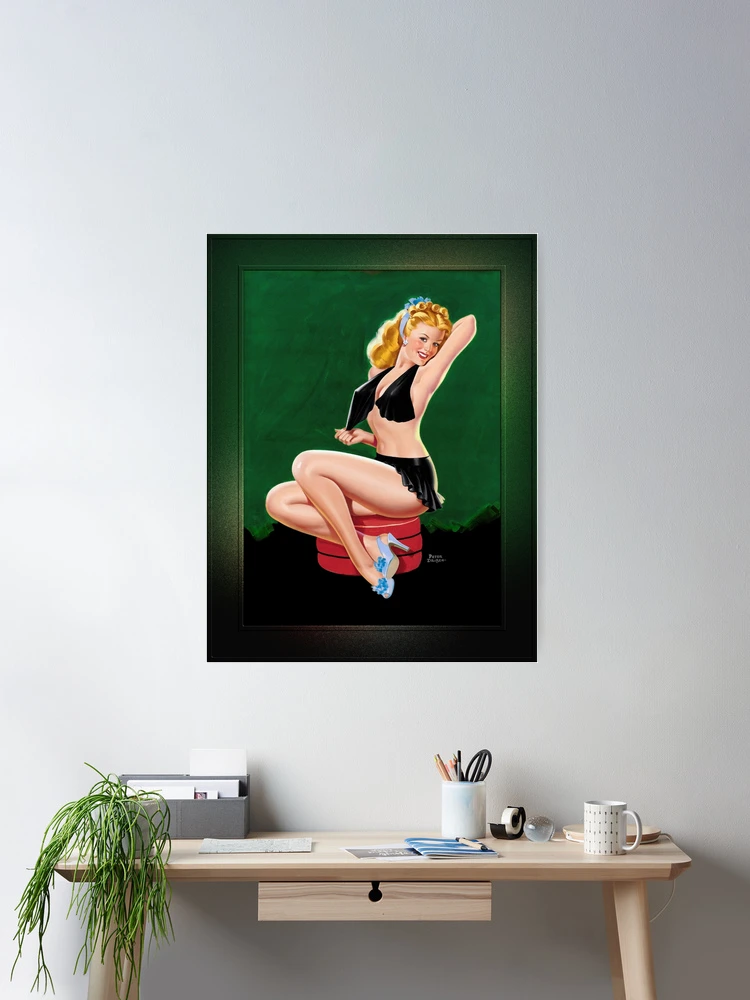
Peter Driben’s (1903 – 1968) artwork “A Revealing Blonde” captures the vivacious charm and sensuous elegance characteristic of mid-20th-century pin-up art. Renowned as one of the foremost illustrators of his time, Driben brings to life a captivating image of femininity, confiance, Et Allure, set against a strikingly minimal yet effective backdrop. This piece exemplifies the golden age of pin-up art, Où la beauté, cheekiness, and glamour were interwoven into every stroke.
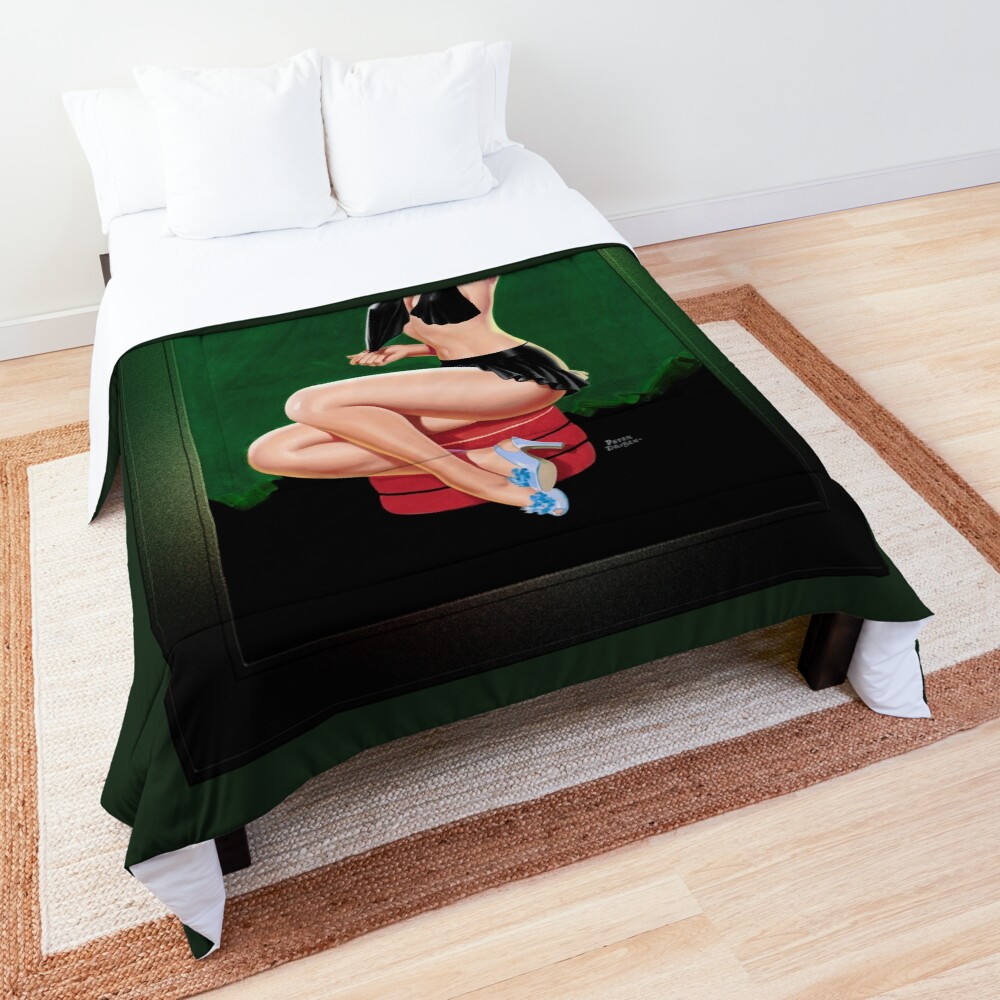
Table des matières
Le sujet: A Timeless Pin-Up Beauty
At the heart of the composition is a vibrant blonde woman, depicted with a radiant smile and an air of effortless confidence. Her pose is dynamic and playful, with one arm gracefully arched behind her head while the other tugs lightly at her cropped black top, lending an air of flirtation and spontaneity. The woman’s golden curls cascade over her shoulders, accentuated by a blue ribbon that adds a touch of innocence to her otherwise sultry demeanor. Her features are meticulously detailed, from her sparkling eyes and rosy cheeks to her perfectly sculpted smile, embodying the idealized beauty standards of the era.
Sa tenue, bien que minime, is purposeful in its design. The black bikini top and ruffled skirt balance simplicity and sophistication, highlighting her figure while maintaining a sense of tasteful allure. Completing her outfit are light blue heels adorned with floral embellishments, an elegant detail that enhances the overall harmony of the image.
Background and Color Palette
The background is an expanse of rich green, a choice that creates a vivid contrast against the subject’s golden hair and fair skin. This bold use of color not only draws attention to the central figure but also emphasizes her liveliness and energy. The green backdrop is smooth and devoid of intricate detail, allowing the viewer to focus entirely on the subject while evoking a sense of timeless sophistication.
The subtle shadowing beneath the figure anchors her to the scene, giving a three-dimensional quality to the otherwise flat composition. The vibrant colors, lignes épurées, and lack of extraneous elements underscore Driben’s mastery in distilling a scene to its essence, ensuring the subject remains the focal point.
The Composition and Style
Driben’s style is emblematic of the classic pin-up genre, blending elements of realism with stylized exaggeration to create an idealized representation of femininity. The contours of the subject’s body are carefully crafted to accentuate her curves, a hallmark of the pin-up aesthetic. The overall composition is balanced and symmetrical, with the circular stool and her poised posture serving as grounding elements amidst the vivid dynamism of her pose.
The technique employed here is unmistakably painterly, with smooth gradients and bold, well-defined lines. This reflects the influence of commercial illustration of the time, where clarity and visual impact were paramount. Driben’s brushwork, while refined, retains a sense of warmth and accessibility, inviting the viewer to engage with the artwork on a personal level.
Ambiance et thème
L'ambiance de “A Revealing Blonde” is lighthearted and playful, encapsulating the optimistic spirit of post-war America. There is an undeniable sense of joy and self-assurance in the subject’s demeanor, celebrating femininity without pretense or inhibition. The flirtatious nature of her pose and expression, coupled with the bright and vibrant color palette, evokes feelings of nostalgia and admiration.
The theme of the artwork aligns with the broader cultural fascination with glamour, beauté, and entertainment during the mid-20th century. Pin-up art, as epitomized by Driben’s work, was not just a celebration of beauty but also an expression of individuality and charm. Cette pièce, en particulier, captures the playful yet empowering essence of the genre, offering a window into a bygone era where artistry and popular culture seamlessly intertwined.
Conclusion
“A Revealing Blonde” by Peter Driben is a quintessential example of classic pin-up art, combining technical excellence with a sense of fun and allure. The meticulous attention to detail in the subject’s features, tenue, and pose, paired with the simplicity of the background, highlights Driben’s ability to create works that are both visually striking and emotionally resonant. This piece stands as a testament to the enduring appeal of pin-up art, celebrating the beauty, confiance, and charm that defined an era.
Il s'agit d'une reproduction de maîtres anciens d'art numérique remasterisée d'une image du domaine public qui est disponible en tant que impression sur toile.
À propos de l'artiste
Info ci-dessous de Wikipedia.org
Peter Driben est né à Boston, et il a étudié à la Vesper George Art School avant de s'installer à Paris en 1925. En suivant des cours à la Sorbonne en 1925, il a commencé une série de dessins à la plume et à l'encre très populaires des showgirls de la ville.
En mars de 1934 Driben a créé sa première pin-up connue qui était la couverture de La Paree Stories; et par 1935, il produisait des couvertures pour Snappy, Dynamisme, Nuits de New York, Vie nocturne française et caprice.
Alors que la popularité de Driben continuait d'augmenter à la fin des années trente, il créa plus de couvertures pour d'autres périodiques, notamment Silk Stocking Stories., Film Merry-Go-Round et vrai écran amusant.
La carrière de Driben s'est élargie à la publicité lorsqu'il a déménagé à New York à la fin 1936. Ici, il a créé des vitrines originales en trois dimensions découpées à l'emporte-pièce pour les radios Philco, Serviettes de bain Canon, et la société de boulangerie Weber.
Son œuvre la plus célèbre est peut-être les affiches originales et les illustrations publicitaires du Faucon maltais.. Peter Driben était également un ami proche de l'éditeur Robert Harrison, et en 1941 il a été engagé pour produire des couvertures pour le nouveau magazine de Harrison Beauty Parade.
À partir de là, Peter a peint des centaines de couvertures pour cette publication et pour les sept autres titres que Harrison devait lancer – Flirter, Chuchotement, Jeter un coup d'oeil, Clin d'œil, Plein les yeux, Rires, et Joker.
Driben avait souvent jusqu'à six ou sept de ses couvertures publiées chaque mois. Le travail de Driben pour Harrison l'a établi comme l'un des artistes pin-up et glamour les plus reconnus et les plus réussis d'Amérique. Juste avant qu'il ne commence à travailler pour Harrison, Driben a épousé l'artiste, comédienne et poète, Louise Kirby.
Dans 1944 on lui a offert l'opportunité inhabituelle, pour un artiste pin-up; qui allait devenir le directeur artistique du New York Sun, un poste qu'il a conservé jusqu'à 1946. Pendant la guerre, sa peinture populaire de soldats américains hissant le drapeau à Iwo Jima a suscité une attention considérable des médias.
Dans 1956, Driben et Louise ont déménagé à Miami Beach, où il a passé ses années de retraite à peindre des portraits (dont un de Dwight D. Eisenhower) et autres oeuvres d'art, qui ont été organisés en expositions à succès par sa femme. Driben est mort en 1968, Louise dans 1984.