

The Red Hotline
The Red Hotline: A Celebration of Glamour and Playfulness
La hotline rouge par Peter Driben (1903 – 1968), an esteemed American pin-up artist of the mid-20th century, was celebrated for his ability to infuse vitality and charm into his works; and this piece is a quintessential example of his artistry, epitomizing the flirtatious yet wholesome essence of pin-up culture. Driben‘s vibrant palette, mastery of form, and knack for storytelling through visual art are on full display in this piece.
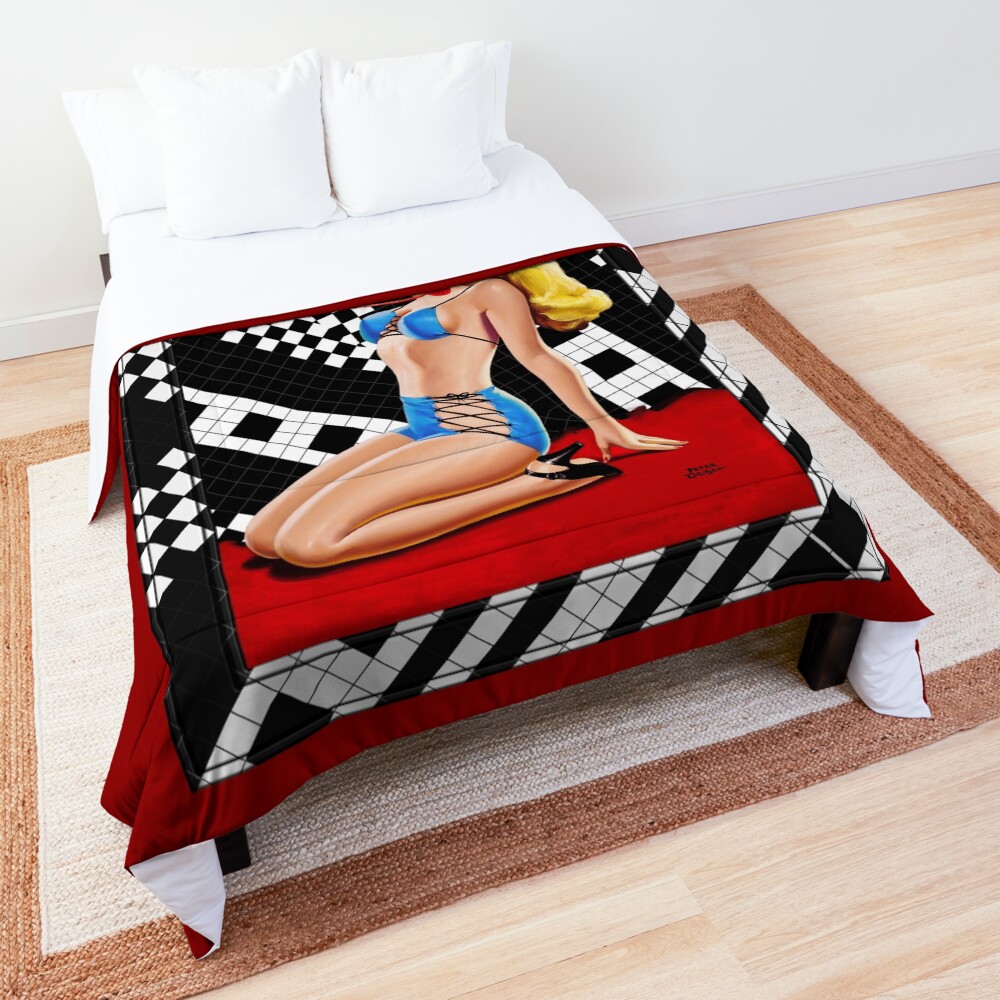
Table des matières
Sujet principal: The Radiant Blonde in Blue
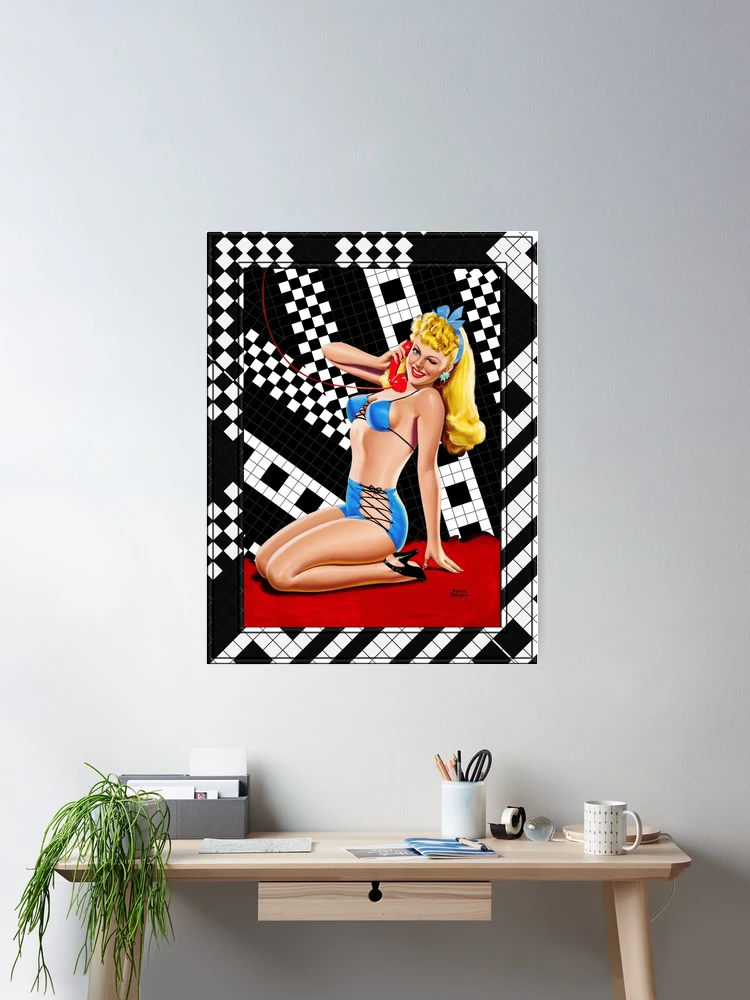
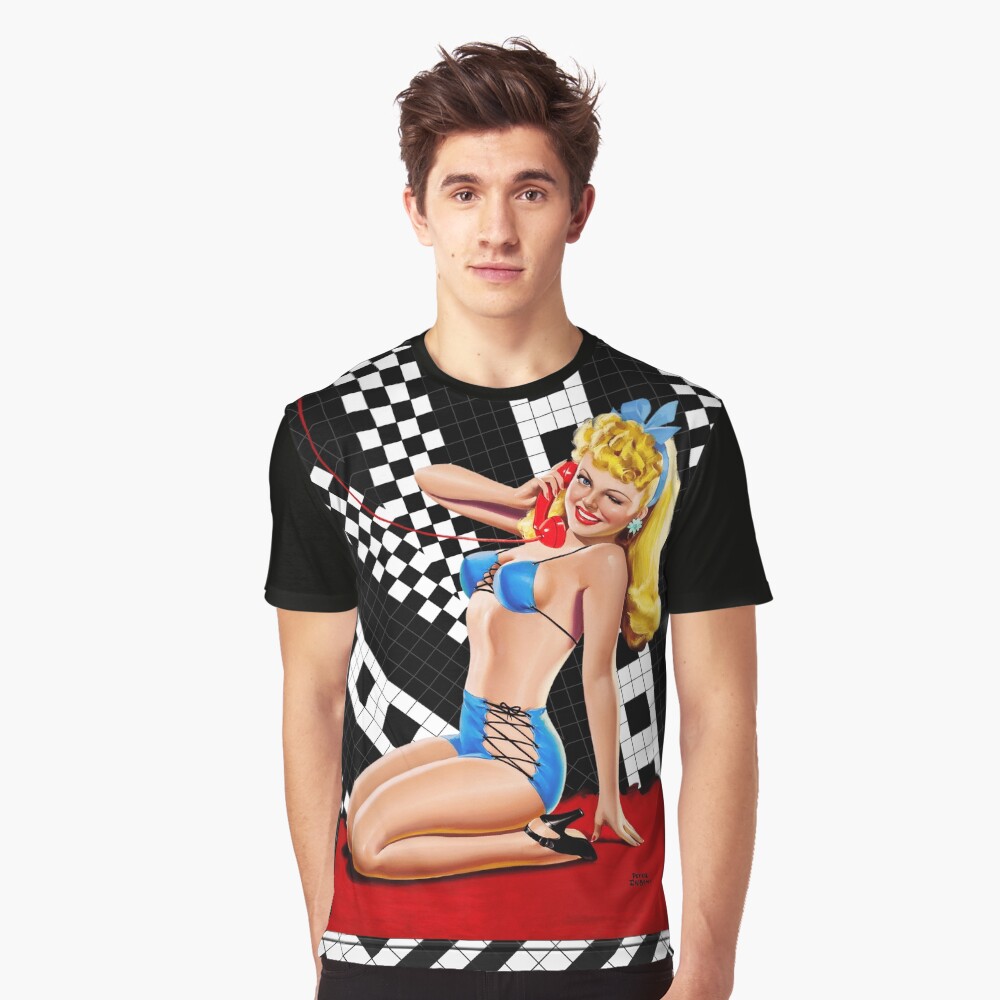
Au coeur de “The Red Hotline” lies a playful and coquettish depiction of a young blonde woman. Her golden hair cascades in carefully stylized waves, adorned with a large, cheerful blue bow that complements her swimsuit. The bright smile on her face, coupled with her winking eye, exudes an inviting charm, drawing viewers into the narrative. She holds a bright red telephone receiver, which lends the artwork its name and serves as a pivotal object within the composition.
The subject is dressed in a light blue bikini with black lace detailing. The high-waisted bottoms, characteristic of 1940s and 1950s fashion, are secured with crisscrossed laces, adding a touch of suggestive allure without compromising the overall playfulness of the scene. Her slender figure, accented by the pose, kneeling on a red carpet with one hand on the ground and the other holding the phone, demonstrates Driben’s skillful portrayal of anatomy and movement.
Background and Surrounding Objects
Le fond de “The Red Hotline” is a dazzling geometric checkerboard pattern, executed in stark black and white. This graphic, almost optical illusion-like design provides a modernist contrast to the soft, feminine figure in the foreground. The abstract background evokes a sense of energy and boldness, reinforcing the dynamic quality of the composition.
The red telephone cord playfully winds across the frame, connecting the subject to an unseen caller and injecting a sense of narrative intrigue. The phone itself, a vibrant red, stands out sharply against the monochrome and blue elements, acting as both a visual and thematic anchor.
The red carpet beneath the woman serves a dual purpose. It frames her pose while adding a warm, inviting tone to the composition. This patch of red balances the cooler tones of her attire and ties back to the telephone, creating a cohesive color scheme.
Style et technique
Driben’s work embodies the Golden Age of pin-up art, an era when illustrators captured an idealized, often cheeky depiction of femininity. His style is defined by bold colors, lignes épurées, and a high level of polish that recalls the glossy advertisements and magazine covers of his time.
Dans “The Red Hotline,” Driben’s use of light and shadow is subtle but effective. The glossy sheen on the telephone and the laces of the swimsuit adds a sense of texture and realism, while the soft shadows along the figure’s curves enhance her three-dimensionality. The artist’s attention to detail—such as the precise rendering of her glossy black heels or the subtle highlights in her hair—showcases his technical prowess.
Thème et humeur
Le thème de “The Red Hotline” is lighthearted and playful, rooted in the optimism and cheeky humor that characterized mid-century pin-up art. The telephone introduces an element of storytelling, inviting viewers to imagine the conversation taking place. Is she flirting with a suitor? Sharing a laugh with a friend? The ambiguity allows for a range of interpretations, adding depth to the seemingly simple scene.
The mood is undeniably fun and flirtatious, yet it remains within the realm of innocent escapism. Driben’s pin-ups often walked the line between suggestiveness and wholesomeness, a balance that made them widely popular and accessible during their time. “The Red Hotline” ne fait pas exception, offering a playful fantasy that never veers into vulgarity.
Materials and Medium
While the specific medium of this piece isn’t detailed here, Driben was known for his work in gouache and oil paints. These mediums allowed him to achieve the vibrant colors and smooth finishes seen in “The Red Hotline.” The level of precision in the lines and shading suggests that this artwork was originally created as an illustration, likely intended for print in a magazine, calendar, or poster.
Cultural Context and Legacy
“The Red Hotline” reflects the cultural zeitgeist of its era. Created during a time when pin-up art was at its peak, it embodies the idealized femininity and playful sensuality that appealed to audiences in the mid-20th century. Driben’s works were part of a broader movement that celebrated beauty, glamour, and the allure of the everyday woman.
As a piece of pin-up art, “The Red Hotline” carries with it the legacy of a genre that influenced fashion, publicité, and popular culture. Aujourd'hui, it stands as a nostalgic reminder of a bygone era, appreciated both for its aesthetic qualities and its historical significance.
Conclusion
“The Red Hotline” by Peter Driben is a masterful example of mid-century pin-up art. Its captivating subject, bold design, and vibrant execution showcase the artist’s talent and creativity. Driben’s ability to combine playfulness with technical precision ensures that this artwork remains an enduring icon of its genre. It captures a moment in time when glamour and charm were celebrated, offering viewers a delightful glimpse into the world of vintage illustration.
Il s'agit d'une reproduction de maîtres anciens d'art numérique remasterisée d'une image du domaine public qui est disponible en tant que impression métallique.
À propos de l'artiste
Info ci-dessous de Wikipedia.org
Peter Driben est né à Boston, et il a étudié à la Vesper George Art School avant de s'installer à Paris en 1925. En suivant des cours à la Sorbonne en 1925, il a commencé une série de dessins à la plume et à l'encre très populaires des showgirls de la ville.
En mars de 1934 Driben a créé sa première pin-up connue qui était la couverture de La Paree Stories; et par 1935, il produisait des couvertures pour Snappy, Dynamisme, Nuits de New York, Vie nocturne française et caprice.
Alors que la popularité de Driben continuait d'augmenter à la fin des années trente, il créa plus de couvertures pour d'autres périodiques, notamment Silk Stocking Stories., Film Merry-Go-Round et vrai écran amusant.
La carrière de Driben s'est élargie à la publicité lorsqu'il a déménagé à New York à la fin 1936. Ici, il a créé des vitrines originales en trois dimensions découpées à l'emporte-pièce pour les radios Philco, Serviettes de bain Canon, et la société de boulangerie Weber.
Son œuvre la plus célèbre est peut-être les affiches originales et les illustrations publicitaires du Faucon maltais.. Peter Driben était également un ami proche de l'éditeur Robert Harrison, et en 1941 il a été engagé pour produire des couvertures pour le nouveau magazine de Harrison Beauty Parade.
À partir de là, Peter a peint des centaines de couvertures pour cette publication et pour les sept autres titres que Harrison devait lancer – Flirter, Chuchotement, Jeter un coup d'oeil, Clin d'œil, Plein les yeux, Rires, et Joker.
Driben avait souvent jusqu'à six ou sept de ses couvertures publiées chaque mois. Le travail de Driben pour Harrison l'a établi comme l'un des artistes pin-up et glamour les plus reconnus et les plus réussis d'Amérique. Juste avant qu'il ne commence à travailler pour Harrison, Driben a épousé l'artiste, comédienne et poète, Louise Kirby.
Dans 1944 on lui a offert l'opportunité inhabituelle, pour un artiste pin-up; qui allait devenir le directeur artistique du New York Sun, un poste qu'il a conservé jusqu'à 1946. Pendant la guerre, sa peinture populaire de soldats américains hissant le drapeau à Iwo Jima a suscité une attention considérable des médias.
Dans 1956, Driben et Louise ont déménagé à Miami Beach, où il a passé ses années de retraite à peindre des portraits (dont un de Dwight D. Eisenhower) et autres oeuvres d'art, qui ont été organisés en expositions à succès par sa femme. Driben est mort en 1968, Louise dans 1984.