

A Storm on a Mediterranean Coast
A Storm on a Mediterranean Coast c1767 by French Painter Claude Joseph Vernet (1714 – 1789); bekannt fir Molerei, drawing and engraving in the Neo-Classic style.
In this dramatic scene of a Mediterranean storm, Vernet has captured the harrowing moments of a group of shipwreck survivors who have managed to pull themselves onto the shore as their life boat is being pulled apart by the rough seas; and while a few watch on from a cliff as their ship is listing to the left and ready to go into a watery grave.
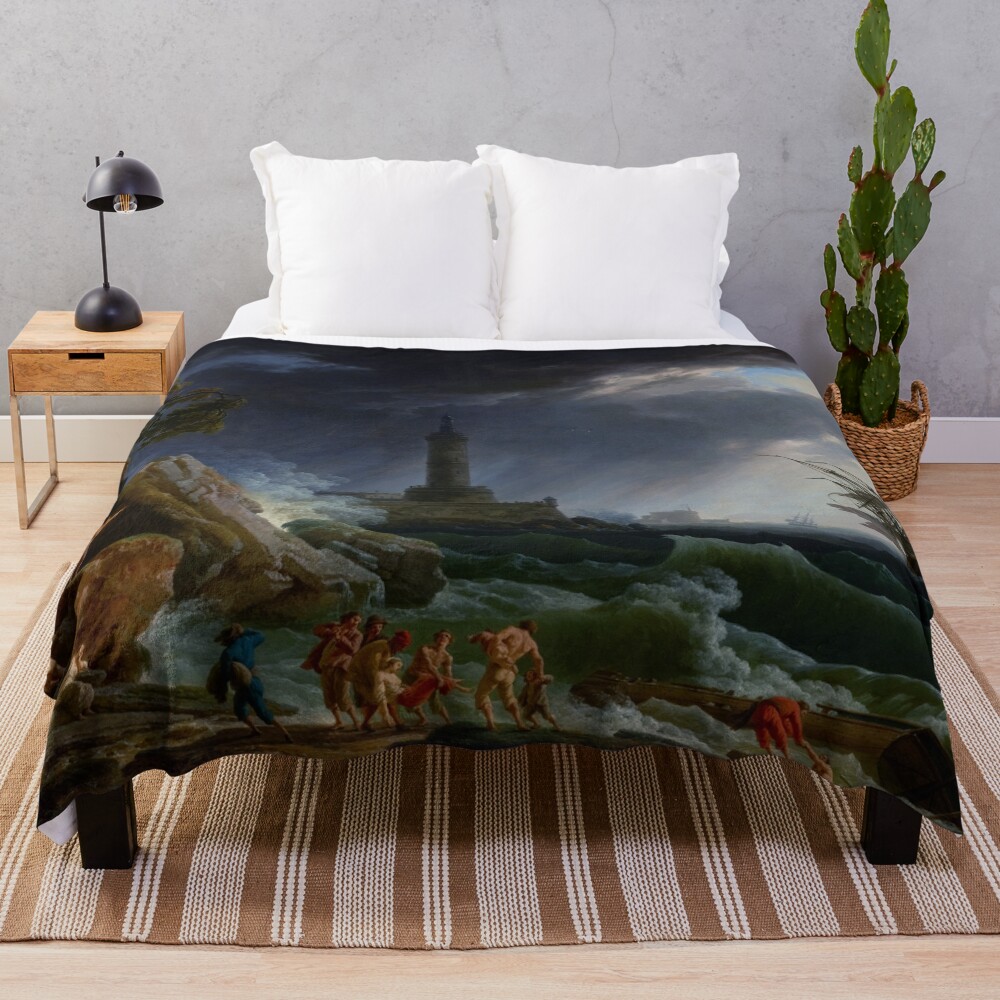
A Storm on a Mediterranean Coast is a retouched digital art reproduction of a public domain image that is available online as a Leinwandprint online.
Info drënner ofgeleet vun Wikipedia.org
De Vernet gouf zu Avignon gebuer, an am Alter vu véierzéng sengem Papp gehollef, Antoine Vernet (1689 – 1753), deen e kompetenten Dekoratiounsmoler war, an de wichtegsten Deeler vu senger Aarbecht.
An 1734, De Vernet ass op Roum fortgaang fir Landschaftsdesigner a maritime Moler ze studéieren, wéi franséische Barockmoler, Draughtsman and Etcher Claude Gellee also known as Claude Lorrain (1600 – 1682); with many of Vernet’s pieces being reminiscent of Lorrain’s work.
For twenty years Vernet lived in Rome, and produced views of seaports, storms, calms, moonlights, and large whales; becoming especially popular with English aristocrats, many of whom were on the Grand Tour (a 17th and 18th century custom of a traditional trip through Europe, which was undertaken by upper-class young European men (iwwer 21 Joer al) of sufficient means and rank usually accompanied by a chaperone).
An 1753 Vernet was recalled to Paris; an iwwerdeems do, by royal command, he executed the series of the seaports of France by which he is best known. An 1757, he painted a series of four paintings titled Four Times of the Day depicting, not surprisingly, four times of the day.
With a certain conventionality in design, proper to his day, Vernet allied the results of constant and honest observation of natural effects of atmosphere, which he rendered with unusual pictorial artistry.
Perhaps no painter of landscapes or sea-pieces has ever made the human figure so completely a part of the scene depicted or so important a factor in his design. In this respect he was heavily influenced by Giovanni Paolo Panini, whom he probably met and worked with in Rome.
Vernet’s work draws on natural themes, but in a way that is neither sentimental or emotive; as the overall effect of his style is wholly decorative. “Others may know better”, he said, with just pride, “how to paint the sky, the earth, the ocean; no one knows better than I how to paint a picture”.