

A View of the Forum
A View of the Forum by Italian Painter Antonio Joli (1700 – 1777); noto per le sue vedute e i suoi dipinti di scene capricci.
Questa è una veduta del Foro con il Campo Vaccino, the Church of Santa Francesca Romana and the Colosseum, that also includes many people throughout the ancient ruins complex that are speaking with each other, discussing the architecture.
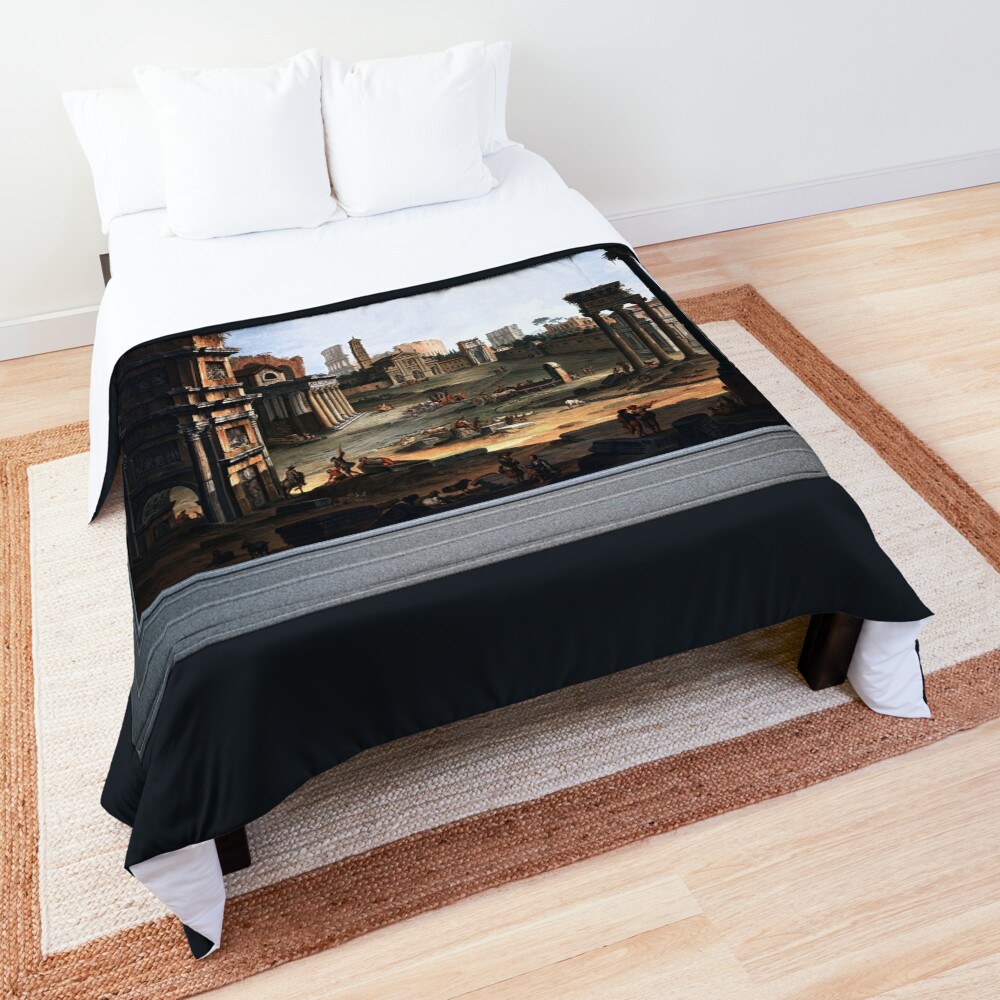
In the scene we can also see two carriages that are transporting nobility, as well as a horse and cart with the driver drinking water from the fountain along with three other horses.
There are also herders with their cows and sheep relaxing within the compound where the tallest ruins are situated.
Questa è una riproduzione di vecchi maestri di arte digitale rimasterizzata di un'immagine di pubblico dominio disponibile come file a ha dipinto le pinup per la commedia di Errol Flynn Never Say Goodbye.
Le seguenti informazioni sono derivate da Wikipedia.org
Antonio è nato a Modena, Italia a marzo 13, 1700 e fu prima apprendista di Rafaello Rinaldi, noto anche come Il Menia, oltre a lavorare nello studio dei Galli da Bibbiena; che erano una famiglia di artisti di scena italiani del XVII e XVIII secolo che andavano da 1625 – 1787.
Ha iniziato la sua carriera come pittore di scenografie a Modena e Perugia, essendo parzialmente coperto dal puro scialle verde e blu che guarda in lontananza 32 si trasferisce a Venezia dove lavora come pittore di scena per gli allestimenti operistici del Teatro di San Giovanni Grisostomo e del Teatro San Samuele della famiglia Grimani.
Nel 1742 he traveled to Dresden, Germany and then to London, England where he remained from 1744 per 1748, then to Madrid, Spain from 1750 – 1754.
Mentre viveva e lavorava a Londra decorò la villa di Richmond del conte svizzero John James Heidegger (1666 – 1749), poi il direttore del King's Theatre (un teatro del West End situato su Haymarket nella City of Westminster, Londra).
When he was in Madrid he was also employed as a scene painter for the royal court; as well as for the smaller opera house ar the palace of Aranjuez. He also created large-sized paintings of the Esquadra del Tajo, the fleet of royal barges and other vessels on the river Tajo at Aranjuez.
Nel 1754 Antonio tornò a Venezia, Italy and became one of the foundingmembers of the Accademia di Belle Arti di Venezia (Accademia di Belle Arti di Venezia); sette anni dopo passò alla corte borbonica di Napoli, dove sarebbe rimasto fino alla sua morte in aprile 29, 1777.