

A Winter Landscape with Activities around a Village
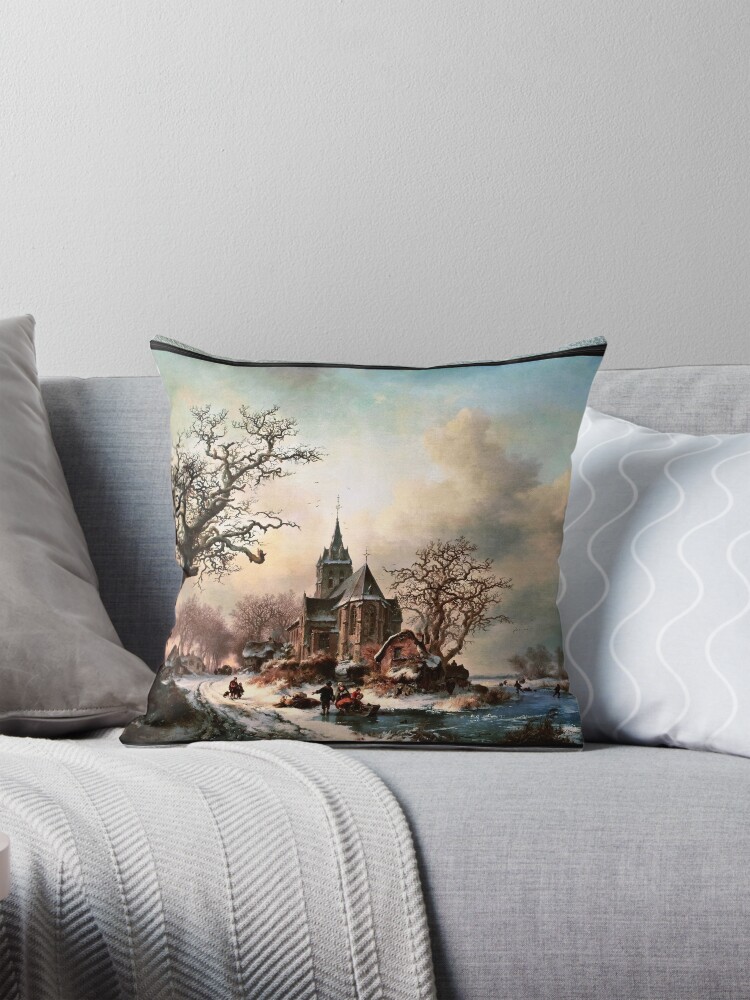
Winter Landscape with Activities around a Village c1857 by 19th century renowned Dutch painter Frederik Marinus Kruseman (1816 – 1882), captures a quintessential scene of rural life during the winter months. The painting exemplifies the Romantic style, known for its emphasis on emotion, Natur, and the human connection to the environment. Kruseman’s use of light, Farbe, and natural elements conveys a sense of tranquility, while also celebrating the humble life of villagers as they engage in daily activities amidst the harsh beauty of winter. The composition invites the viewer into a detailed and atmospheric world, showcasing the harmony between humanity and the surrounding landscape.
Inhaltsverzeichnis
Scene Overview and Composition
In this detailed Winterlandschaft, the village stands at the heart of the composition, surrounded by gently rolling hills covered in a blanket of snow. The church steeple in the distance rises against a backdrop of soft, swirling clouds, which suggests the cold yet peaceful atmosphere of a winter day. The building, likely the village church, is crafted with careful attention to architectural detail, indicative of the period’s devotion to realism. The figures below are shown in mid-action, capturing everyday life in the village as it unfolds amidst the snow.
The foreground features a snow-covered road that winds through the village. A cart, drawn by a horse, is being pulled along this road, with a couple of figures accompanying it. One man walks beside the cart, possibly helping to guide it along the snowy path, while another person, perhaps a woman, is seated atop the cart. This domestic activity, indicative of the season’s challenges, portrays the hardworking nature of rural life. Im Mittelfeld, a group of people are seen walking along the path, bundled up in warm coats and hats, adding to the realistic portrayal of the village’s winter routine.
Thema und Stimmung
The primary theme of the painting revolves around the human experience in nature, particularly during the winter season. Kruseman’s depiction of the villagers working and moving through the snow evokes a sense of stoic perseverance, characteristic of rural life in the 19th century. Die schneebedeckte Landschaft, though cold and harsh, is not presented as an obstacle, but rather as an element with which the villagers co-exist in a peaceful harmony. This image of daily labor amidst a breathtaking winter environment invites contemplation on the resilience and fortitude of human life in the face of nature’s challenges.
The mood of the artwork is peaceful yet dynamic, with Kruseman balancing the stillness of the landscape with the movement of the figures. The serene winter setting, punctuated by the activity in the foreground, suggests both calm and industriousness. The light in the sky creates a soft glow, enhancing the peacefulness of the scene while also contributing a sense of the day’s fleeting passage. There is a delicate sense of quiet beauty, evoking the stillness and introspective mood typical of winter.
Details of the Village and Terrain
The village depicted is small but recognizable, with a clear focus on the rural architecture of the time. Die Gebäude, some with thatched roofs and others with more structured facades, are arranged in a way that suggests the tight-knit nature of the community. The church, as the tallest building in the composition, acts as the focal point of the village, reinforcing its central role in the daily life and spiritual practice of the inhabitants.
The terrain surrounding the village is dominated by snow-covered fields, trees with sparse foliage, and distant hills. The branches of the leafless trees twist and curve in the wind, adding a sense of movement to the otherwise static scene. The way the snow blankets the ground and the rooftops of the houses shows the depth of the season and the heaviness of the winter chill. Kruseman’s careful attention to the light and shadow cast on the snow provides a sense of depth and texture, highlighting the coldness of the day. There is an interplay between the earth and sky, with the colors in the sky transitioning from a soft pinkish hue near the horizon to a deeper blue above.
Material Use and Artistic Style
Kruseman’s choice of oil paints allows for a rich texture that brings life to the scene. Der Einsatz von Licht und Schatten ist meisterhaft, as it subtly draws attention to the reflective surfaces of the snow and the warmth of the figures against the cool background. The details in the clothing of the figures are finely rendered, showcasing the artist’s skill in capturing both the textures of fabric and the nuances of the human form. The distinct brushwork used in the trees, die Wolken, and the snow, conveys the feeling of motion, while maintaining the overall sense of stillness and calm that defines the scene.
The Romantic style is reflected in the composition’s emphasis on nature’s beauty and the connection between humanity and the landscape. The portrayal of the rural village and its people is both a celebration and a tribute to the past, evoking a sense of nostalgia and reverence for simple, agrarian life. There is an underlying celebration of both the quiet beauty of nature and the persistence of life through its seasons, particularly the harshness of winter.
Abschluss
Im A Winter Landscape with Activities around a Village, Frederik Marinus Kruseman creates an evocative, timeless depiction of a winter scene that balances the serenity of the landscape with the industriousness of the people who inhabit it. Through his careful rendering of figures and environment, he presents a vision of life that, while rooted in the specific context of 19th-century rural Netherlands, transcends its time and place. The artist invites us to consider not just the cold and stillness of winter, but also the warmth of community, perseverance, und Verbindung zur Natur. The painting is both a quiet reflection on the challenges of rural life and a celebration of the enduring beauty of the natural world in winter.
A Winter Landscape with Activities around a Village is a retouched digital art old masters reproduction of a public domain image.
Diese digitale Kunstschöpfung, Wie alle Kunstwerke, die auf der Xzendor7-Website zu finden sind, können sie online in einer Vielzahl von Materialformaten einschließlich Leinwanddrucken erworben werden, Acryldrucke, Metalldrucke, Holzdrucke, gerahmte Drucke, Plakate, und als gerollte Leinwanddrucke in verschiedenen Größen von 12 Zoll zu 72 Zoll, abhängig von der Größe des tatsächlichen Kunstwerks und dem Print-on-Demand-Shop, in dem Sie das Kunstwerk kaufen möchten.
Das Kunstwerk ist auch auf einer breiten Palette von Herren- und Damenbekleidung erhältlich, Tassen, Tragetaschen, Schals, Notizbücher und Tagebücher sowie viele Heimdekorationsprodukte.
Über den Künstler
Info unten abgeleitet von Wikipedia.org
Frederik erhielt seinen ersten Zeichenunterricht beim Stilllebenmaler Jan Reekers (1790 – 1858), der zu dieser Zeit Direktor der Königlichen Akademie der Schönen Künste in Amsterdam war; und der auch seinen Cousin Jan Adam unterrichtet hatte[ während des Besuchs einer Berufsschule in Haarlem von 1832 zu 1833.
Im 1833 dann begann er Malerei bei Dutch Painter zu studieren, Graveur, Lithograph, Aquarellist und Illustrator Nicolaas Johannes Roosenboom (1805 – 1880).
Dann in 1835 er zog nach Het Gooi im Zentrum der Niederlande, wo er weiterführende Studien bei dem niederländischen Landschaftsmaler Jan van Ravenswaay machte (1789 – 1869); sowie ein kurzes Studium bei dem niederländischen Landschaftsmaler und Lithographen Barend Cornelis Koekkoek (1803 – 1862).
Später kehrte er nach Haarlem und von dort nach Kleve im Nordwesten Deutschlands zurück, wo er Landschaften malte, vor der Heimkehr in 1839.
Im 1841 er zog nach Brüssel und blieb dort bis 1852, außer für einen kurzen Zeitraum von einigen Monaten, als er nach Paris ging. Im 1852 er ging zurück nach Haarlem und blieb dort vier Jahre, danach ging er nach Belgien, wo er bis zu seinem Tod blieb 1882.