

A Winter Landscape with Activities around a Village
Winter Landscape with Activities around a Village c1857 by 19th century renowned Dutch painter Frederik Marinus Kruseman (1816 – 1882), captures a quintessential scene of rural life during the winter months. The painting exemplifies the Romantic style, known for its emphasis on emotion, naturaleza, and the human connection to the environment. Kruseman’s use of light, color, and natural elements conveys a sense of tranquility, while also celebrating the humble life of villagers as they engage in daily activities amidst the harsh beauty of winter. The composition invites the viewer into a detailed and atmospheric world, showcasing the harmony between humanity and the surrounding landscape.
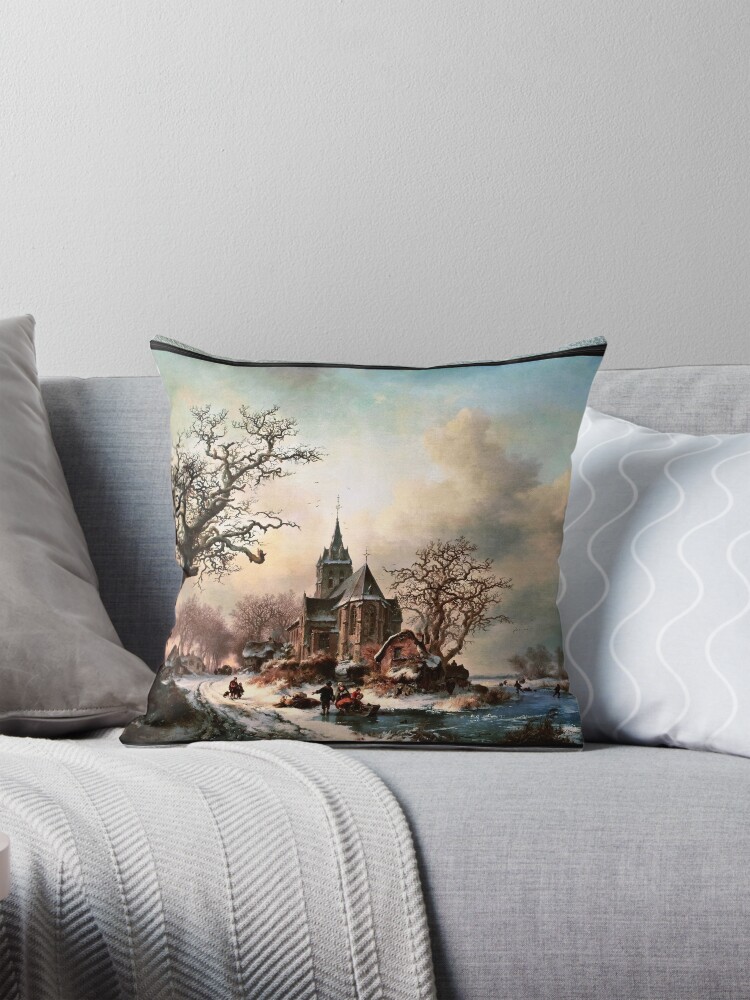
Tabla de contenido
Scene Overview and Composition
In this detailed paisaje de invierno, the village stands at the heart of the composition, surrounded by gently rolling hills covered in a blanket of snow. The church steeple in the distance rises against a backdrop of soft, nubes arremolinadas, which suggests the cold yet peaceful atmosphere of a winter day. The building, likely the village church, is crafted with careful attention to architectural detail, indicative of the period’s devotion to realism. The figures below are shown in mid-action, capturing everyday life in the village as it unfolds amidst the snow.
The foreground features a snow-covered road that winds through the village. A cart, drawn by a horse, is being pulled along this road, with a couple of figures accompanying it. One man walks beside the cart, possibly helping to guide it along the snowy path, while another person, perhaps a woman, is seated atop the cart. This domestic activity, indicative of the season’s challenges, portrays the hardworking nature of rural life. En el término medio, a group of people are seen walking along the path, bundled up in warm coats and hats, adding to the realistic portrayal of the village’s winter routine.
Tema y estado de ánimo
The primary theme of the painting revolves around the human experience in nature, particularly during the winter season. Kruseman’s depiction of the villagers working and moving through the snow evokes a sense of stoic perseverance, characteristic of rural life in the 19th century. The snow-covered landscape, though cold and harsh, is not presented as an obstacle, but rather as an element with which the villagers co-exist in a peaceful harmony. This image of daily labor amidst a breathtaking winter environment invites contemplation on the resilience and fortitude of human life in the face of nature’s challenges.
The mood of the artwork is peaceful yet dynamic, with Kruseman balancing the stillness of the landscape with the movement of the figures. The serene winter setting, punctuated by the activity in the foreground, suggests both calm and industriousness. The light in the sky creates a soft glow, enhancing the peacefulness of the scene while also contributing a sense of the day’s fleeting passage. There is a delicate sense of quiet beauty, evoking the stillness and introspective mood typical of winter.
Details of the Village and Terrain
The village depicted is small but recognizable, with a clear focus on the rural architecture of the time. los edificios, some with thatched roofs and others with more structured facades, are arranged in a way that suggests the tight-knit nature of the community. The church, as the tallest building in the composition, acts as the focal point of the village, reinforcing its central role in the daily life and spiritual practice of the inhabitants.
The terrain surrounding the village is dominated by snow-covered fields, trees with sparse foliage, and distant hills. The branches of the leafless trees twist and curve in the wind, adding a sense of movement to the otherwise static scene. The way the snow blankets the ground and the rooftops of the houses shows the depth of the season and the heaviness of the winter chill. Kruseman’s careful attention to the light and shadow cast on the snow provides a sense of depth and texture, highlighting the coldness of the day. There is an interplay between the earth and sky, with the colors in the sky transitioning from a soft pinkish hue near the horizon to a deeper blue above.
Material Use and Artistic Style
Kruseman’s choice of oil paints allows for a rich texture that brings life to the scene. The use of light and shadow is masterful, as it subtly draws attention to the reflective surfaces of the snow and the warmth of the figures against the cool background. The details in the clothing of the figures are finely rendered, showcasing the artist’s skill in capturing both the textures of fabric and the nuances of the human form. The distinct brushwork used in the trees, the clouds, and the snow, conveys the feeling of motion, while maintaining the overall sense of stillness and calm that defines the scene.
The Romantic style is reflected in the composition’s emphasis on nature’s beauty and the connection between humanity and the landscape. The portrayal of the rural village and its people is both a celebration and a tribute to the past, evoking a sense of nostalgia and reverence for simple, agrarian life. There is an underlying celebration of both the quiet beauty of nature and the persistence of life through its seasons, particularly the harshness of winter.
Conclusión
En A Winter Landscape with Activities around a Village, Frederik Marinus Kruseman creates an evocative, timeless depiction of a winter scene that balances the serenity of the landscape with the industriousness of the people who inhabit it. Through his careful rendering of figures and environment, he presents a vision of life that, while rooted in the specific context of 19th-century rural Netherlands, transcends its time and place. The artist invites us to consider not just the cold and stillness of winter, but also the warmth of community, perseverance, y conexión con el mundo natural. The painting is both a quiet reflection on the challenges of rural life and a celebration of the enduring beauty of the natural world in winter.
A Winter Landscape with Activities around a Village is a retouched digital art old masters reproduction of a public domain image.
Esta creación de arte digital, al igual que todas las obras de arte que se pueden encontrar en el sitio web de Xzendor7, están disponibles para su compra en línea en una variedad de formatos de materiales, incluidas impresiones en lienzo, impresiones acrílicas, impresiones de metal, impresiones de madera, láminas enmarcadas, carteles, y como lienzos enrollados en una variedad de tamaños, desde 12 pulgadas a 72 pulgadas según el tamaño de la obra de arte real y la tienda de impresión bajo demanda en la que elija comprar la obra de arte.
La obra de arte también está disponible en una amplia gama de prendas de vestir para hombres y mujeres., tazas, totalizadores, bufandas, cuadernos y diarios y muchos productos de decoración del hogar..
Sobre el artista
Información a continuación derivada de Wikipedia.org
Frederik recibió sus primeras lecciones de dibujo del pintor de naturalezas muertas Jan Reekers (1790 – 1858), quien en ese momento era director de la Real Academia de Bellas Artes de Ámsterdam; y que también había sido tutor de su primo Jan Adam[ mientras asistía a una escuela de formación profesional en Haarlem desde 1832 a 1833.
En 1833 luego comenzó a estudiar pintura con el pintor holandés, Grabador, Litógrafo, Acuarelista e ilustrador Nicolaas Johannes Roosenboom (1805 – 1880).
Entonces en 1835 se mudó a Het Gooi en el centro de Nertherlands, donde realizó estudios avanzados con el pintor paisajista holandés Jan van Ravenswaay (1789 – 1869); además de estudiar durante un breve período de tiempo con el pintor paisajista y litógrafo holandés Barend Cornelis Koekkoek (1803 – 1862).
Más tarde regresó a Haarlem y de allí a Kleve, en el noroeste de Alemania, donde pintó paisajes., antes de regresar a casa en 1839.
En 1841 se mudó a Bruselas y permaneció allí hasta 1852, excepto por un breve período de unos meses cuando fue a París. En 1852 Regresó a su casa en Haarlem y permaneció allí durante cuatro años., después de lo cual se fue a Bélgica, donde permaneció hasta su muerte en 1882.