

En ung dame med en rød fan
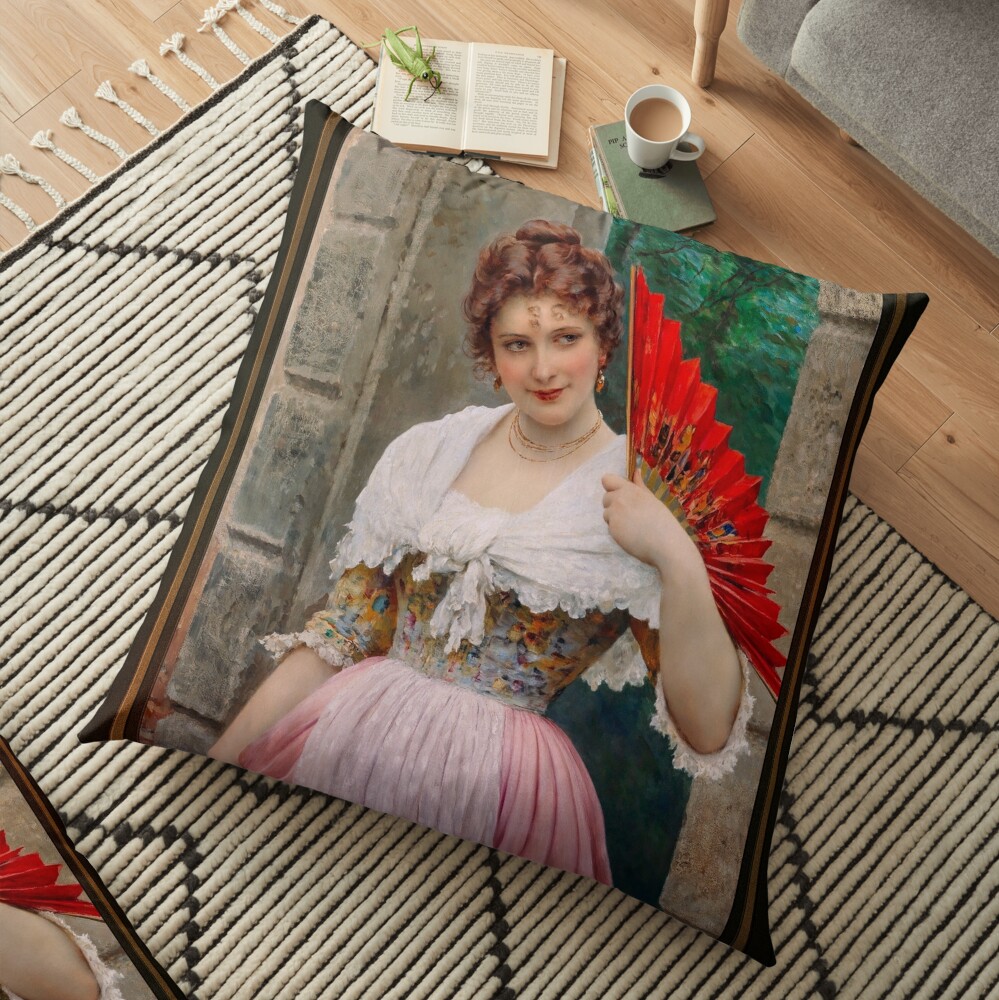
“En ung dame med en rød fan,” oprettet i 1897 by Italian painter Eugen von Blaas (1843–1931), is an exquisite example of the artist’s talent for capturing elegant scenes from daily life, steeped in the opulence of late 19th-century Europe. In this particular painting, Blaas conveys the sophisticated world of aristocratic women, emphasizing grace, skønhed, og raffinement. The painting is not only a portrait of a young woman but also an embodiment of the fashion, attitudes, and natural beauty of its time.
Indholdsfortegnelse
Emnet og kompositionen
At the center of the composition is a young woman, her delicate features framed by a soft cascade of light brown curls that hint at the youthful energy and warmth of the scene. She wears a gown that speaks to the fashionable styles of the late 19th century, with its high waistline, billowing skirt, and the intricate textile work that blends pastel hues of pink, lavender, and white.
The woman’s posture is relaxed yet refined, holding a vibrant red fan that contrasts sharply with the muted tones of her attire and background. The fan serves as both an accessory and an integral visual element, drawing the viewer’s eye immediately. The vibrant red of the fan, with its delicate painted designs, contrasts beautifully with her attire, and its boldness contrasts with the soft elegance of her gown.
The artist captures the woman’s gaze with a sense of intimacy and intrigue. Hendes øjne, framed by soft curls, look to the side with a knowing expression, as if caught in a moment of daydreaming or perhaps conversing with someone off to the left of the frame. This subtle connection between the viewer and the subject draws the audience into the narrative of the scene, inviting them to imagine the woman’s thoughts or the circumstances of her moment in time.
Baggrunden og indstillingen
Baggrunden for “En ung dame med en rød fan” is a garden scene, visible through a stone archway. The earthy tones of the stonework and the lush green foliage beyond create a serene, almost idyllic atmosphere. The setting suggests an aristocratic outdoor space, perhaps a private garden or a terrace of a noble estate, offering a perfect setting for a leisurely afternoon. The contrast between the stone and the natural greenery serves as a metaphor for the blend of human sophistication and nature’s untainted beauty.
The setting enhances the sense of elegance, with the classical stonework surrounding the archway symbolizing tradition and permanence. The surrounding greenery, imidlertid, offers a feeling of freshness and tranquility, reinforcing the timeless nature of the subject and her surroundings.
Materialer, Techniques, and Style
The work is painted using oil paints, a medium that allows for rich textures, depth, and light play. Blaas uses a masterful technique to capture the details of the woman’s clothing, creating a lifelike quality that feels almost tangible. The texture of the fabric, especially the soft folds of the gown, is rendered with meticulous attention to light and shadow, bringing a sense of volume and movement to the fabric.
The use of color in this painting is particularly striking. The soft pastels of the woman’s gown evoke a feeling of calm and softness, while the red of the fan is a bold statement, adding vibrancy and intensity to the composition. Blaas’s attention to detail, from the soft blush of the woman’s cheeks to the intricate design of the fan, showcases his ability to transform the mundane into something beautiful and worthy of admiration.

The Mood and Theme of the Artwork
The mood of the painting is serene, elegant, and contemplative. The young lady’s posture and expression convey a sense of calm and quiet confidence. Indstillingen, with its lush greenery and classical stonework, reinforces the notion of timeless beauty and aristocratic leisure. The fan, as an object, carries with it connotations of femininity, charm, and social grace, as well as the more intimate aspect of personal comfort.
The theme of the painting revolves around the idealized representation of femininity during the late 19th century, a time when women were often seen as symbols of grace and decorum. Blaas captures the gentle beauty and poise of the woman, elevating her to an almost ethereal status. This type of portrayal was common in the art of the time, which sought to celebrate and idealize the lives of the upper classes, particularly women. The presence of nature in the background subtly reinforces the connection between the subject and her surroundings, suggesting that the young woman, while of aristocratic status, is still part of the natural world.
Konklusion
Eugen von Blaas's “En ung dame med en rød fan” encapsulates the charm and elegance of the late 19th century through both its subject and the artist’s technique. Lysets samspil, farve, and texture transforms an everyday moment into a celebration of beauty, mode, og femininitet. Gennem dette stykke, Blaas invites the viewer into a world of aristocratic leisure, where elegance is embodied in both the subject and her surroundings. The painting’s combination of soft, delicate details and the vibrant contrast of the fan captures the essence of an era defined by sophistication and artistic refinement.
Dette er en remastered digital art old masters reproduktion af et offentligt domæne billede, der er tilgængeligt som en lærred print online.
Denne digitale kunstskabelse, som med alt det kunstværk, der kan findes på Xzendor7-webstedet, er det tilgængeligt for køb online i en række materialeformater, herunder lærredstryk, akryltryk, metaltryk, trætryk, indrammede tryk, plakater, og som rullede lærred udskriver i forskellige størrelser fra 12 tommer til 72 tommer afhængigt af størrelsen på det faktiske kunstværk og den print-on-demand-butik, du vælger at købe kunsten fra.
Kunstværket er også tilgængeligt på en bred vifte af mænds og kvinders beklædning, krus, totes, tørklæder, notesbøger og journaler og mange boligindretningsprodukter.
Kunstner Bio
Info nedenfor stammer fra Wikipedia.org
Han blev født i Albano, nær Rom, til en tyrolsk far og italiensk mor. Hans far Karl, også en maler, var hans lærer. Hans mor, Agnesina Auda, var en velhavende romersk kvinde. Familien flyttede til Venedig, da Karl blev professor ved Academy of Venice. Han malede ofte scener i Venedig, men også portrætter og religiøse malerier.
Blandt hans værker er bryllupsformen i sakristiet; Bingo i Campielo i Venedig; En dukketeater på en skole; og La Ninetta. Kunstkritikeren Luigi Chirtani, da maleriet blev vist på Mostra Nazionale di Venezia, beskrev det som Smukt, flatterende, smuk, kærtegnede, gjort rent, poleret, vaskeri i et maleri af Mr.. Blære, favoritportrætisten af store venetianske aristokrater, iklædt gallasatiner, skinnende smykker, de riges frisurer.
Hans farverige og temmelig teatrale periodebilleder af det venetianske samfund, for eksempel. På balkonen (1877; Privat samling), var ganske forskellige i forhold til sarte pasteller og raderinger af gårdene, balkon og kanaler i det moderne Venedig.
Eugene de Blaas’ malerier blev udstillet på Royal Academy, Fine Art Society, New Gallery og Arthur Tooth and Sons Gallery i London, og også på Walker Art Gallery i Liverpool