

Bean Óg le Fan Dearg
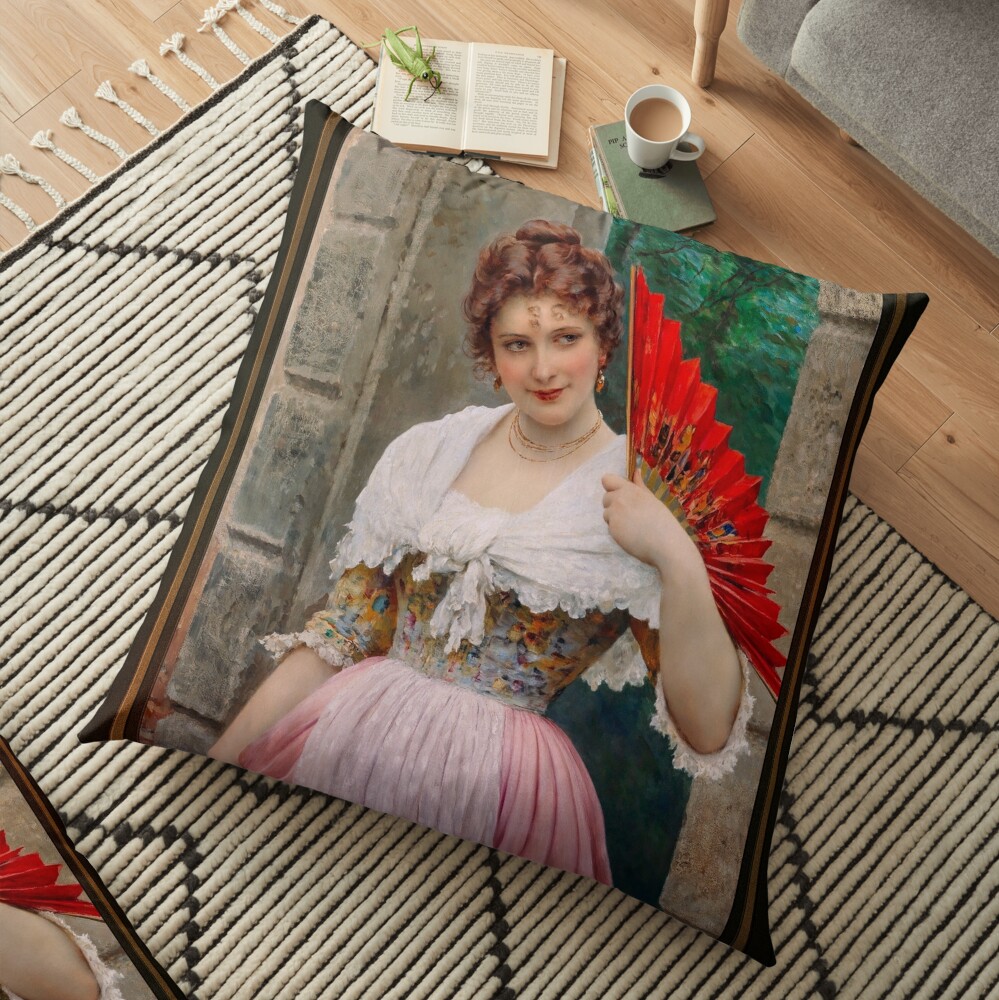
“Bean Óg le Fan Dearg,” a cruthaíodh i 1897 by Italian painter Eugen von Blas (1843–1931), is an exquisite example of the artist’s talent for capturing elegant scenes from daily life, steeped in the opulence of late 19th-century Europe. In this particular painting, Blaas conveys the sophisticated world of aristocratic women, emphasizing grace, áilleacht, and refinement. The painting is not only a portrait of a young woman but also an embodiment of the fashion, attitudes, and natural beauty of its time.
Clár na nÁbhar
An tÁbhar agus Comhdhéanamh
At the center of the composition is a young woman, her delicate features framed by a soft cascade of light brown curls that hint at the youthful energy and warmth of the scene. She wears a gown that speaks to the fashionable styles of the late 19th century, with its high waistline, billowing skirt, and the intricate textile work that blends pastel hues of pink, labhandar, agus bán.
The woman’s posture is relaxed yet refined, holding a vibrant red fan that contrasts sharply with the muted tones of her attire and background. The fan serves as both an accessory and an integral visual element, drawing the viewer’s eye immediately. The vibrant red of the fan, with its delicate painted designs, contrasts beautifully with her attire, and its boldness contrasts with the soft elegance of her gown.
The artist captures the woman’s gaze with a sense of intimacy and intrigue. A súile, framed by soft curls, look to the side with a knowing expression, as if caught in a moment of daydreaming or perhaps conversing with someone off to the left of the frame. This subtle connection between the viewer and the subject draws the audience into the narrative of the scene, inviting them to imagine the woman’s thoughts or the circumstances of her moment in time.
The Background and Setting
Cúlra na “Bean Óg le Fan Dearg” is a garden scene, visible through a stone archway. The earthy tones of the stonework and the lush green foliage beyond create a serene, almost idyllic atmosphere. The setting suggests an aristocratic outdoor space, perhaps a private garden or a terrace of a noble estate, offering a perfect setting for a leisurely afternoon. The contrast between the stone and the natural greenery serves as a metaphor for the blend of human sophistication and nature’s untainted beauty.
The setting enhances the sense of elegance, with the classical stonework surrounding the archway symbolizing tradition and permanence. The surrounding greenery, ach, offers a feeling of freshness and tranquility, reinforcing the timeless nature of the subject and her surroundings.
Ábhair, Teicnící, agus Stíl
The work is painted using oil paints, a medium that allows for rich textures, doimhneacht, and light play. Blaas uses a masterful technique to capture the details of the woman’s clothing, creating a lifelike quality that feels almost tangible. The texture of the fabric, especially the soft folds of the gown, is rendered with meticulous attention to light and shadow, bringing a sense of volume and movement to the fabric.
The use of color in this painting is particularly striking. The soft pastels of the woman’s gown evoke a feeling of calm and softness, while the red of the fan is a bold statement, adding vibrancy and intensity to the composition. Blaas’s attention to detail, from the soft blush of the woman’s cheeks to the intricate design of the fan, showcases his ability to transform the mundane into something beautiful and worthy of admiration.

The Mood and Theme of the Artwork
Tá giúmar an phéintéireachta suaimhneach, dea-, and contemplative. The young lady’s posture and expression convey a sense of calm and quiet confidence. An socrú, with its lush greenery and classical stonework, reinforces the notion of timeless beauty and aristocratic leisure. An lucht leanúna, as an object, carries with it connotations of femininity, charm, and social grace, as well as the more intimate aspect of personal comfort.
The theme of the painting revolves around the idealized representation of femininity during the late 19th century, a time when women were often seen as symbols of grace and decorum. Blaas captures the gentle beauty and poise of the woman, elevating her to an almost ethereal status. This type of portrayal was common in the art of the time, which sought to celebrate and idealize the lives of the upper classes, particularly women. The presence of nature in the background subtly reinforces the connection between the subject and her surroundings, suggesting that the young woman, while of aristocratic status, is still part of the natural world.
Conclúid
Eugen von Blaas’s “Bean Óg le Fan Dearg” encapsulates the charm and elegance of the late 19th century through both its subject and the artist’s technique. Idirghníomhú an tsolais, dath, and texture transforms an everyday moment into a celebration of beauty, faisin, agus femininity. Tríd an bpíosa seo, Blaas invites the viewer into a world of aristocratic leisure, where elegance is embodied in both the subject and her surroundings. The painting’s combination of soft, delicate details and the vibrant contrast of the fan captures the essence of an era defined by sophistication and artistic refinement.
Seo atáirgeadh seanmháistrí ealaíne digiteach athmháistrithe d’íomhá fearainn phoiblí atá ar fáil mar a priontáil chanbhás ar líne.
Cruthú ealaíne digiteach seo, mar atá an saothar ealaíne go léir atá le fáil ar shuíomh Gréasáin Xzendor7 ar fáil le ceannach ar líne i bhformáidí éagsúla ábhar lena n-áirítear priontaí canbháis, priontaí aicrileach, priontaí miotail, priontaí adhmaid, priontaí frámaithe, póstaeir, agus mar phriontaí chanbhás rollta i méideanna éagsúla ó 12 orlach go 72 orlach ag brath ar mhéid an tsaothair ealaíne iarbhír agus ar an siopa priontála ar éileamh a roghnaíonn tú an ealaín a cheannach uaidh.
Tá an saothar ealaíne ar fáil freisin ar raon leathan éadaí fear agus ban, mugaí, totes, scaifeanna, leabhair nótaí agus irisleabhair agus go leor táirgí maisiúcháin tí.
Beathaisnéis Ealaíontóir
Faisnéis Thíos Díorthaithe ó Wikipedia.org
Rugadh é ag Albano, in aice leis an Róimh, le hathair ón Tír Eoghain agus máthair Iodálach. a athair Karl, freisin péintéir, a bhí ina mhúinteoir. A mháthair, Agnesina Auda, bean ró-mhaith a bhí inti. Bhog an teaghlach go dtí an Veinéis nuair a rinneadh Ollamh le Karl in Acadamh na Veinéise. Phéinteáil sé radhairc go minic sa Veinéis, ach freisin portráidí agus pictiúir reiligiúnacha.
I measc a chuid saothar tá An fhoirm nuptial sa sacraistí; Bingo i Campielo sa Veinéis; Radharc puipéid i scoil; agus La Ninetta. An léirmheastóir ealaíne Luigi Chirtani, nuair a taispeánadh an phéintéireacht ag an Mostra Nazionale di Venezia, cur síos air mar Álainn, flattering, deas, caraithe, glanta, snasta, níocháin i bpéinteáil le Mr. lamhnán, an portráidí is fearr le huaisle móra Veinéiseach, cóirithe i satins gala, jewelry shining, stíleanna gruaige an saibhir.
A íomhánna tréimhse ildaite agus sách amharclainne den tsochaí Veinéiseach, e.g. Ar an mBalcóin (1877; Bailiúchán Príobháideach), a bhí an-difriúil i gcomparáid le pastail íogair agus eitseáil na gclós, BALCÓIN agus canálacha na Veinéise nua-aimseartha.
Eugene de Blas’ Taispeánadh pictiúir san Acadamh Ríoga, Cumann na Mínealaíne, Gailearaí Nua agus Gailearaí Arthur Tooth and Sons i Londain, agus freisin ag Dánlann Walker i Learpholl