

The Eavesdropper
“The Eavesdropper,” a cruthaíodh i 1906 by the Italian painter Eugen von Blas (1843–1931), is a striking depiction of a young woman caught in a moment of curiosity and intrigue. The work exemplifies the artist’s skill in portraying both the innocence and subtle emotional complexity of his subjects.
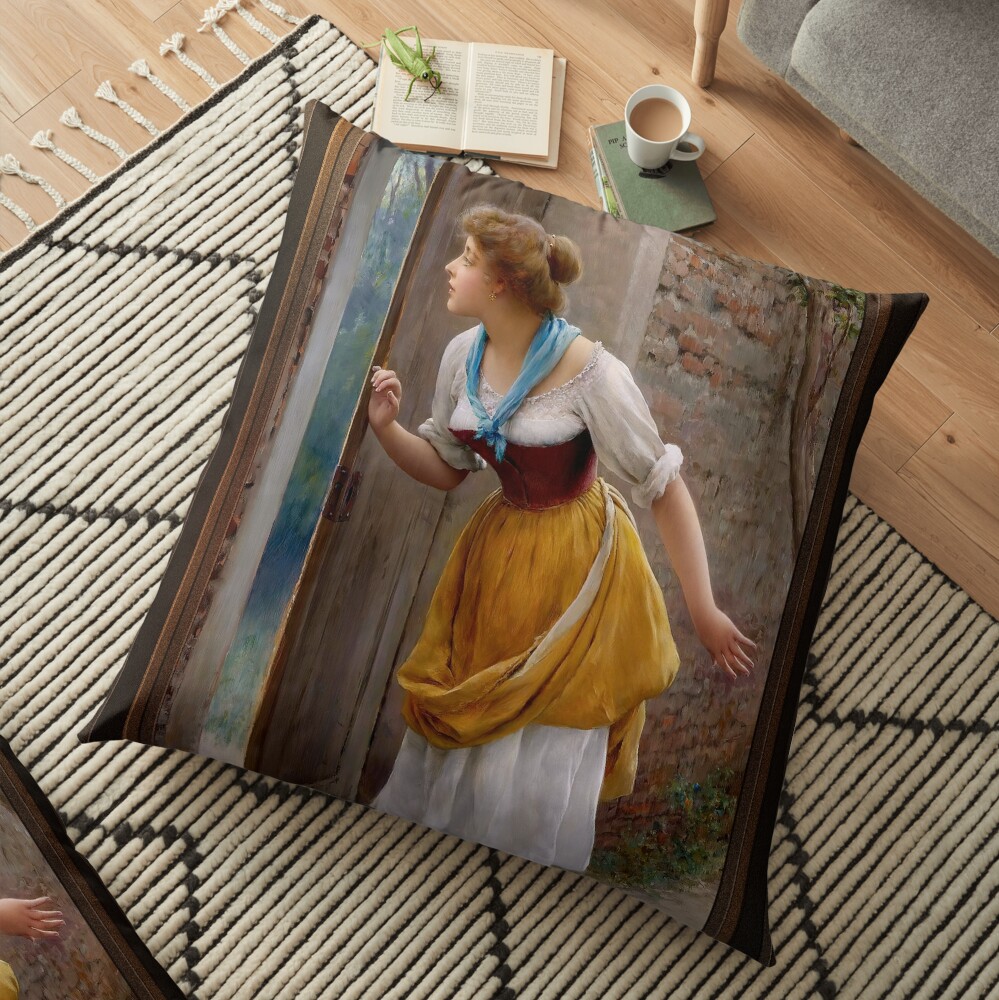
Set against a rustic background of muted earth tones, the painting is an elegant blend of realism and intimate narrative. The young woman, with her head turned towards a partially opened door, gazes with focused attention, as though she is listening to something on the other side. The composition captures a quiet yet suspenseful moment, perfectly suited to the genre of genre painting for which von Blaas is renowned.
Clár na nÁbhar
An phríomh -ábhar
At the heart of this work is the young woman, her delicate form framed by the weathered doorway. She is dressed in a traditional European peasant outfit, a combination of earthy tones that contrasts sharply with the vibrancy of her striking blue scarf and soft white blouse. The woman’s attire, her bodice tight and crimson, skirt flowing with a yellow hue, imbues her with both humility and grace.
The soft folds of her skirt and apron suggest that she is likely a domestic worker or a figure of modest social standing. Her posture is one of anticipation, her body angled towards the door, a slight tilt of the head giving the impression of listening intently to something she is not meant to hear.
Her hand is poised delicately on the door, as if she’s about to pull it open wider, but remains suspended in a moment of indecision. The figure is set in motion by her movement and the life-like quality that von Blaas has captured. The gaze of the woman is directed just beyond the edge of the door, her expression caught between curiosity and hesitation, her eyes seemingly searching for clues, seeking the source of whatever caught her attention. The focus on her facial expression adds to the intrigue, leaving the viewer wondering what she has overheard or glimpsed.
Objects and Details
The woman’s presence in the scene is made even more striking by the surrounding environment. The setting is a narrow, rustic alleyway or courtyard, evident from the rough-hewn stonework and the rich texture of the brick wall behind her. The architecture and terrain of this backdrop reveal much about the time period and social setting. The wall is aged and weathered, lending the scene a sense of history, as though this moment of eavesdropping is taking place within a space that has witnessed many such private encounters before.
The door itself is also a key element in the composition, its wood dark and aged, showing visible signs of wear. A rusty metal handle contrasts with the rich textures of the bricks, bringing a level of realism to the artwork. The woman’s hand is almost in direct contact with this handle, emphasizing the fragility of the moment, she stands on the cusp of something unknown, a boundary between what is public and private.
Nádúr, freisin, plays an essential role in the painting. In the upper left corner, a small tree or shrub grows beside the stone wall, a gentle hint of greenery that adds a touch of life to an otherwise neutral-toned environment. Na plandaí, though sparse, help to temper the rigid, industrial feel of the brickwork, bringing warmth and organic balance to the composition.
Stíl agus teicníc
Eugen von Blaas was known for his meticulous attention to detail and his ability to create paintings that seemed to almost breathe with life. “The Eavesdropper” is a prime example of this. The artist’s technique is deeply rooted in the realist tradition, with an emphasis on natural light, uigeacht, and the precise rendering of human figures. The folds of the woman’s skirt and the fine fabric of her blouse are painted with great care, capturing every nuance of material and texture. The soft play of light across her face and the shadows around the door give depth and dimension, creating a believable three-dimensional space.
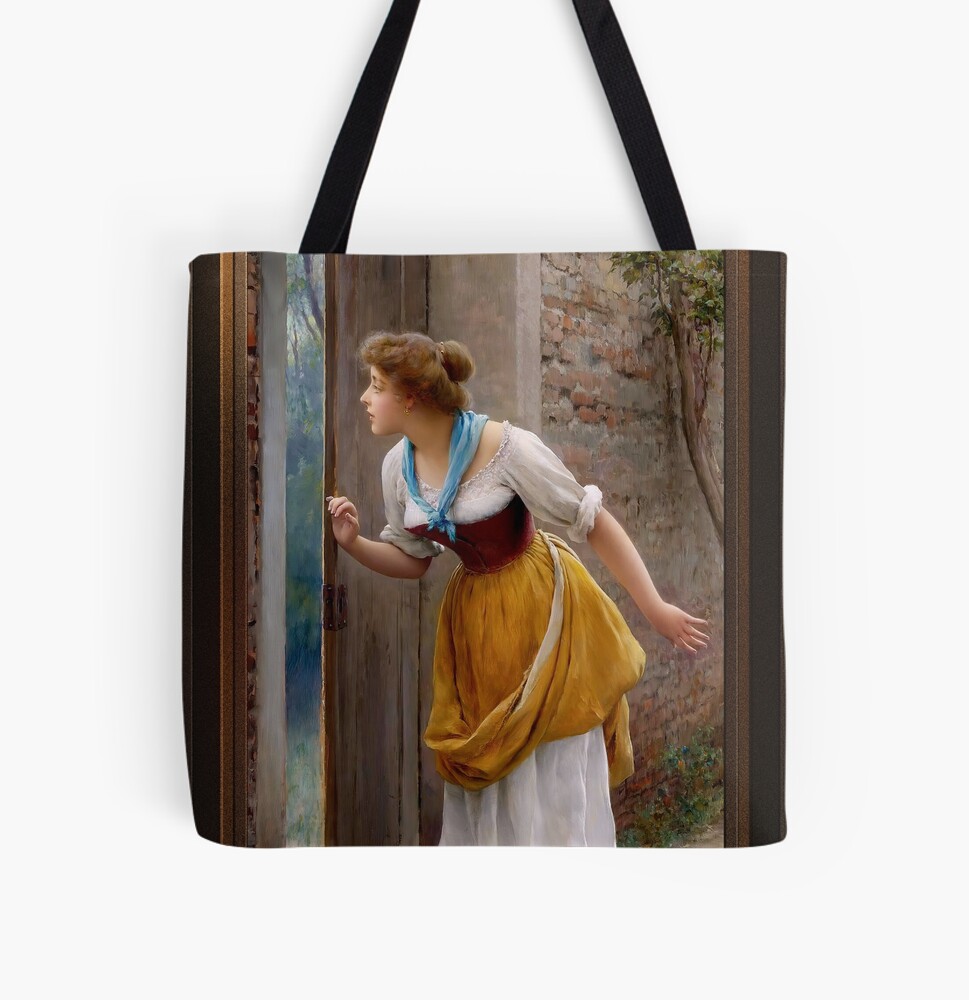
The colors in this piece are warm yet restrained, with the earthy tones of the bricks and the woman’s clothing forming a harmonious palette. The soft yellows and whites in her attire contrast with the more muted colors of the background, creating a focal point in the figure of the woman.
The blue scarf, tied around her neck, serves as a striking visual accent, drawing attention to her face and adding a sense of softness and tranquility. This color contrast enhances the overall emotional tone of the work, contributing to the mood of quiet suspense.
The brushwork in “The Eavesdropper” is both precise and fluid. The artist’s handling of textures, from the rustic bricks to the delicate folds of fabric, is incredibly detailed. The face of the woman is rendered with a softness that invites the viewer to connect emotionally with her, emphasizing the realism that von Blaas sought to achieve. The painting has a photographic quality, capturing a fleeting moment with such clarity that it almost seems as though it could have been a real scene witnessed by the artist.
Téama agus giúmar
Téama na “The Eavesdropper” is one of curiosity, suspense, and perhaps even secrecy. The woman’s actions imply a sense of eavesdropping—something forbidden or private that she is trying to uncover. This sense of voyeurism adds an element of psychological depth to the piece, drawing the viewer into a narrative of hidden knowledge and the consequences of discovering something that was never meant to be heard.
The mood of the painting is one of quiet tension. While there is no overt action, the woman’s body language and her gaze create a sense of suspense. There is an implicit suggestion of something unfolding just beyond the door, something that the woman cannot see fully, but is nonetheless drawn to. The muted background and the stillness of the moment heighten the suspense, allowing the viewer to project their own interpretation onto the scene.
Conclúid
Eugen von Blaas’s “The Eavesdropper” is a masterful depiction of a fleeting moment in time, skillfully capturing the emotional nuances of curiosity and the tension between public and private spaces. The realism and attention to detail invite the viewer to contemplate not only the physical setting but also the internal world of the subject. In its quiet suspense, the painting speaks to universal themes of human nature—our desire to know what lies beyond the threshold, and the complex emotions that come with uncovering secrets not meant for our ears.
Seo atáirgeadh seanmháistrí ealaíne digiteach athmháistrithe d’íomhá fearainn phoiblí atá ar fáil mar a priontáil chanbhás ar líne.
Cruthú ealaíne digiteach seo, mar atá an saothar ealaíne go léir atá le fáil ar shuíomh Gréasáin Xzendor7 ar fáil le ceannach ar líne i bhformáidí éagsúla ábhar lena n-áirítear priontaí canbháis, priontaí aicrileach, priontaí miotail, priontaí adhmaid, priontaí frámaithe, póstaeir, agus mar phriontaí chanbhás rollta i méideanna éagsúla ó 12 orlach go 72 orlach ag brath ar mhéid an tsaothair ealaíne iarbhír agus ar an siopa priontála ar éileamh a roghnaíonn tú an ealaín a cheannach uaidh.
Tá an saothar ealaíne ar fáil freisin ar raon leathan éadaí fear agus ban, mugaí, totes, scaifeanna, leabhair nótaí agus irisleabhair agus go leor táirgí maisiúcháin tí.
Beathaisnéis Ealaíontóir
Faisnéis Thíos Díorthaithe ó Wikipedia.org
Rugadh é ag Albano, in aice leis an Róimh, le hathair ón Tír Eoghain agus máthair Iodálach. a athair Karl, freisin péintéir, a bhí ina mhúinteoir. A mháthair, Agnesina Auda, bean ró-mhaith a bhí inti. Bhog an teaghlach go dtí an Veinéis nuair a rinneadh Ollamh le Karl in Acadamh na Veinéise. Phéinteáil sé radhairc go minic sa Veinéis, ach freisin portráidí agus pictiúir reiligiúnacha.
I measc a chuid saothar tá An fhoirm nuptial sa sacraistí; Bingo i Campielo sa Veinéis; Radharc puipéid i scoil; agus La Ninetta. An léirmheastóir ealaíne Luigi Chirtani, nuair a taispeánadh an phéintéireacht ag an Mostra Nazionale di Venezia, cur síos air mar Álainn, flattering, deas, caraithe, glanta, snasta, níocháin i bpéinteáil le Mr. lamhnán, an portráidí is fearr le huaisle móra Veinéiseach, cóirithe i satins gala, jewelry shining, stíleanna gruaige an saibhir.
A íomhánna tréimhse ildaite agus sách amharclainne den tsochaí Veinéiseach, e.g. Ar an mBalcóin (1877; Bailiúchán Príobháideach), a bhí an-difriúil i gcomparáid le pastail íogair agus eitseáil na gclós, BALCÓIN agus canálacha na Veinéise nua-aimseartha.
Eugene de Blas’ Taispeánadh pictiúir san Acadamh Ríoga, Cumann na Mínealaíne, Gailearaí Nua agus Gailearaí Arthur Tooth and Sons i Londain, agus freisin ag Dánlann Walker i Learpholl