

Abbey in Ruins in Valencia Countryside c1838
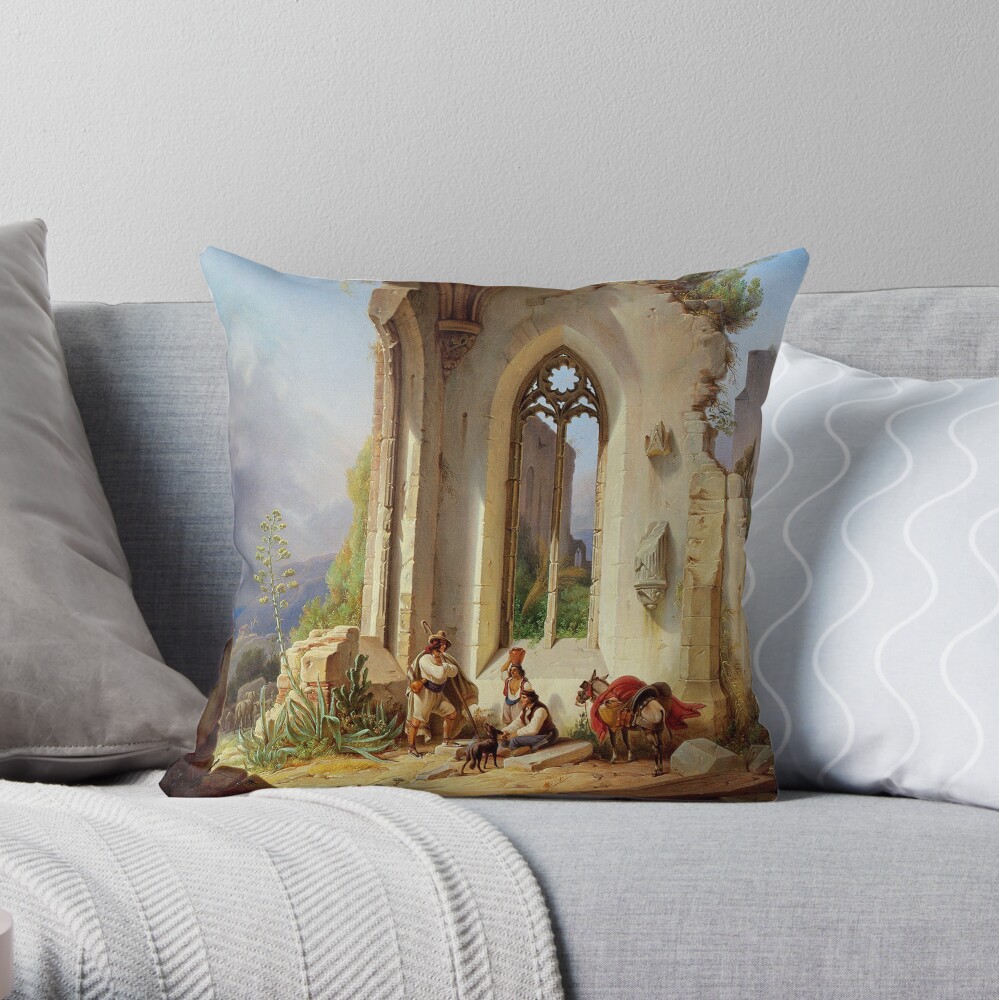
An obair ealain “Abbey in Ruins in Valencia Countryside,” air a chruthachadh a-steach 1838 by the German painter Wilhelm Gail (1804 – 1890), presents a romanticized depiction of an ancient abbey set amidst the picturesque and tranquil Valencia countryside. Through the lens of the Romantic movement, which flourished throughout Europe during the late 18th and early 19th centuries, Wilhelm Gail captures the profound interaction between nature and the remnants of human civilization. This painting invites the viewer to contemplate the themes of decay, siubhal ùine, and the persistence of nature despite the ruinous structures left behind.
Clàr-innse
Am Prìomh Chuspair: The Abbey in Ruins
The focal point of the painting is the grand, yet dilapidated abbey, whose towering arches and shattered windows have long since ceased to serve their original religious or communal purpose. The ruins of the abbey stand as a testament to a past that is now inaccessible, its once-pristine structure now slowly crumbling due to the ravages of time.
The ornate Gothic ailtireachd details still remain visible, showcasing finely executed stone carvings that hint at the abbey’s former glory. Nàdar, ge-tà, has begun to reclaim what was once a symbol of human creation. Craobhan, preasan, and vines now cling to the walls of the abbey, emphasizing the inevitable decline of even the most monumental constructions in the face of nature’s inexorable growth.
Cruth-tìre agus Cruth-tìre
The surrounding terrain of the painting is a vast, open landscape that extends far beyond the ruins, typical of the Spanish countryside in the Valencia region. The dry, rolling hills stretch into the distance, suggesting the expansive, arid environment that dominated the region. The subtle gradients of earth tones in the soil convey the heat of the region, typical of the Mediterranean climate.
Ri aghaidh na deilbh, there are patches of grass and wild vegetation that provide a stark contrast to the stonework of the abbey. The land seems to carry an air of quiet desolation, though it is not completely devoid of life. A few animals can be seen in the scene, including a donkey and a small dog, both of which seem to be part of the human presence in the scene.
The figures of men, positioned near the abbey’s remnants, are integral to the scene, offering a human scale to the ruins and reminding the viewer of the fragile relationship between man and the environment.
The Human Figures and Daily Life
Ri aghaidh na deilbh, three men are depicted, seemingly engaged in a moment of rest after traveling through the countryside. Two of the men are seated on the ground, with one of them tending to the small dog, while the third man stands nearby, leaning on a staff. Each of these figures wears traditional attire of the time, including loose-fitting shirts, wide-brimmed hats, and leather boots, fitting the rural, everyday life of the period.
Their connection to the land is emphasized by their humble presence, and their peaceful interaction with the natural world adds to the timeless feeling of the artwork. Air a 'chùl, a pack donkey, laden with supplies, is tethered near the ruins. Tha an toirt a-steach seòlta seo de bheathaichean agus an gnìomh socair fois a’ nochdadh cuspair buanseasmhachd daonna ann an saoghal a tha air a chomharrachadh le gluasad ùine agus atharrachaidh..
Solas, Mood, and Atmosphere
Tha làimhseachadh faiceallach Wilhelm Gail air solas is dubhar a’ toirt mothachadh domhainn air fìor-eòlas don dealbh, agus aig an aon àm a’ togail faireachdainn tòcail. Tha an eadar-chluich de sholas na grèine agus faileas taobh a-staigh na tobhta a’ cur cuideam air inneach na cloiche, a’ cruthachadh càileachd trì-thaobhach a tharraingeas aire an neach-amhairc gu bòidhchead faded na h-ailtireachd.
Bidh solas bog a’ sìoladh a-steach bhon taobh chlì, a' soillseachadh mìrean an structair a bha uair glòrmhor, fhad 'sa tha na beanntan fad às air an ionnlaid le ceò, Glow Golden. Tha faireachdainn an t-seallaidh neònach, gidheadh sìtheil, leis an soilleire, speur fosgailte a’ tabhann faireachdainn de shàmhchair. The atmosphere created by the natural elements, combined with the starkness of the abbey’s ruins, induces a contemplative feeling about the transitory nature of human achievement and the power of nature to endure.
Symbolism and Romantic Themes
As with many works of the Romantic era, “Abbey in Ruins in Valencia Countryside” expresses the Romantic fascination with nature, an sublime, and the impermanence of human creations. The abandoned abbey symbolizes the passage of time, the decline of religious and institutional authority, and the inevitable decay of human-made structures.
Nàdar, as seen in the encroaching vines and foliage, is depicted as a force that cannot be controlled, reclaiming what was once its own. The figures of the men, though human, seem insignificant in comparison to the vastness of the landscape, emphasizing the theme of human fragility in the face of time and nature.
Style and Artistic Techniques
The painting adheres to the style of Romanticism, gluasad a chuir cuideam air faireachdainn, aonranachd, and the beauty of nature. Wilhelm Gail’s meticulous attention to detail and use of light and shadow convey the influence of German Romantic painters, who often depicted natural landscapes and ruins in a dramatic manner.
His skillful handling of the ruins, combined with the almost ethereal lighting, brings the scene to life, making it both a historical snapshot and a timeless meditation on decay and renewal. The detailed brushwork in the textures of the stone and vegetation provides a heightened sense of realism, drawing attention to the natural beauty of the ruins and their surrounding environment.
Co-dhùnadh
“Abbey in Ruins in Valencia Countryside c1838” by Wilhelm Gail is a masterful example of the Romantic style, combining natural beauty, historical contemplation, agus samhlaidheachd domhainn. The depiction of an ancient, crumbling abbey set against the sprawling Spanish landscape invites viewers to reflect on the transient nature of human endeavors, the inevitability of decay, and the quiet persistence of nature.
Through the artist’s careful use of light, mion-fhiosrachadh, agus co-sgrìobhadh, the painting not only captures the physical ruins of the abbey but also evokes a deeper, more emotional understanding of time’s passage and the natural forces that shape our world.
Is e seo seann mhaighstirean cadail ath-chuairteachaidh air ath-shuidheachadh de dh 'ìomhaigh fearann poblach a tha ri cheannach air-loidhne mar a clò-bhualadh canabhas rollaichte.
Artist Bio Information Is Derived From Wikipedia.org
Wilhelm was the son of an electoral gallery supervisor, and in accordance with his father’s wishes after finishing high school, began studying architecture at the Academy of Fine Arts in Munich, A' Ghearmailt; but would later devote himself to painting.
After Wilhelm completed his studies at the academy, ghabh e tuilleadh leasanan ann an stiùidio a bhràthar-chèile, am peantair Peantair Gearmailteach Peter von Hess agus aig an àm seo, chruthaich e grunn chruthan-tìre a sheall e ainmhidhean agus cleachdaidhean dùthaich a dhachaigh.
Ann an 1825 Shiubhail Wilhelm dhan Eadailt air cuireadh Baron von Malzen, an chargé d’affaires rìoghail Bavarian aig cùirt Sardinianach; fhad ‘s a bha e an sin chruthaich e grunn ìomhaighean ailtireachd agus pìosan gnè a chaidh fhoillseachadh mar lithographs fo na tiotalan carraighean Ròmanach ann an stàitean Sardinia agus seallaidhean mòr-chòrdte Genova.
Nuair a thill e gu Munich, Chruthaich Wilhelm grunn dhealbhan de thogail bho chuimhne bhon turas aige; a bha a’ toirt a-steach an t-seann drochaid-uisge anns a’ Campagna agus an lios chlabhsair ann an Viterbo, ris an do ghabh am poball ris gu math, quickly making him a popular painter.
Ann an 1830 Wilhelm again left Germany, and this time took a trip to Paris, France to study; but after the outbreak of the July Revolution he left and went to Chartres; and from there would take other trips to Italy and Spain to further increase is artistic knowledge and skill.
Ann an 1854, Wilhelm was appointed as chief plenipotentiary and soon afterwards to the cabinet council of the Bavarian Duke Nikolaus von Leuchtenberg.