

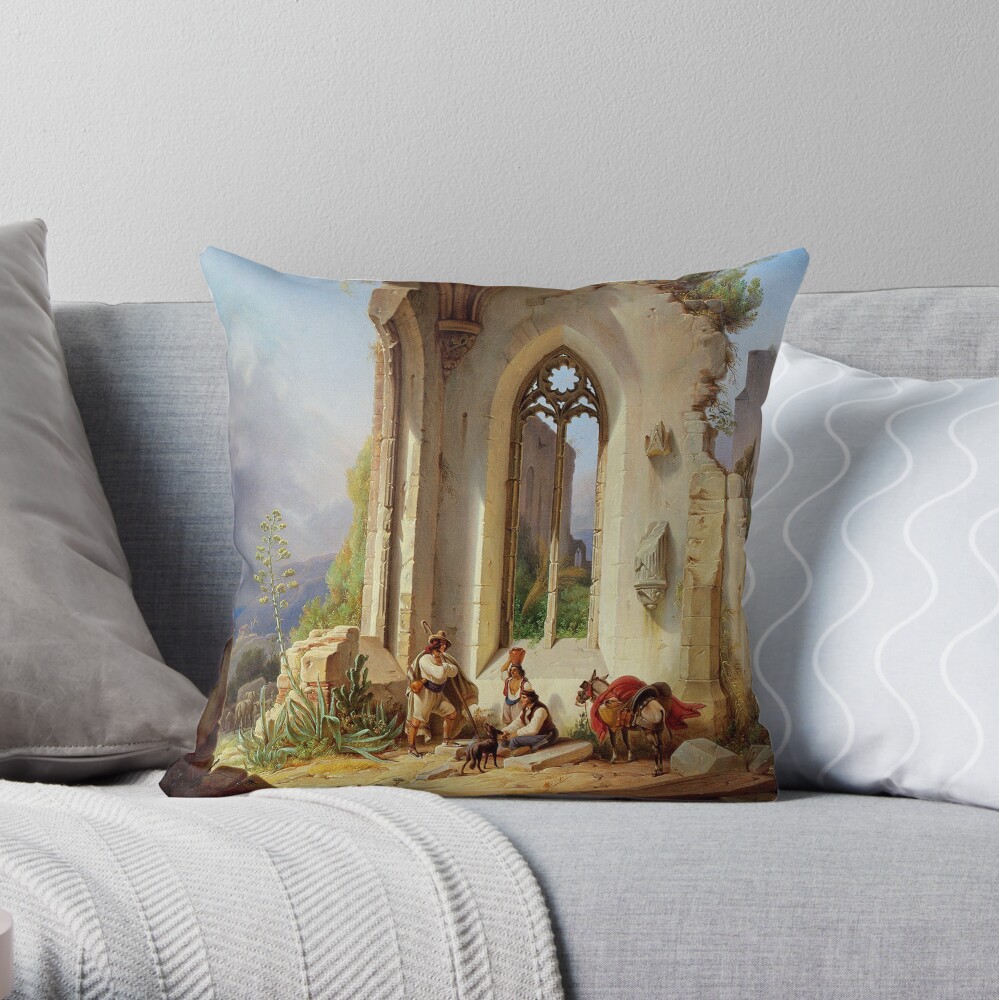
Opactwo w ruinach na wsi w Walencji ok. 1838 r
Grafika “Opactwo w ruinach na wsi w Walencji,” stworzony w 1838 przez niemieckiego malarza Wilhelma Gaila (1804 – 1890), przedstawia romantyczny obraz starożytnego opactwa położonego pośród malowniczych i spokojnych krajobrazów Walencji. Przez pryzmat ruchu romantycznego, który rozkwitł w całej Europie pod koniec XVIII i na początku XIX wieku, Wilhelm Gail uchwycił głęboką interakcję między naturą a pozostałościami ludzkiej cywilizacji. Obraz ten zachęca widza do kontemplacji tematów rozkładu, upływ czasu, i trwałość natury pomimo pozostawionych ruin.
Spis treści
Główny temat: Opactwo w ruinie
The focal point of the painting is the grand, yet dilapidated abbey, whose towering arches and shattered windows have long since ceased to serve their original religious or communal purpose. The ruins of the abbey stand as a testament to a past that is now inaccessible, its once-pristine structure now slowly crumbling due to the ravages of time.
The ornate Gothic architektoniczny details still remain visible, showcasing finely executed stone carvings that hint at the abbey’s former glory. Natura, jednak, has begun to reclaim what was once a symbol of human creation. Trees, krzewy, and vines now cling to the walls of the abbey, emphasizing the inevitable decline of even the most monumental constructions in the face of nature’s inexorable growth.
Teren i krajobraz
The surrounding terrain of the painting is a vast, open landscape that extends far beyond the ruins, typical of the Spanish countryside in the Valencia region. The dry, rolling hills stretch into the distance, suggesting the expansive, arid environment that dominated the region. The subtle gradients of earth tones in the soil convey the heat of the region, typical of the Mediterranean climate.
Na pierwszym planie, there are patches of grass and wild vegetation that provide a stark contrast to the stonework of the abbey. The land seems to carry an air of quiet desolation, though it is not completely devoid of life. A few animals can be seen in the scene, including a donkey and a small dog, both of which seem to be part of the human presence in the scene.
The figures of men, positioned near the abbey’s remnants, are integral to the scene, offering a human scale to the ruins and reminding the viewer of the fragile relationship between man and the environment.
Postacie ludzkie i życie codzienne
Na pierwszym planie, three men are depicted, seemingly engaged in a moment of rest after traveling through the countryside. Two of the men are seated on the ground, with one of them tending to the small dog, while the third man stands nearby, leaning on a staff. Each of these figures wears traditional attire of the time, including loose-fitting shirts, wide-brimmed hats, and leather boots, fitting the rural, everyday life of the period.
Their connection to the land is emphasized by their humble presence, and their peaceful interaction with the natural world adds to the timeless feeling of the artwork. W tle, a pack donkey, laden with supplies, is tethered near the ruins. This subtle inclusion of animals and the mundane act of rest reflects the theme of human perseverance in a world marked by the passage of time and change.
Światło, Nastrój, i Atmosfera
Wilhelm Gail’s careful handling of light and shadow brings a deep sense of realism to the painting, while also evoking an emotional atmosphere. The interplay of sunlight and shadows within the ruins highlights the texture of the stone, creating a three-dimensional quality that draws the viewer’s attention to the faded beauty of the architecture.
A soft light filters in from the left, illuminating the fragments of the once-glorious structure, while the distant hills are bathed in a hazy, złoty blask. The mood of the scene is somber, yet peaceful, with the bright, open sky offering a sense of serenity. The atmosphere created by the natural elements, combined with the starkness of the abbey’s ruins, induces a contemplative feeling about the transitory nature of human achievement and the power of nature to endure.
Symbolism and Romantic Themes
As with many works of the Romantic era, “Opactwo w ruinach na wsi w Walencji” expresses the Romantic fascination with nature, wzniosłość, and the impermanence of human creations. The abandoned abbey symbolizes the passage of time, the decline of religious and institutional authority, and the inevitable decay of human-made structures.
Natura, as seen in the encroaching vines and foliage, is depicted as a force that cannot be controlled, reclaiming what was once its own. The figures of the men, though human, wydają się nieistotne w porównaniu z ogromem krajobrazu, podkreślając temat kruchości człowieka w obliczu czasu i natury.
Style and Artistic Techniques
Obraz utrzymany jest w stylistyce romantyzmu, ruch kładący nacisk na emocje, indywidualizm, i piękno natury. Skrupulatna dbałość Wilhelma Gaila o szczegóły oraz wykorzystanie światła i cienia oddają wpływ niemieckich malarzy romantycznych, który często w dramatyczny sposób przedstawiał naturalne krajobrazy i ruiny.
Jego umiejętne obchodzenie się z ruinami, w połączeniu z niemal eterycznym oświetleniem, ożywia scenę, co czyni go zarówno migawką historyczną, jak i ponadczasową medytacją nad rozkładem i odnową. Szczegółowe tekstury kamienia i roślinności zapewniają większe poczucie realizmu, drawing attention to the natural beauty of the ruins and their surrounding environment.
Wniosek
“Opactwo w ruinach na wsi w Walencji ok. 1838 r” by Wilhelm Gail is a masterful example of the Romantic style, combining natural beauty, historical contemplation, and profound symbolism. The depiction of an ancient, crumbling abbey set against the sprawling Spanish landscape invites viewers to reflect on the transient nature of human endeavors, the inevitability of decay, and the quiet persistence of nature.
Through the artist’s careful use of light, detail, i skład, the painting not only captures the physical ruins of the abbey but also evokes a deeper, more emotional understanding of time’s passage and the natural forces that shape our world.
Jest to retuszowana reprodukcja starych mistrzów sztuki cyfrowej obrazu domeny publicznej, która jest dostępna do zakupu online jako zrolowany obraz na płótnie.
Artist Bio Information Is Derived From Wikipedia.org
Wilhelm was the son of an electoral gallery supervisor, and in accordance with his father’s wishes after finishing high school, began studying architecture at the Academy of Fine Arts in Munich, Niemcy; but would later devote himself to painting.
After Wilhelm completed his studies at the academy, he took further lessons in the studio of his brother-in-law, the painter German Painter Peter von Hess and during this time, created a number of landscapes which he depicted the fauna and customs of his homeland.
W 1825 Wilhelm traveled to Italy at the invitation of Baron von Malzen, the royal Bavarian chargé d’affaires at the Sardinian court; while there he created several architectural images and genre pieces that were published as lithographs under the titles Monuments romains dans les états de sardaigne and Scènes populaires de Genova.
Upon his return to Munich, Wilhelm created numerous paintings of building from memory from his journey’s; which included the ancient aqueduct in the Campagna and the cloister courtyard in Viterbo, which were well accepted by the public, quickly making him a popular painter.
W 1830 Wilhelm again left Germany, and this time took a trip to Paris, France to study; but after the outbreak of the July Revolution he left and went to Chartres; and from there would take other trips to Italy and Spain to further increase is artistic knowledge and skill.
W 1854, Wilhelm was appointed as chief plenipotentiary and soon afterwards to the cabinet council of the Bavarian Duke Nikolaus von Leuchtenberg.