

Figure allégorique de la musique
Eduard Julius Friedrich Bendemann’s 19th-century classique chef-d'œuvre, “Figure allégorique de la musique,” serves as a striking visual representation of music’s transcendent and powerful nature. Created by the German artist Eduard Julius Friedrich Bendemann, né dans 1811 et passant 1889, this artwork conveys the allegorical relationship between music and human expression through meticulous craftsmanship and symbolism. In this powerful rendering, Bendemann intertwines elements of classical beauty, la forme humaine, and musical instruments to bring forth an emotive and awe-inspiring depiction of music’s divine essence.
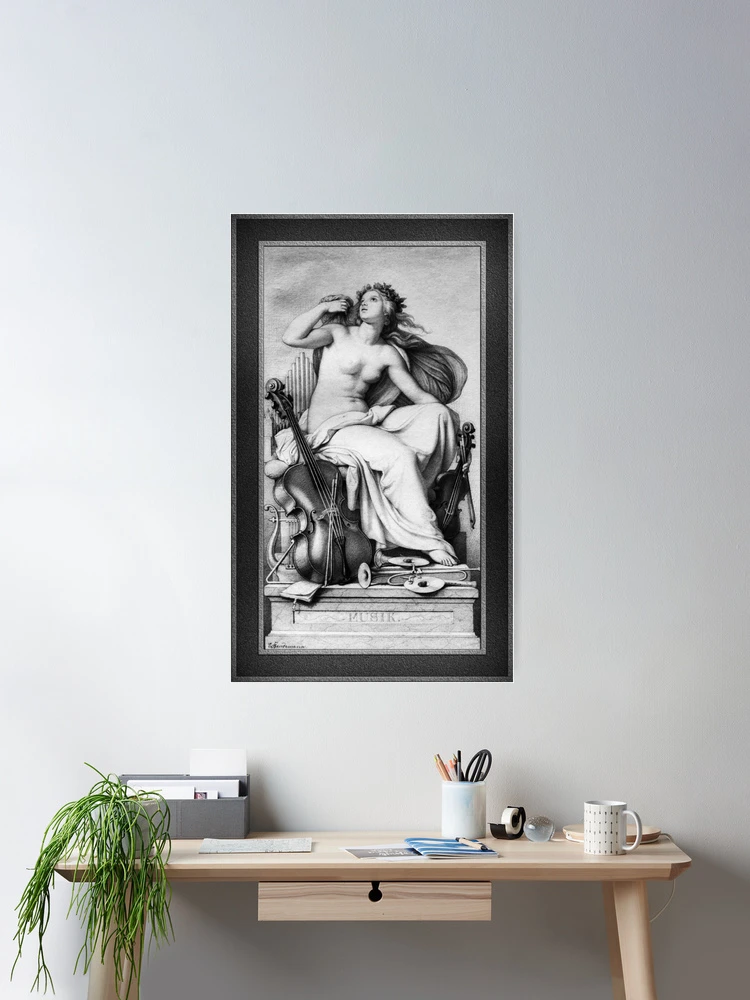
Table des matières
Subject of the Artwork
The central figure in “Figure allégorique de la musique” is a graceful female figure, seated in a position that suggests both contemplative repose and quiet strength. The figure is portrayed in a semi-reclined posture, leaning slightly to one side, which draws the viewer’s attention to her commanding yet serene presence. She is captured without clothing from the waist up, which emphasizes the purity and universality of the allegorical theme. The delicate yet confident expression on her face, coupled with her gentle yet deliberate hand gesture, invites the viewer to contemplate the intangible force of music she personifies. Her facial features are rendered with great sensitivity, reflecting the classical ideals of beauty that were so highly regarded during the 19th century.
The figure’s crown of laurel leaves further reinforces her role as a symbol of divine inspiration, similar to the way musicians and poets were traditionally honored in antiquity. The flowing hair, caught mid-motion, evokes the dynamic nature of music itself, suggesting that it is both a still and active force that can flow freely like the winds.
Objects and Instruments
The most prominent objects surrounding the allegorical figure are the various musical instruments scattered around her. The central instruments, a violin and a flute, are positioned near her feet, while additional musical elements, such as cymbals, une corne, and an oboe, are subtly placed in the composition. These instruments are not merely incidental, but carefully selected to represent the variety and breadth of music as an art form. They are part of a visual symphony that complements the figure’s larger-than-life symbolism.
The violin, en particulier, is a prominent instrument in the painting, lying close to the figure’s form and perhaps symbolizing the emotional depth and complexity of music. The flute, known for its ethereal and delicate sound, reinforces the more sublime and transcendent nature of music. Entre-temps, the scattered cymbals, horn, and oboe add a sense of balance to the scene, suggesting that music encompasses a wide range of emotional tones, from the delicate to the powerful, and from the introspective to the grandiose.
The strategic placement of these instruments around the figure highlights their connection to her, implying that she is not merely a passive representation of music but rather an active force that channels and gives shape to these instruments. Through this thoughtful arrangement, Bendemann portrays music as an entity that exists in a harmonious relationship with both the artist and the audience.
Terrain et arrière-plan
The background of the artwork is sparsely detailed, which serves to focus attention on the figure and the instruments. In the top left corner, faint architectural elements suggest a classical or temple-like structure, evoking ancient Greece and Rome, which were historically seen as the origins of both music and the arts. The columns that appear to frame the figure’s body further reinforce the classical motif and allude to the timeless nature of music. This choice of minimalism in the setting underscores the notion that the essence of music transcends earthly boundaries and can exist without a specific geographical context.
Bendemann’s use of shading and contrast brings depth to the scene, with light falling softly across the figure’s body and the surrounding objects. This creates a chiaroscuro effect that enhances the overall sense of depth and dimensionality. The careful attention to light and shadow also contributes to the mood of the piece, imbuing the figure with a sense of divine otherworldliness. Her form is bathed in a soft glow, highlighting her as an exalted, almost ethereal figure who embodies the very spirit of music.
Style et humeur
Bendemann’s work is deeply rooted in the classical tradition, both in its reverence for ancient ideals and in its technical execution. The meticulous rendering of the human form and the soft blending of light and shadow reflect the artist’s academic training and his commitment to classical realism. The emotional tone of the piece, pourtant, extends beyond mere technical proficiency. The allegorical figure, surrounded by musical instruments, conveys a deep sense of harmony and balance, both in the composition itself and in the wider message it communicates about the role of music in the human experience.
The mood of the painting is one of reverence and introspection. The figure’s posture and expression suggest an inner calmness, yet her presence is commanding, as though she is not only a muse but also an active force. This sense of calm is counterbalanced by the dynamic quality of the flowing hair and the positioning of the musical instruments, which imbue the scene with energy and motion. Ensemble, these elements create a mood of divine tranquility fused with creative potential.
The work’s classical composition and serene tone encourage viewers to reflect on the timeless role of music in culture and the arts. The artist’s use of symbolism invites an exploration of music as both a divine gift and a human expression of emotion, connaissance, and transcendence.
Conclusion
“Figure allégorique de la musique” by Eduard Julius Friedrich Bendemann captures the essence of music as a timeless, transcendent force. Through its careful depiction of a central allegorical figure, surrounded by musical instruments and framed by architectural elements, the painting conveys both the emotional depth and the divine inspiration that music embodies. The artist’s mastery of classical techniques, combined with the thoughtful composition, evokes a mood of serene contemplation and reverence for the art form. This masterpiece, emblematic of the Romantic and Classical traditions, continues to resonate with audiences, reminding us of the enduring power and beauty of music.
La figure allégorique de la musique est une reproduction de maîtres anciens d'art numérique retouchée d'une image du domaine public.
Informations ci-dessous dérivées de Wikipedia.org
Edouard est né à Berlin, L'Allemagne en décembre 3, 1811 à Anton Heinrich Bendemann un banquier juif et Fanny Eleonore Bendemann née von Halle; fille du banquier juif Joel Samuel von Halle.
Dès son plus jeune âge, Eduard a démontré un talent pour l'art, et même si à l'époque les fils poursuivaient généralement des études et des métiers similaires ou apparentés à leurs pères, il a été autorisé à étudier l'art et a été inscrit à l'école d'art du peintre allemand Wilhelm von Schadow (1789 – 1862), situé à Dusseldorf, Allemagne.
Dans 1828 à l'âge de 17, il a attiré l'attention avec une peinture qu'il a faite de sa grand-mère; et en 1830 fait un voyage scolaire en Italie, où il resterait pendant un an et travaillerait dans une série de travaux de peinture; avec des gens qui remarquent son 1832 peinture Les Juifs en deuil en exil; qui a été présenté dans l'exposition d'art de Berlin.
La même année, il crée également Les deux filles au puits et enchaîne avec Jérémie au milieu des ruines de Jérusalem.; et pour cette pièce a reçu une médaille à Paris, France en 1837, avec son œuvre la plus connue étant The Harvest.
Dans 1838 Eduard a été nommé professeur de l'Académie des Beaux-Arts de Dresde (fondé en 1764); et a été chargé de décorer les trois salles du Palais Royal de Dresde avec des peintures murales; qui comprenait la salle du trône, la chambre de la tour, et la salle de la tour.
Cette entreprise colossale occupera la majeure partie de son temps pour la prochaine 15 année; puis de 1859 à 1867 il a été directeur de l'Académie de Düsseldorf.