

Allégorie de la Musique
Allégorie de la Musique (Allegory of Music) c1764 by French Painter François Boucher (1703 – 1770); also known as a draftsman, engraver and decorator in the French Rococo style, that was well known for his lavish mythological, allegorical and erotic motifs and was the court painter of Louis XV and a favorite of the Marquise de Pompadour.
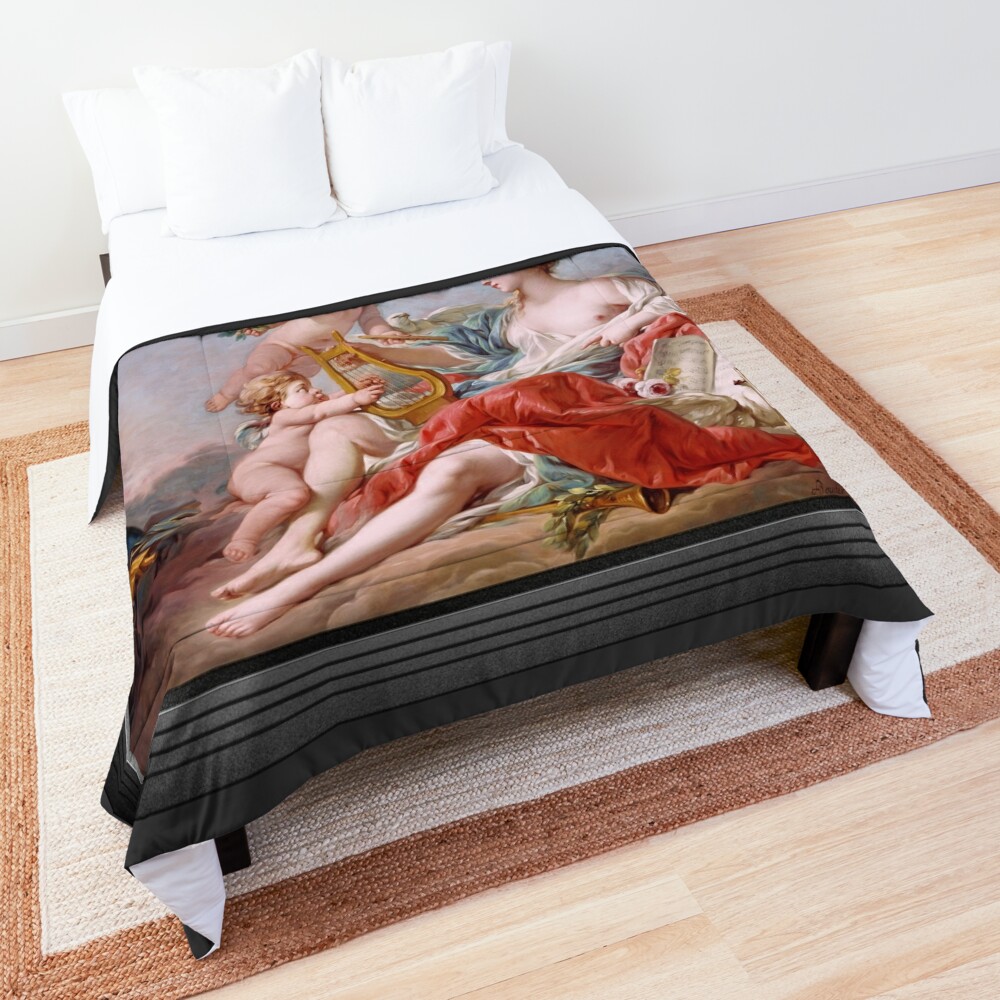
This free flowing Rococo style painting by Boucher interprets the meaning of music by showing an attractive young female figure wrapped in layers of garment revealing her bare left shoulder and breast, as her left forearm rest on red cloth that is laid over clouds that are supporting her in the heavens.
She is holding in her extended right hand a gold lyre that is being played by winged putti that is leaning against her right leg, with another putti fly above them holding a laurel wreath in its right hand and a flute in its extended left hand.
By the floating putti and positioned by the upper arm of the young lady is a white dove, which makes up a set of three, with the other two situated at the base of some open sheet music and pink roses, that are position just below her left forearm.
Below her is a horn slightly covered with more laurel leaves; and behind the putti that is playing the layer is a blue helmet with a gold grown and blue top feather beside a cloth wrapped sword with a gold handle.
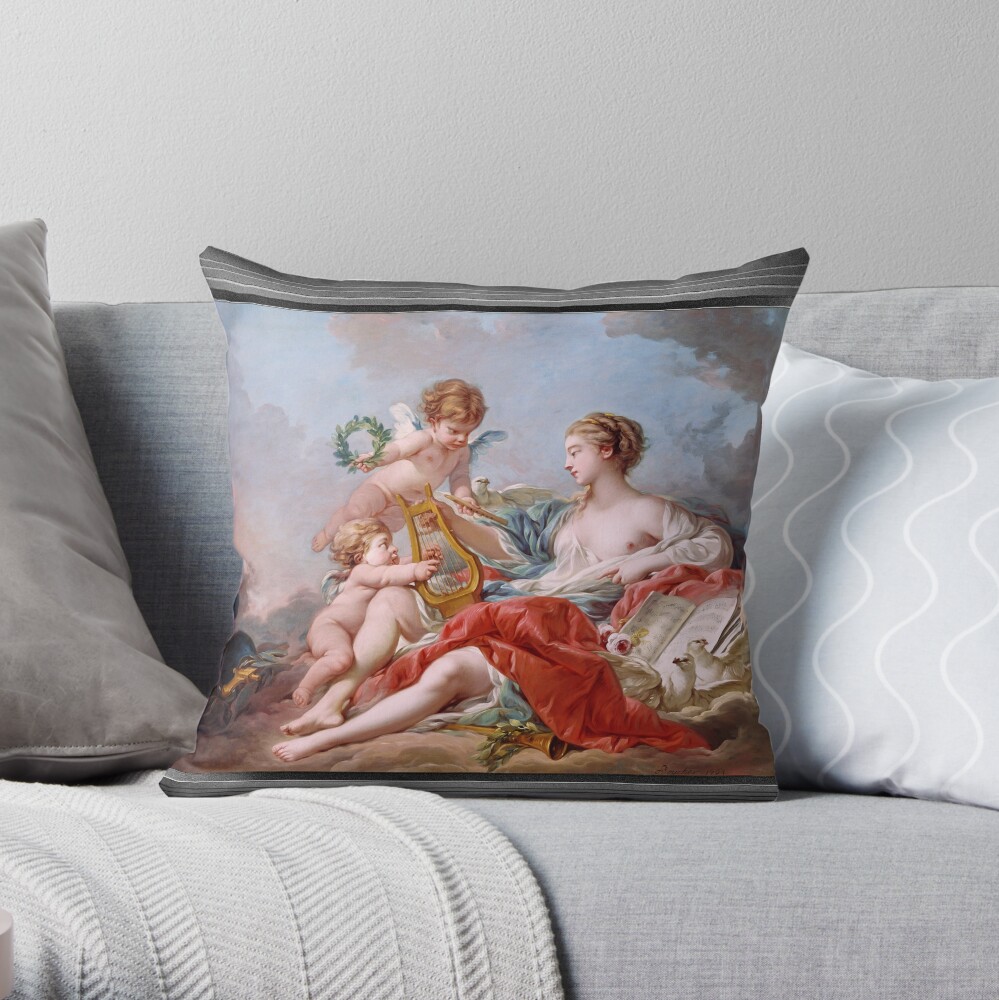
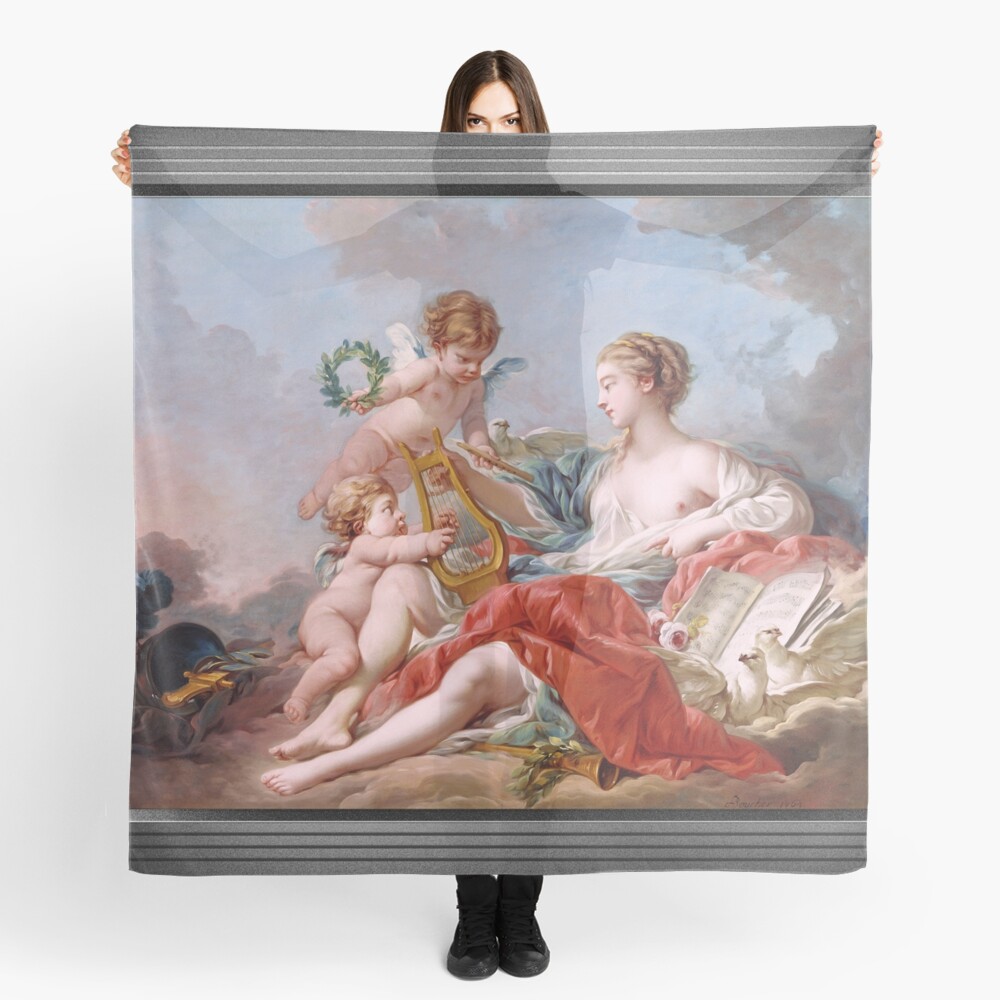
Allégorie de la Musique is a remastered digital art old masters reproduction of a public domain image that is available as a impressão em tela on-line.
Informações abaixo derivadas de Wikipédia.org
Natural de Paris, Boucher era filho de um pintor menos conhecido Nicolas Boucher, que lhe deu a sua primeira formação artística. Aos dezessete anos, uma pintura de Boucher foi admirada pelo pintor François Lemoyne. Lemoyne mais tarde nomeou Boucher como seu aprendiz, mas depois de apenas três meses, foi trabalhar para o gravador Jean-François Cars.
Em 1720, ele ganhou o Grande Prêmio de Roma de elite de pintura, mas só aproveitou a consequente oportunidade de estudar na Itália cinco anos depois, devido a problemas financeiros na Royal Academy of Painting and Sculpture.[1] Ao retornar dos estudos na Itália, foi admitido na refundada Académie de peinture et de escultura em 24 novembro 1731. Sua peça de recepção (peça de recepção) foi seu Rinaldo e Armida de 1734.
Boucher casou-se com Marie-Jeanne Buzeau em 1733. O casal teve três filhos juntos. Boucher tornou-se membro do corpo docente em 1734 e a sua carreira acelerou a partir deste ponto quando foi promovido Professor e depois Reitor da Academia, tornando-se inspetor da Royal Gobelins Manufactory e finalmente Premier Peintre du Roi (Primeiro Pintor do Rei) em 1765. Retrato de Marie-Louise O'Murphy c. 1752
Boucher morreu em 30 Poderia 1770 em sua cidade natal, Paris. Seu nome, junto com o de sua patrona Madame de Pompadour, tornou-se sinônimo do estilo rococó francês, levando os irmãos Goncourt a escrever: “Boucher é um daqueles homens que representam o gosto de um século, quem expressa, personificá-lo e incorporá-lo.”
Boucher é famoso por dizer que a natureza é “muito verde e mal iluminado” (muito verde e mal iluminado).
Boucher foi associado ao gravador de pedras preciosas Jacques Guay, quem ele ensinou a desenhar. Ele também foi mentor do pintor morávio-austríaco Martin Ferdinand Quadal, bem como do pintor neoclássico Jacques-Louis David em 1767.[4] Mais tarde, Boucher fez uma série de desenhos de obras de Guay que Madame de Pompadour então gravou e distribuiu como um volume lindamente encadernado para cortesãos favorecidos.