

Amalia de Llano y Dotres, Condesa de Vilches
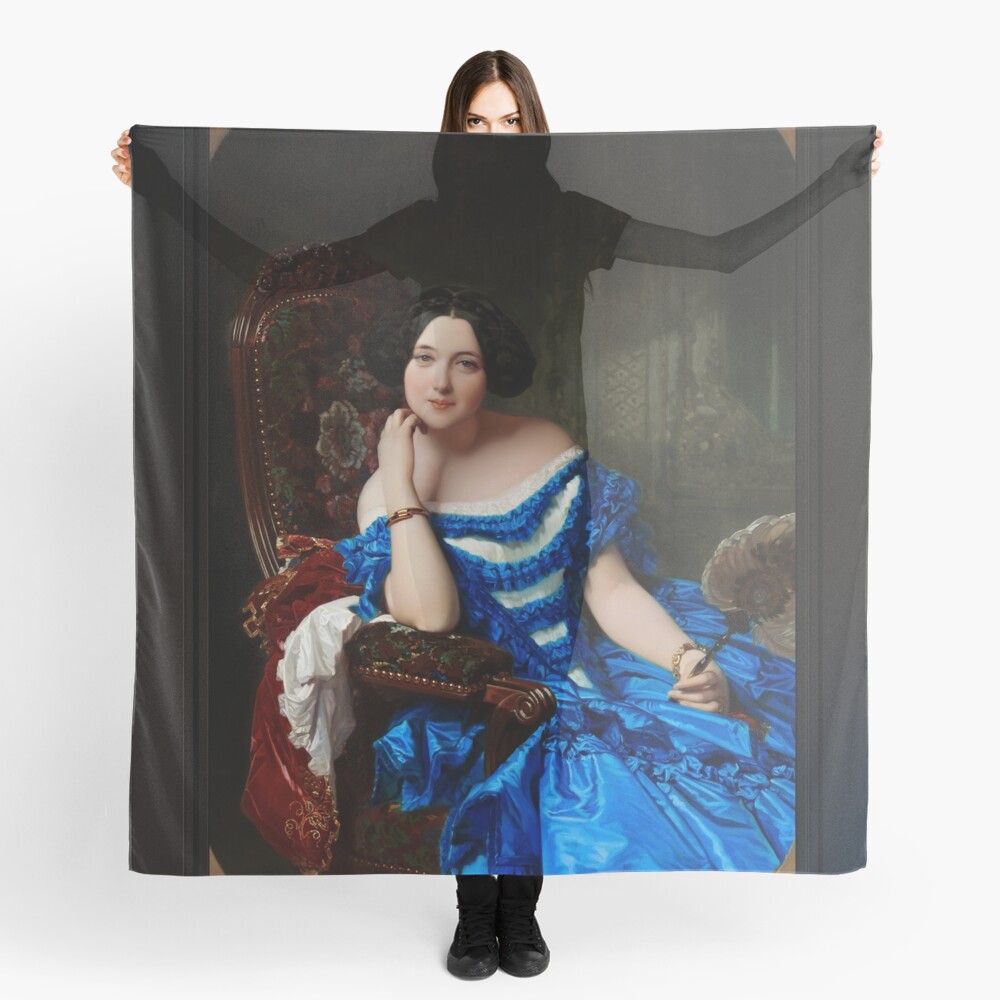
Amalia de Llano y Dotres, Condesa de Vilches (Amalia de Llano, a Spanish countess and author) c1853 by Spanish-Italian Painter Federico de Madrazo y Kuntz (1815 – 1894); also a lithographer, writer and politician.
This is a wonderful portrait of the Spanish countess and writer Amalia de Llano (1822 – 1874); who was a significant figure of the Spanish cultural life of 19th century Madrid.
She was born into the wealthy bourgeoisie family of Ramón de Llano y Chávarri and Pilar Dotres y Gibert; and when her father passed away, her mother married the IX Marquis of Almonacid de los Oteros; Francisco Falcó y Valcárcel, which moved the family into the circles of the aristocracy.
When she was 17 let starý, Amalia married Gonzalo Vilches y Parga (1808 – 1879), the Viscount of La Cervanta; a v 1848 Queen Isabel II ennobled her husband, which elevated hime to the dignity of Count of Vilches; this then made her the Viscountess of La Cervanta as well as the Countess of Vilches.
This portrait of Amalia has her sitting in a room with a large mirror on the wall to her left, in a beautifully carved wooden chair with a high back with elaborately floral embroidered padding.
She is wearing a blue ruffled dress with a white undergarment with a gold wrap bracelet on her right forearm, a chained and jeweled bracelet on her left wrist as well as a pearl ring with a gold band on the fourth finger of her left hand in which she is holding a large feathered hand fan.
She is resting her right cheek on the fingers of her right hand that are held upwards to her face; and behind her just over the arm of the chair is a deep red cape with a white silk lining and gold decorative trim along its perimeter.
Amalia de Llano y Dotres, Condesa de Vilches is a remastered digital art old masters reproduction of a public domain image that is available as a canvas print online.
Níže uvedené informace jsou odvozeny z Wikipedia.org
Federico se narodil v Římě José de Madrazo y Agudo (1781 – 1859), malíř a bývalý ředitel muzea Prado; and was part of a line of great artists, that included his grandfather on his mother side; Tadeusz Kuntze (1733 – 1793), polský malíř.
Other members of this creative family include his brothers, who were the painter Luis de Madrazo (1825 – 1897), Pedro de Madrazo (1816 – 1898), umělecký kritik a Juan de Madrazo (1829 – 1880), architekt.
Among Federico’s his children were the painter Ricardo de Madrazo (1851 – 1917), Raimundo de Madrazo y Garreta (1841 – 1920) and Cecilia de Madrazo y Garreta (1846 – 1932) who married the great Orientalist artist, Marià Fortuny (1838 – 1874).
The Madrazo family has been described as one of the most important painting Spanish painting dynasties of the 19th century; which completely dominated painting in Spain during that period.
Federico začal brát uměleckou lekci od svého otce, a zatímco stále navštěvuje Královskou akademii San Fernando, namaloval svůj první obraz Vzkříšení Krista c1829; který koupila královna Christina.
Brzy po tomto obraze vytvořil Achilles ve svém stanu, a poté představil Akademii Kontinenci Scipia, což mu zajistilo přijetí za člena “za zásluhy”.
O tři roky později Federico odjel do Paříže, kde studoval na Franz Winterhalter a maloval portréty barona Taylora a Ingrese. (francouzský neoklasický malíř).
v 1837 získal provizi za vytvoření obrazu pro galerii ve Versailles, pro které maloval “Godfrey de Bouillon byl prohlášen králem Jeruzaléma”; brzy poté se vrátil do Říma a ujal se projektů vytvářejících portréty pro španělskou aristokracii.
Tato digitální umělecká tvorba, stejně jako všechna umělecká díla, která lze nalézt na webu Xzendor7, je k dispozici ke koupi online v různých materiálových formátech včetně tisků na plátno, akrylové tisky, kovové potisky, otisky dřeva, zarámované tisky, plakáty, a jako rolované obrazy na plátně v různých velikostech od 12 palce až 72 palce v závislosti na velikosti skutečného uměleckého díla a obchodu s tiskem na vyžádání, ve kterém se rozhodnete umění koupit.