

Amarilla
Amarilla by British Painter Frederic Leighton (1830 – 1896); was schilder en beeldhouwer, die deel uitmaakte van de Academische, Neoklassieke en Britse esthetische stromingen; maar ook als politicus.
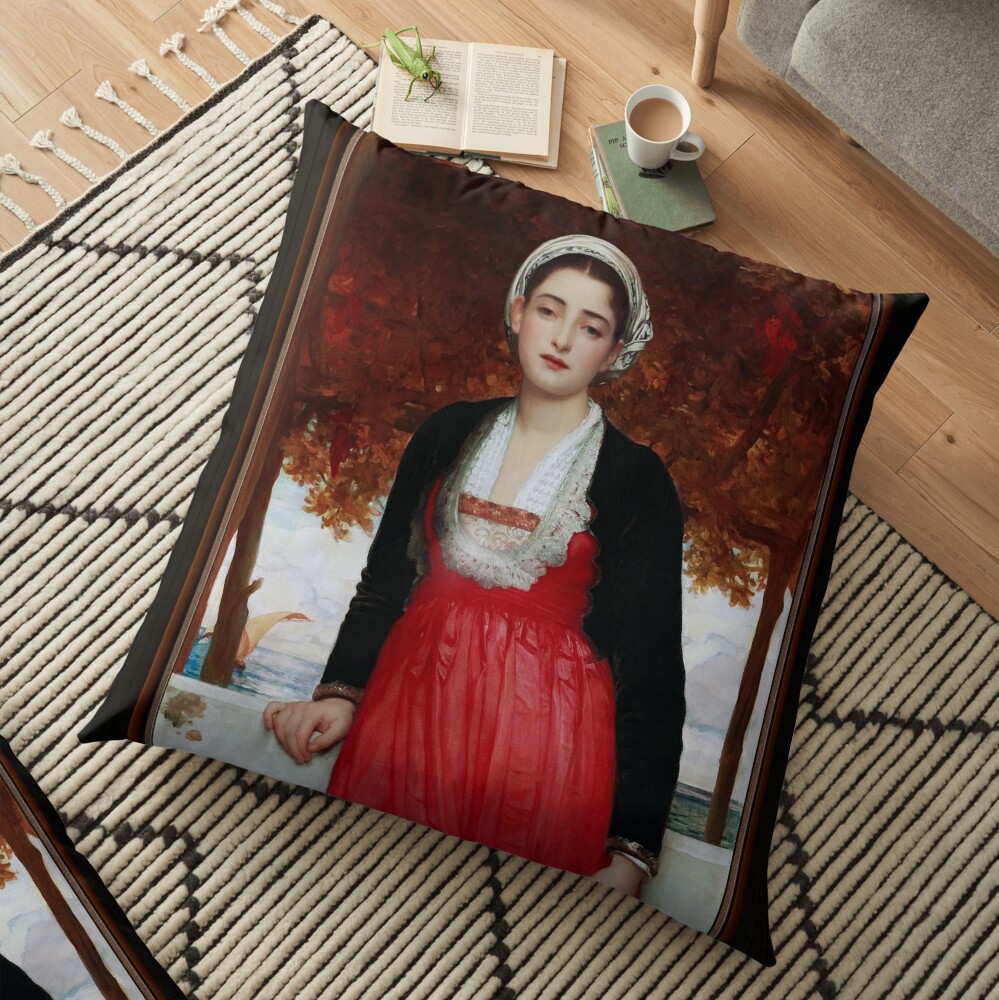
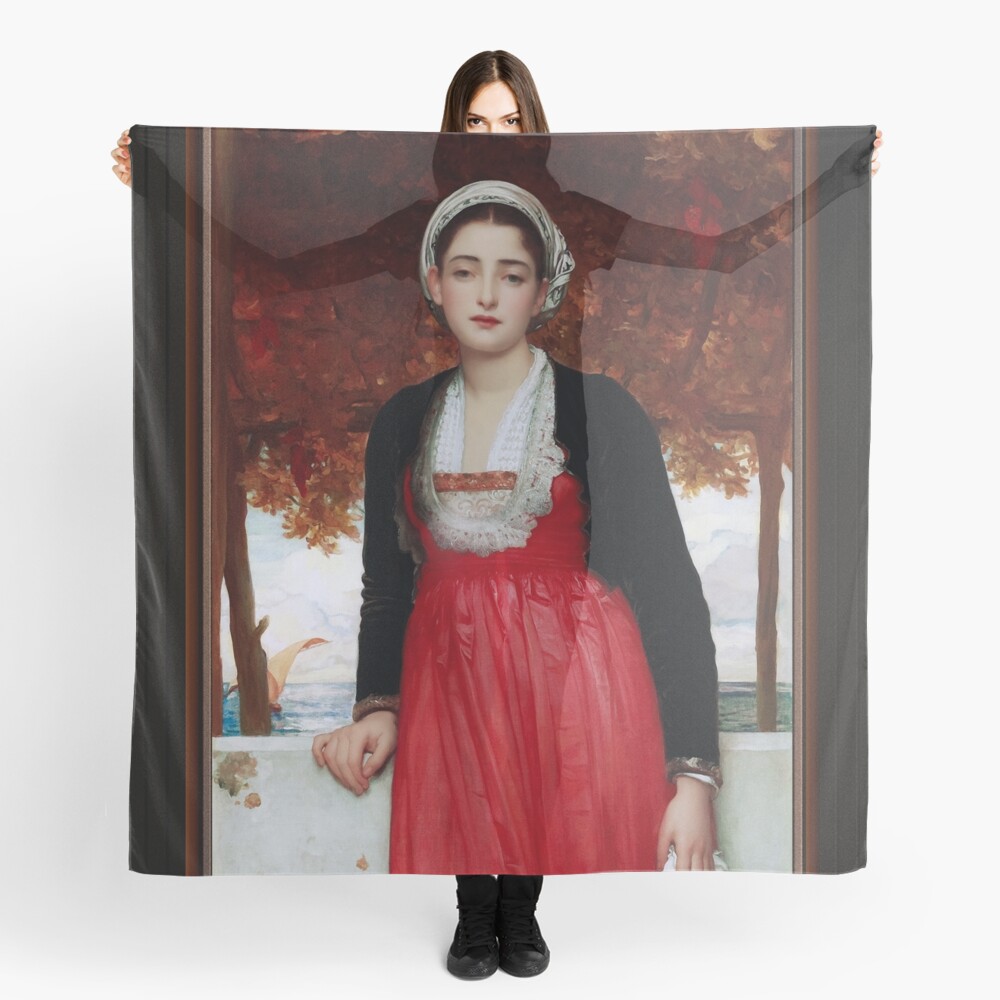
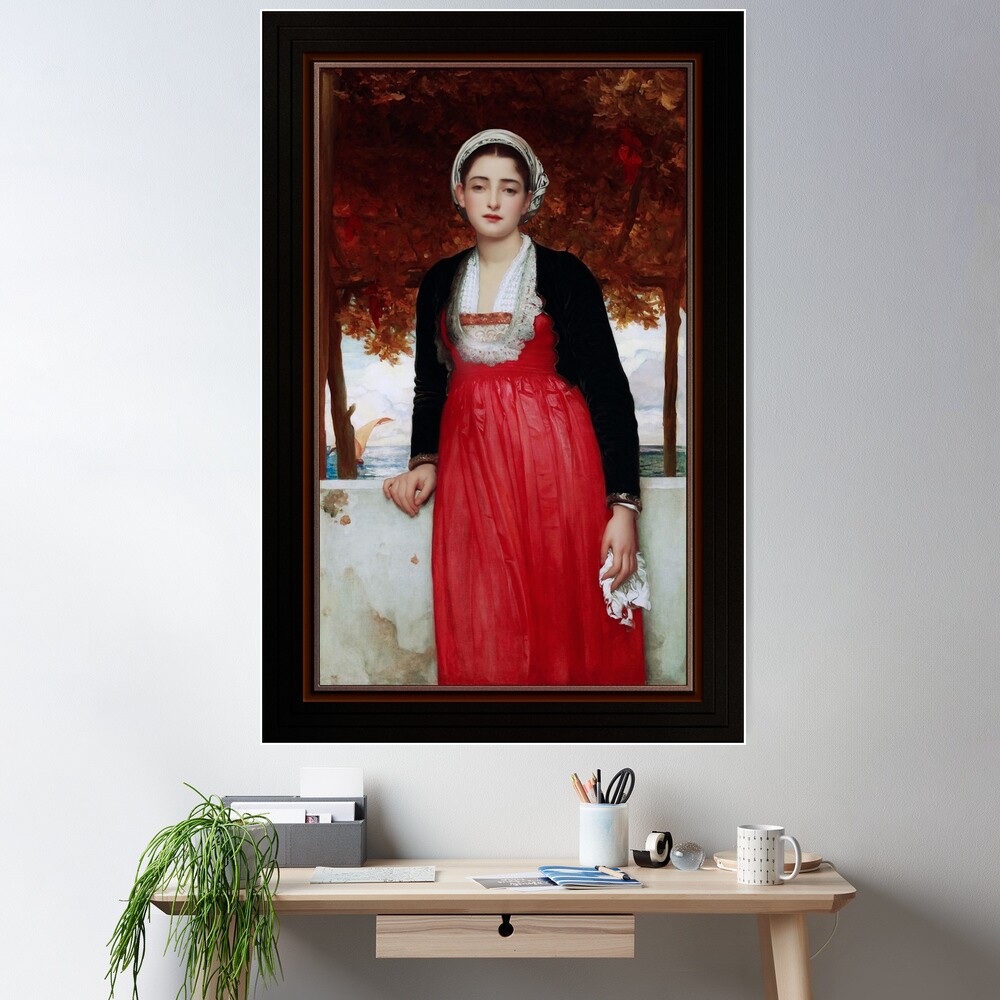
This is a beautiful portrait of a young alluring brunette girl with a sad look on her face posing by a stone wall that overlooks the ocean and a shoreline of green foliage.
Directly behind her are two large trees with brown leaves and some red leaves, that indicate the fall season has arrived; and just off to her right we can see small sailboat coming towards the shore.
She has wrapped around her head a white kerchief with a black line pattern along its edge, a white blouse, a full length red dress, a black velour vest jacket; and is holding a handkerchief in her left hand, with her right hand resting on the ledge of the stone wall.
Dit is een remastered reproductie van digitale kunst oude meesters van een openbaar domeinafbeelding dat beschikbaar is als a canvas print online.
Info hieronder van Wikipedia.org
Leighton werd geboren in Scarborough aan Augusta Susan en Dr. Frederic Septimus Leighton. Hij had twee zussen, waaronder Alexandra, de biograaf van Robert Browning.[2] Hij werd opgeleid aan de University College School, Londen.
Daarna ontving hij zijn artistieke opleiding op het Europese continent, eerst van Eduard von Steinle en vervolgens van Giovanni Costa. Op leeftijd 17, in de zomer van 1847, hij ontmoette de filosoof Arthur Schopenhauer in Frankfurt en tekende zijn portret, in grafiet en gouache op papier – de enige bekende volledige studie van Schopenhauer gedaan vanuit het leven.
Toen hij was 24 hij was in Florence; hij studeerde aan de Academie voor Schone Kunsten, en schilderde de processie van de Cimabue Madonna door de Borgo Allegri. Van 1855 naar 1859 hij woonde in Parijs, waar hij Ingres ontmoette, Delacroix, Corot en Millet.
In 1860, hij verhuisde naar Londen, waar hij associeerde met de Prerafaëlieten. Hij ontwierp het graf van Elizabeth Barrett Browning voor Robert Browning op de Engelse begraafplaats, Florence in 1861. In 1864 hij werd een medewerker van de Koninklijke Academie en in 1878 hij werd de president (1878–96).
Zijn 1877 beeldhouwwerk, Atleet worstelen met een Python, werd destijds beschouwd als het begin van een renaissance in de hedendaagse Britse beeldhouwkunst, aangeduid als de nieuwe sculptuur. De Amerikaanse kunstcriticus Earl Shinn beweerde destijds dat: “Behalve Leighton, er is bijna niemand die in staat is om een correct beschilderd figuur in de poort van het Kensington Museum op te hangen”. Zijn schilderijen vertegenwoordigden Groot-Brittannië op de grote... 1900 Parijs tentoonstelling.
Leighton werd geridderd in Windsor in 1878, en werd een baron gemaakt, van Holland Park Road in de parochie van St. Mary Abbots, Kensington, in the County of Middlesex, eight years later. He was the first painter to be given a peerage, in the 1896 New Year Honours.
The patent creating him Baron Leighton, of Stretton in the County of Shropshire, was issued on 24 Januari 1896; Leighton died the next day of angina pectoris.
On his death his barony was extinguished after existing for only a day; this is a record in the Peerage. His house in Holland Park, London has been turned into a museum, the Leighton House Museum.
It contains many of his drawings and paintings, as well as some of his former art collection including works by Old Masters and his contemporaries such as a painting dedicated to Leighton by Sir John Everett Millais.
The house also features many of Leighton’s inspirations, including his collection of Iznik tiles. Its centerpiece is the magnificent Arab Hall. The Hall is featured in issue ten of Cornucopia. A blue plaque commemorates Leighton at Leighton House Museum.